Best Mini ITX Cases 2026
The top small form factor PC cases for 2026, from the beginner-friendly NR200P V2 to the ultra-compact A4-H2O. Expert picks, pros and cons, and side-by-side...
As an Amazon Associate we earn from qualifying purchases made through our links — this doesn't affect our picks.
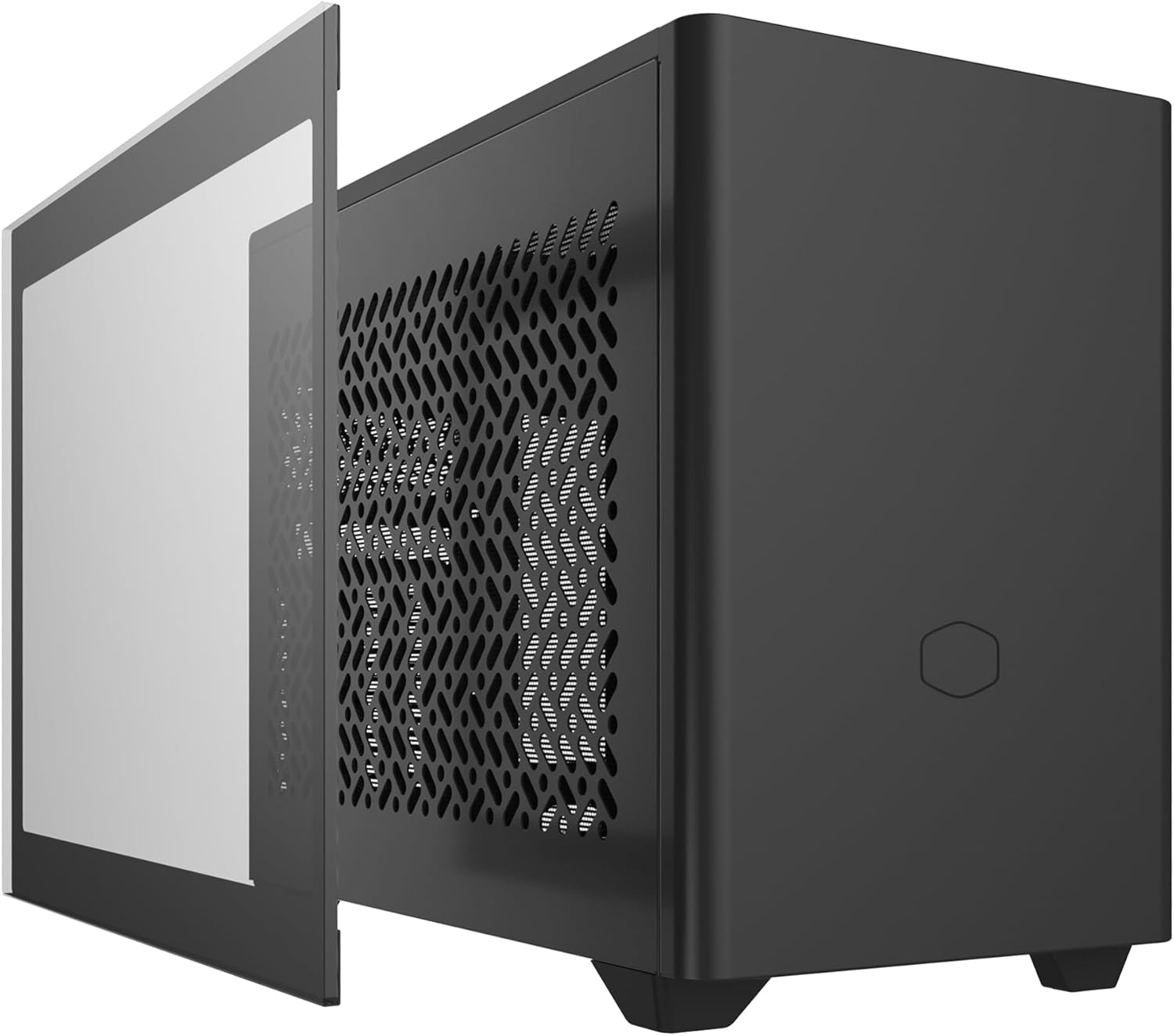
Cooler Master NR200P V2 Mini-ITX PC Case
Our top recommendation for this category
Price as of Apr 20, 2026 — see current price on Amazon.
Small form factor builds have taken over r/buildapc. It's apartment living, LAN party portability, or honestly just not wanting a full tower the size of a mini-fridge next to your desk. Mini ITX enclosures are outselling full-size ATX cases in 2026 for the first time, and the case options have never been better. The catch: picking the wrong one means hours of fighting your own hardware.
This guide covers five of the best mini ITX cases right now, from Cooler Master's NR200P V2 (which literally ships with RTX 5090 compatibility printed on the box) to the Lian Li A4-H2O that packs a 240mm AIO into just 11 liters. The picks draw on Tom's Hardware and PC Gamer test data, plus a lot of r/buildapc and r/sffpc build logs where real people report what actually breaks down in practice.
| Case | Volume | GPU Clearance | AIO Support | Price | |
|---|---|---|---|---|---|
| Cooler Master NR200P V2 | 18.25L | 357mm | 280mm | $109 | Check Price |
| SSUPD Meshlicious | 14.7L | 338mm | 240mm | $99 | Check Price |
| Lian Li Q58 | 14.3L | 320mm | 280mm | $130 | Check Price |
| Fractal Design Terra | 11.4L | 322mm | 120mm | $180 | Check Price |
| Lian Li A4-H2O | 11L | 322mm | 240mm | $150 | Check Price |
Cooler Master NR200P V2
Cooler Master NR200P V2 Mini-ITX PC Case
Pros
- Designed for RTX 5090 and RX 9070 XT clearance
- 357mm GPU support (longest in class)
- Tool-free 360-degree panel access
- Supports both mesh and tempered glass panels
Cons
- Slightly bland exterior vs competitors
- SFX PSU required (budget consideration)
Price as of Apr 20, 2026 — see current price on Amazon.
Cooler Master actually put RTX 5090 and RX 9070 XT compatibility on the product listing as a feature. That's unusual and it tells you something about how much bigger current flagship GPUs have gotten. The 357mm horizontal clearance is the longest on this list, and it matters: the original NR200P maxed out at 330mm, which was borderline with some triple-fan 3090 AIB designs. The V2 just removes that calculation entirely.
Building in it is about as approachable as an ITX case gets. Tool-free panel removal on the side, top, and front means you can access any part of the build without digging for screws. I've seen multiple r/buildapc build logs with 280mm Corsair and Arctic AIOs installed without any cable disasters. That's not guaranteed with every ITX case.
$109 for this much clearance and build quality is a genuine deal. You're not getting walnut panels or brushed aluminum here, but the mesh options keep temps in check and it accepts SFX-L PSUs up to 130mm. Most builders will end up here and not regret it.
SSUPD Meshlicious
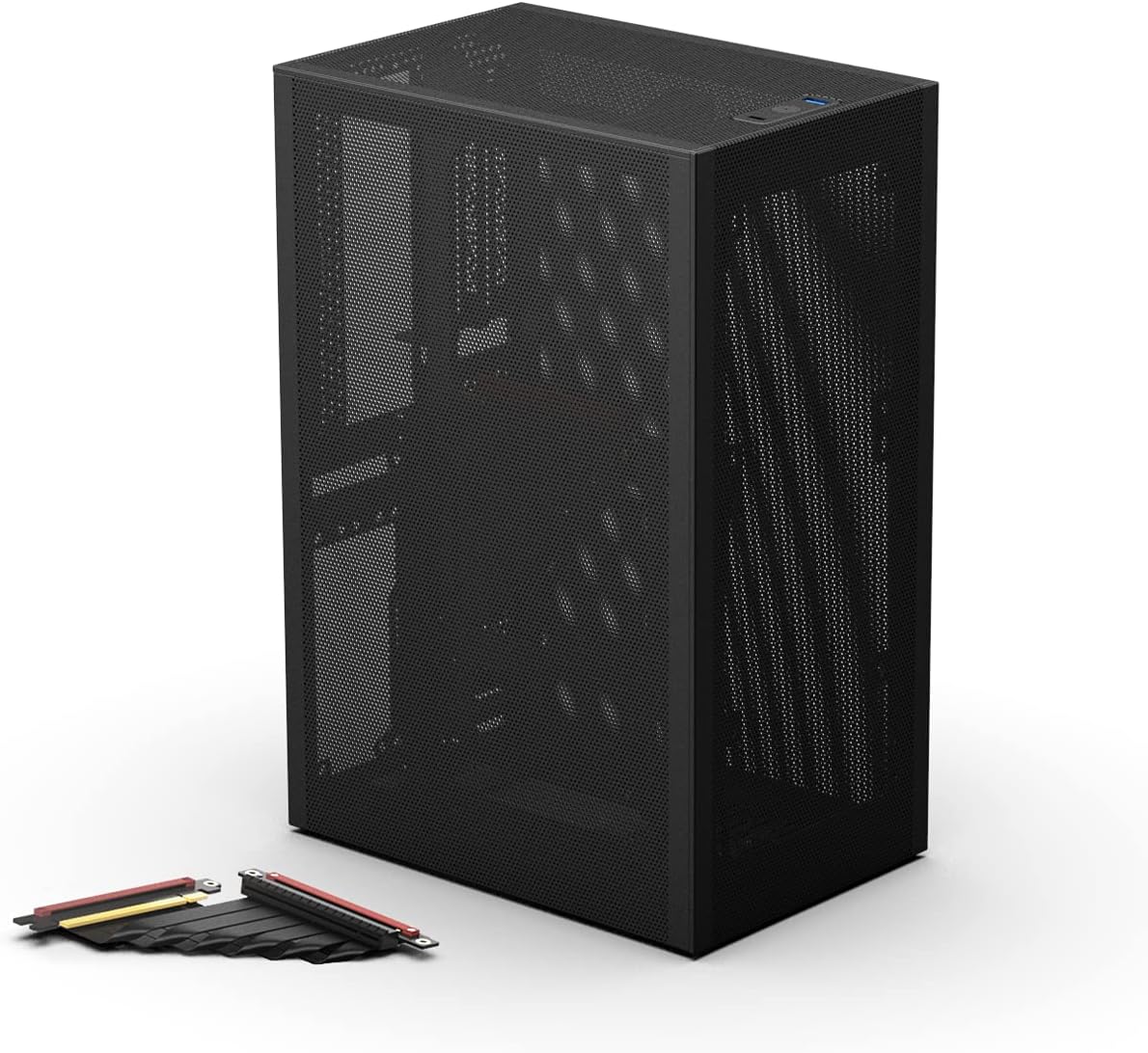
SSUPD Meshlicious Mini-ITX SFF Case (PCIe 4.0, Black)
Pros
- Best-in-class airflow from full mesh panels
- PCIe 4.0 riser included
- Tool-free panel removal
- Fits 338mm GPU with ease
Cons
- No PCIe 5.0 riser option yet
- Tempered glass version costs more and runs hotter
Price as of Apr 20, 2026 — see current price on Amazon.
There's basically one reason the Meshlicious gets mentioned in almost every SFF airflow thread: the full mesh side panels aren't decorative. Put a good case fan configuration in here and you get close to open-air cooling performance in a 14.7-liter box. GamersNexus and Hardware Unboxed thermal data shows it running 3-5 degrees Celsius cooler under load versus glass-panel competitors at the same price point. That gap is real.
Two versions: full mesh and a tempered glass hybrid. Buy the mesh. The glass one looks better in photos and you will be warmer for it. The mesh version at $99 with a PCIe 4.0 riser already in the box is hard to argue with.
At 14.7 liters it's not the smallest here, but 338mm GPU clearance means virtually any triple-fan AIB card fits. SSUPD is a Lian Li brand, which explains why the fit and finish is better than the price suggests. And the build process falls somewhere in the middle of this list in terms of difficulty: more involved than the NR200P V2, way less involved than the A4-H2O.
Lian Li Q58
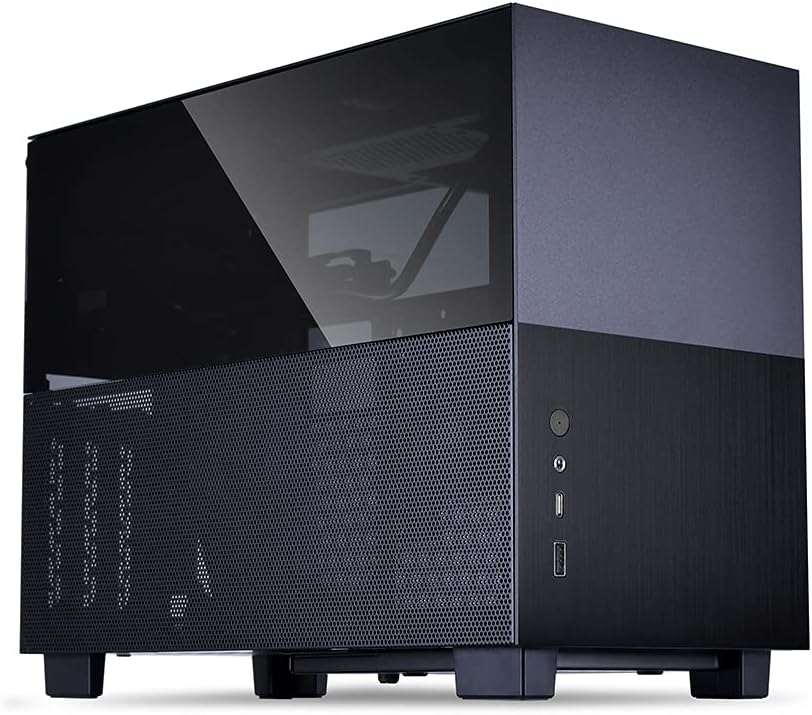
Lian Li Q58 Mini Tower Computer Case (PCIe 4.0, Black)
Pros
- PCIe 4.0 riser included out of the box
- Supports SFX and SFX-L PSUs
- 280mm AIO fits comfortably
- Good mix of glass and mesh panel options
Cons
- Cable management is genuinely tricky in the tight interior
- PCIe riser cable positioning takes practice
Price as of Apr 20, 2026 — see current price on Amazon.
The Q58 is what I'd call the sensible middle ground. It's 14.3 liters, which is compact without being punishing. You get a PCIe 4.0 riser in the box (saves $30 right there), it supports 280mm AIOs, and the GPU clearance at 320mm covers everything except the most extreme triple-fan RTX 5090 coolers.
Look, the cable management is the honest criticism here. The interior has a slit in the motherboard tray for routing PCIe cables, and getting it tidy requires some patience. Build log after build log on Reddit shows the same thing: cables behind the motherboard plate if you know what you're doing, chaos if you rush it. But the end result fits together properly and the dual panel options (glass or mesh side) let you choose your thermal vs visual tradeoff.
At $130 it's priced reasonably against the NR200P V2, and the build quality of the aluminum accents and SPCC steel body is noticeably better than Cooler Master's plastic-heavy exterior. If you care about how the finished build looks on your desk, the Q58 punches above its price.
Fractal Design Terra
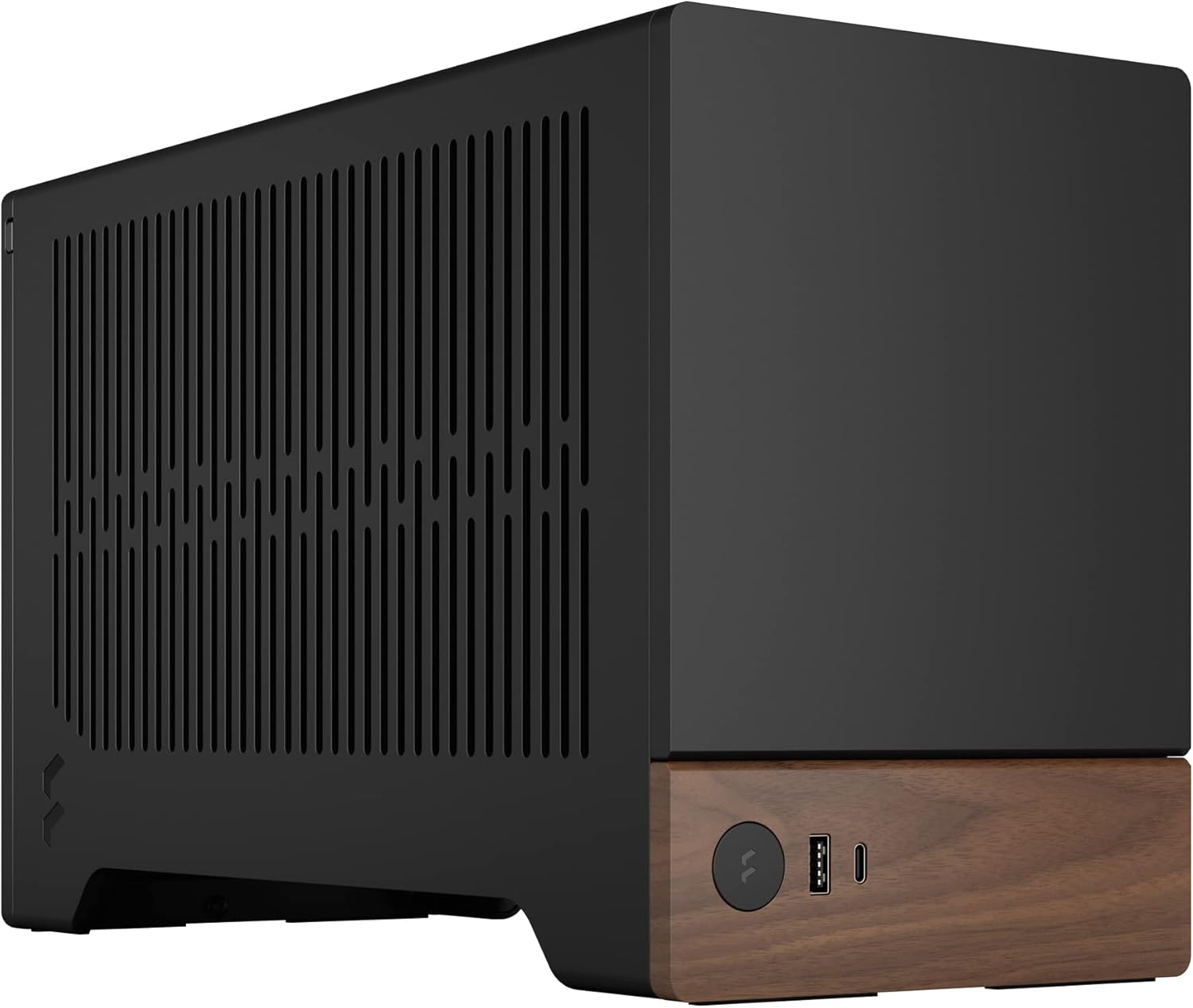
Fractal Design Terra Mini-ITX Case (Graphite)
Pros
- Stunning design with solid walnut wood front panel
- Adjustable spine lets you configure airflow path
- 11.4L is seriously compact for what it fits
- USB-C front panel included
Cons
- No front audio jacks (dealbreaker for some)
- Very limited cooling headroom for high-TDP builds
- Price premium is real
Price as of Apr 20, 2026 — see current price on Amazon.
The Terra is the case you buy when you want your desk setup to look like a design object rather than a gaming rig. The solid walnut front panel is not a veneer, not a sticker, not a texture but real wood, and it looks genuinely stunning next to a good monitor. This is the case that gets photos posted on r/battlestations, not r/buildapc.
Practically speaking, the 11.4L volume and adjustable central spine are what make it work. You can slide the spine to create more space for GPU or more space for cooling, though with limitations. The cooling headroom here is tight. Fractal rates it for a 48-77mm CPU cooler depending on spine position, and the single 120mm fan slot on top means you're not going to pump much heat out of a 250W GPU without careful management. This is a case for mid-range builds where you prioritize thermals intelligently.
But if your CPU is a modern efficient chip and your GPU is an RTX 5070 or 5070 Ti rather than a power-hungry flagship, the Terra breathes surprisingly well. The 322mm GPU clearance and SFX-L PSU support make it more capable than its dimensions suggest. For what it costs, the build quality is exceptional.
Lian Li A4-H2O
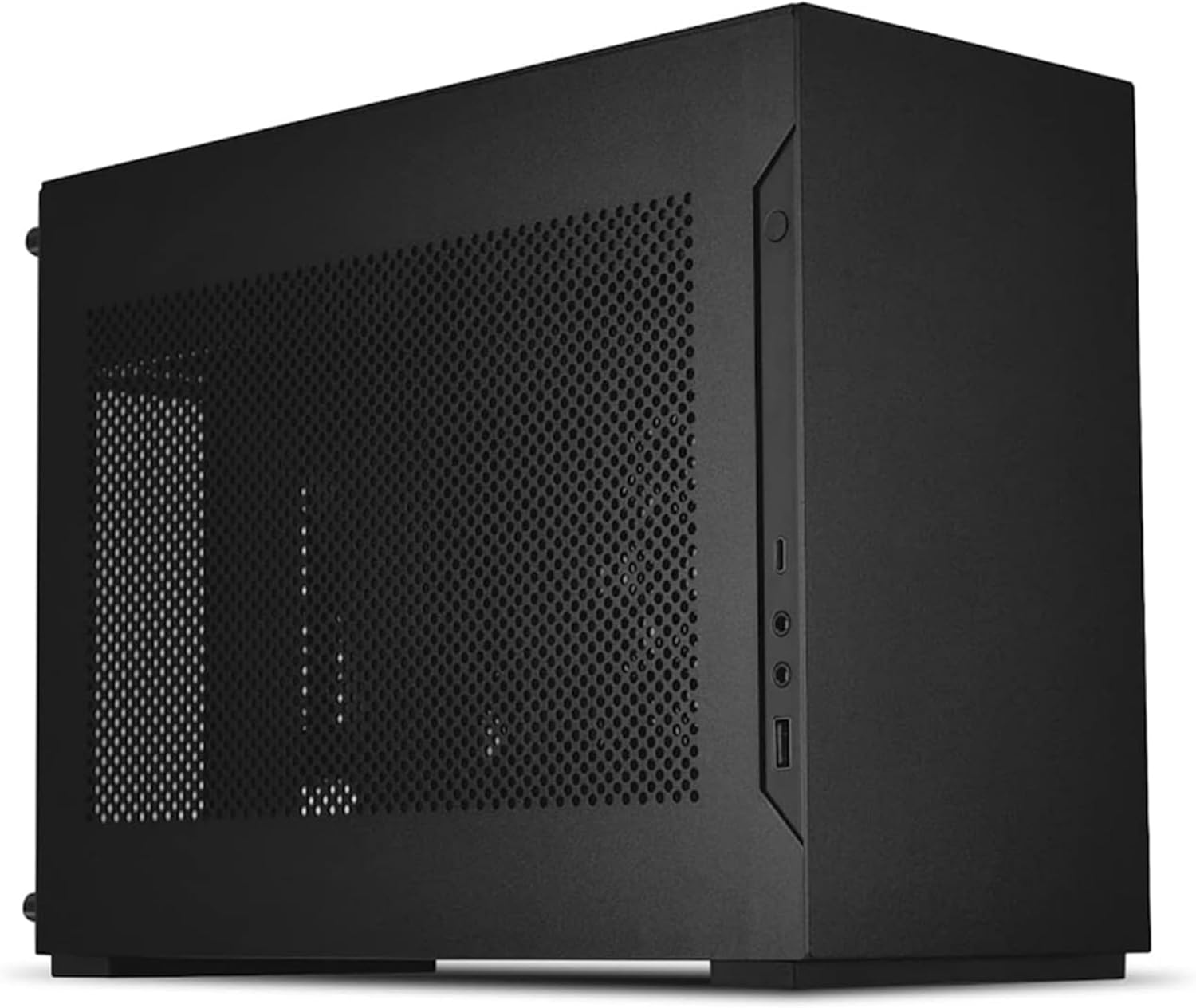
Lian Li A4-H2O Mini-ITX PC Case (Black)
Pros
- Only 11 liters with 240mm AIO support (remarkable engineering)
- Triple-slot GPU support up to 322mm
- PCIe 4.0 riser included
- Premium aluminum exterior
Cons
- Hardest build process on this list (not for beginners)
- Limited cable management space
- SFX PSU required, no SFX-L
Price as of Apr 20, 2026 — see current price on Amazon.
Eleven liters. I keep coming back to that number. Eleven liters fits a full desktop CPU, a triple-slot GPU, a 240mm AIO, and a SFX PSU. GamersNexus reviewed the Dan Case A4-H2O when it first launched and described the thermal engineering as "impressive given the constraints," which for them is about as enthusiastic as it gets.
The build is hard. Not "mildly tricky" hard, but actually hard. The sandwich layout puts the GPU on one side and the motherboard on the other with a PSU shelf between them. You'll need specific cable lengths, and getting the PCIe riser cable routed without kinking takes patience. The r/sffpc subreddit has entire megathreads dedicated to A4-H2O cable guides. If your only prior builds have been mid-towers, this will feel alien.
That said, if you've done a compact build before and you're willing to sit down with a cable guide and some patience, the payoff is real. The aluminum exterior is solid, it travels well, and honestly the finished result looks unlike anything else on a desk. The PCIe 4.0 riser is in the box. And yes, you can carry it under your arm to a LAN party.
What to Look for in a Mini ITX Case
Volume: How Small Is Too Small?
Mini ITX cases range from about 8 liters (extreme enthusiast builds that require custom components) to 20+ liters (basically a micro-ATX at that point). The sweet spot for most people is 11-18 liters. That range lets you use standard SFX PSUs, fit a full-height GPU, and support a 240mm or 280mm AIO without requiring special versions of every component.
Below 11 liters you're in DAN Case or Ghost S1 territory. These exist, they're real, and they produce amazing builds, but they demand expertise and often proprietary PSU adapters.
PSU Form Factor
Every case on this list requires SFX or SFX-L power supplies. Standard ATX PSUs will not fit. SFX PSUs cost $20-40 more than equivalent ATX units, so budget for this. The Cooler Master V850 SFX Gold is the most frequently recommended option on Reddit at around $130. Seasonic and Corsair both make solid SFX-L units as well.
Don't buy the case before confirming your PSU. It's the single most common mistake in ITX builds.
GPU Clearance and Slot Width
Modern flagship GPUs like the RTX 5090 FE measure around 336mm long and use 3.5 physical slots. The NR200P V2 (357mm, up to 4 slots) is the only case here with genuine headroom for these. Every other case on the list is fine for triple-slot AIB cards up to 322-338mm, which covers the RTX 5070, 5080, and most 3-slot 5090 AIB designs.
Always check the exact specs of your GPU against the case spec sheet before buying. A4-H2O at 322mm clearance is genuinely tight for some 5080 AIB designs. Check the case's spec sheet, then check your GPU manufacturer's dimensions.
Airflow vs Aesthetics
Full mesh panels cool better. Period. The Meshlicious in full-mesh configuration runs 3-5°C cooler than the glass-panel version in back-to-back tests. The Terra and Q58 offer a tempered glass option that looks better but trades thermal performance.
If you're building a high-TDP system (a Ryzen 9 + RTX 5080, say), the mesh Meshlicious or NR200P V2 with mesh panels are the right call. If your system is a more efficient mid-range config and desk aesthetics matter, the glass panels are a reasonable choice.
AIO vs Air Cooling in SFF
Most people assume you need water cooling in a mini ITX build. You don't. A good 92mm or 120mm air cooler like the Noctua NH-L12S or the Thermalright AXP120-X67 fits in every case on this list and performs adequately for most CPUs at stock settings. The Q58 and NR200P V2 have room for 280mm AIOs, but "room for an AIO" does not mean "you must use an AIO."
Air cooling in the NR200P V2 with an NH-L12S produces barely any noise. AIO in the Meshlicious with push-pull is obviously more cooling capacity. Both approaches work. Choose based on your noise sensitivity and thermal headroom, not based on what looks impressive in a photo.
Frequently asked questions
- Do I need an SFX PSU for mini ITX cases?
- Yes, virtually all modern mini ITX cases require SFX or SFX-L power supplies. Standard ATX PSUs will not fit. Budget an extra $100-$130 for a quality SFX unit from Cooler Master, Seasonic, or Corsair on top of your case cost.
- Can I use a regular full-size GPU in a mini ITX case?
- Most cases here support triple-slot AIB GPUs up to 320-357mm in length. The NR200P V2 has the most clearance at 357mm, making it suitable for even the largest RTX 5090 AIB cards. Check both the length AND the slot width of your specific GPU model against the case specs before ordering.
- Are mini ITX cases harder to build in?
- Yes, but the difficulty varies a lot. The NR200P V2 is designed with tool-free panel access and is about as beginner-friendly as an ITX case gets. The A4-H2O is genuinely challenging with its sandwich layout and requires planning. For first-time SFF builders, start with the NR200P V2 or the Meshlicious.
- Will a mini ITX build run hotter than a full-size tower?
- Only if you underconfigure cooling. A properly cooled ITX build with good case fans runs within 5-8°C of an equivalent ATX system. The key is choosing a case with adequate airflow paths. The Meshlicious and NR200P V2 with mesh panels both achieve near-tower cooling performance in testing.
- What mini ITX motherboard brands are best?
- ASUS ROG Strix, MSI MEG, and Gigabyte AORUS consistently produce the best mini ITX boards in 2026. For value, the ASUS Prime Z890M-PLUS and MSI MAG B860M Mortar are highly rated on r/buildapc. Mini ITX boards often cost $50-$100 more than equivalent Micro-ATX boards due to the engineering density required.
- Is 11 liters really enough for a gaming PC?
- Yes. The Lian Li A4-H2O at 11 liters fits a 240mm AIO, a triple-slot GPU, and a full desktop CPU. You're not giving up gaming performance by going small; you're giving up some build margin for error and paying more for compact PSU and CPU cooling components.
Bottom Line
For most people building in 2026, the Cooler Master NR200P V2 is the answer. The explicit next-gen GPU compatibility, forgiving build process, and $109 price make it an easy recommendation for anyone who doesn't have a specific reason to go smaller. If airflow is your priority, the SSUPD Meshlicious in full-mesh black is $10 cheaper and arguably better cooled. The Lian Li Q58 and Fractal Terra are the right picks for builders who care about how the case looks on a desk and are willing to pay for it. And the A4-H2O is for people who've already built one SFF system and want to push the size limits further. It's remarkable what Lian Li crammed into 11 liters.
How We Pick
We pick products by combining spec-level research, price checks, trusted third-party benchmarks, and owner sentiment from high-signal sources.
- Performance and real-world value in the category this guide targets
- Price-to-performance and deal consistency over recent pricing windows
- Build quality, reliability patterns, and known long-term issues
- Recommendation refresh cadence to keep these picks current
Author
TheTechSearch Editorial Team
Independent product reviewers & PC builders
We compare real-world specs, reviews and owner reports, price trends, and user feedback to recommend gear that actually makes sense to buy.