Best Home Theater Subwoofers 2026
Four subwoofers worth buying in 2026, sorted by room size and by whether you care more about movie impact or musical accuracy. Expert picks, pros and cons, a...
As an Amazon Associate we earn from qualifying purchases made through our links — this doesn't affect our picks.
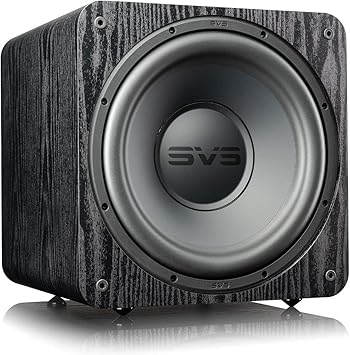
SVS SB-1000 Pro
Apartments, mixed music and movie systems, and anyone whose partner has opinions about furniture
Price as of Sep 14, 2026 — see current price on Amazon.
Ask anyone who has spent real money on a home theater what they'd upgrade first, and the answer is almost never the TV. It's the sub.
A decent subwoofer does more for how a movie feels than another thousand dollars of display ever will. The problem is that subwoofer shopping is full of numbers that don't mean what you think they mean, and the biggest one is the number printed on the box.
I've had four of these in my living room over the past two years, in a room that's about 3,200 cubic feet with one open wall into a kitchen. That matters, and I'll explain why in a minute.
Quick Picks
| Subwoofer | Driver | Amp (RMS) | Enclosure | Rated Low End | Price | |
|---|---|---|---|---|---|---|
| SVS SB-1000 Pro | 12-inch | 325W | Sealed | 20Hz | $599.00 | Check Price |
| SVS PB-1000 Pro | 12-inch | 325W | Ported | 17Hz | $849.00 | Check Price |
| Klipsch R-120SW | 12-inch | 200W | Ported | 29Hz | $329.00 | Check Price |
| Polk Audio Monitor XT12 | 12-inch | 100W | Ported | 24Hz | $359.00 | Check Price |
Short version. Most people should buy the SB-1000 Pro. Go up to the PB-1000 Pro if your room is big or your taste in movies runs to things that shake the furniture. Klipsch is the value play here, and Polk is the one carrying an asterisk.
SVS SB-1000 Pro
SVS SB-1000 Pro
Best for: Apartments, mixed music and movie systems, and anyone whose partner has opinions about furniturePros
- Sealed 13-inch cube that genuinely disappears into a room, which is rare at this output level
- Sledge STA-325D amp, 325W RMS, rated 20Hz to 270Hz within plus or minus 3dB
- The SVS phone app gives you a three-band parametric EQ, crossover, polarity and room gain, which almost nothing else at this price offers
- Audioholics measured it flat down to 25Hz and hitting 101dB at 31Hz, which for a cabinet this small is absurd
Cons
- Roughly double the Klipsch's price for less raw output above 30Hz
- Sealed alignment gives up real ground below 25Hz to its own ported sibling
- One sub in a 3,000-plus cubic foot room is still one sub, and you'll hear the limits during a big scene
Price as of Sep 14, 2026 — see current price on Amazon.
This is the sub I kept.
The thing that separates the Pro version from the old SB-1000 isn't the driver. It's the DSP. You get a 50MHz Analog Devices processor and an app that lets you pull down the one frequency your room is shouting at you, and in a normal rectangular room there is always one. Mine was a 43Hz peak from a wall reflection. Six dB of cut in the app and the boom went away.
That's the part reviewers undersell. A subwoofer you can actually correct beats a nominally more powerful one you can't.
Audioholics found it flat to 25Hz with the DSP shaping the response, which sealed boxes don't normally manage. They roll off earlier and more gently than that. SVS is essentially spending amplifier headroom to buy extension, which is a fine trade when you have 325 watts to spend.
Music is where it pulls ahead. Kick drums start and stop when they're supposed to. If you mostly watch movies and never listen to an album, that precision matters less than you'd expect, and you should probably read the next section instead.
SVS PB-1000 Pro

SVS PB-1000 Pro
Best for: Rooms over about 3,000 cubic feet, dedicated theater spaces, and action-movie peoplePros
- Roughly a 12dB advantage over the sealed SB-1000 Pro in the 20Hz to 25Hz range, per Audioholics measurements
- Same 325W Sledge amplifier and the same excellent app control
- Dual ports move enough air to pressurise a large open-plan room
- Rated down to 17Hz, which is below the point where you stop hearing bass and start feeling it
Cons
- The cabinet is enormous and there is no hiding it
- Ported boxes are fussier about placement than sealed ones and will sound one-note if you get it wrong
- $250 more than the sealed version for an advantage you only collect in the bottom octave
Price as of Sep 14, 2026 — see current price on Amazon.
Twelve decibels is not a small number. It's roughly four times the perceived loudness at the frequencies where a submarine hull groans or a Dune sandworm arrives.
That advantage lives almost entirely below 25Hz, though. Above 30Hz these two subs measure close enough that you'd need to A/B them to care. So the question is simple: does your content have real bottom-octave material, and does your room have the volume to need it?
If you're in an apartment, no. You'll be running it at 30% and annoying a neighbor.
If you have a dedicated room, or a big open living space with vaulted ceilings, this is the pick. Bigger rooms eat bass. The physics doesn't negotiate.
One warning. Ported subs need placement work. Do the subwoofer crawl: put the sub in your listening seat, play a bass-heavy track, then crawl around the floor at ear height and listen for where it sounds most even. Put the sub there. It takes twenty minutes and it's worth more than any spec on this page.
Klipsch R-120SW

Klipsch R-120SW
Best for: First subwoofer, mid-size room, movie-first system on a real budgetPros
- 200W RMS and 400W peak for $329, which is the best output-per-dollar on this list
- 12-inch spun-copper woofer in a rear-ported cabinet that plays loud without strain
- Amazon's long-running bestseller in the category with thousands of reviews behind it
- Line-level and LFE inputs, so it drops into any receiver without thought
Cons
- Rated 29Hz on the low end, so the bottom octave is simply not there
- No app, no parametric EQ, no room correction, just a knob
- Ported and rear-firing, which means it wants breathing room behind it
- Klipsch's house sound is punchy rather than subtle, and on music it can feel heavy-handed
Price as of Sep 14, 2026 — see current price on Amazon.
If you're buying your first sub and $599 makes you wince, buy this one and stop reading reviews.
The R-120SW does the thing people actually want a subwoofer to do. Explosions land. Car chases have weight. It plays loud for the money in a way the more refined options can't match at this price, because Klipsch spent the budget on driver and amplifier rather than on DSP.
What you give up is the bottom. Rated 29Hz means the truly deep material, the stuff you feel through the couch, is rolled off before it gets to you. For most people watching most movies that's fine, and honestly you don't miss what you've never had.
But you'll notice on music. The R-120SW is enthusiastic. That's a compliment during a Marvel film and less of one during a jazz trio recording.
Give it 8 to 12 inches of clearance behind the port. Shoved into a corner against a wall, it turns boomy fast.
Polk Audio Monitor XT12
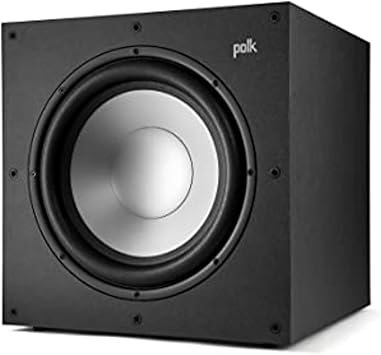
Polk Audio Monitor XT12
Best for: Smaller rooms where extension matters more than sheer volume, and Polk speaker owners matching a systemPros
- Rated down to 24Hz, five hertz deeper than the Klipsch, which is audible on the right material
- Dynamic Balanced 12-inch woofer in a low-resonance MDF cabinet with a removable grille
- Variable crossover from 80Hz to 160Hz plus phase switching, so it integrates cleanly with small speakers
- Line-level RCA, LFE and five-way binding post inputs covers every receiver you might own
Cons
- 100W Class A/B amplifier against the Klipsch's 200W, at a higher price
- Currently $359, which is $30 more than a sub that plays significantly louder
- No app or DSP correction of any kind
- Runs out of headroom earlier than anything else here in a large room
Price as of Sep 14, 2026 — see current price on Amazon.
Here's the asterisk I mentioned.
At $359 with a 100W amplifier, this sits above a 200W Klipsch in price and below it in output. On paper that's a bad trade, and for a big room it is a bad trade.
The counter-argument is the rated 24Hz. Polk tuned this for extension rather than for maximum sound pressure, and in a smaller sealed-off room, say a 12 by 14 bedroom theater, the extra depth is more useful than headroom you'd never use. Room gain does a lot of work in a small space.
Prices move, too. This sub has spent long stretches near $300, and at $300 the argument gets much easier. At $359 against a $329 Klipsch, buy it because you want the low end or because you already own Polk speakers and want the voicing to match. Not because it's the better value, because right now it isn't.
How to Actually Choose
Start with the room, not the sub
Measure length times width times height. Under about 2,000 cubic feet, a sealed 12-inch sub has plenty of authority and you'll appreciate the smaller box. Between 2,000 and 3,500, either alignment works and it comes down to taste. Above 3,500 cubic feet, or with an open wall into another space, go ported or go with two subs.
Open floor plans are the thing people underestimate. Bass doesn't respect the line where your living room becomes your kitchen, and all that extra volume has to be pressurised by the same driver.
Sealed or ported is a taste question, mostly
Sealed cabinets roll off gradually and tend to sound tighter. Ported cabinets are more efficient and hit harder in the bottom octave, at the cost of a steeper cliff below the tuning point and more sensitivity to placement.
Music-heavy system: sealed. Movie-heavy system in a big room: ported. Mixed use in a normal living room: sealed, and it isn't close, because the smaller box gives you far more placement freedom.
Ignore peak power ratings
Peak wattage is a marketing figure. RMS is the one that describes what the amplifier does continuously. The Klipsch's "400W" is 200W RMS, and the SVS subs' 325W RMS figures are the honest comparison point.
Driver size gets over-weighted too. All four of these are 12-inch drivers, and they perform very differently.
Two small subs beat one big one
This is the advice nobody takes and everybody who takes it is glad they did. Two subs in different positions average out the room's standing waves, so more seats get good bass rather than just the sweet spot.
Two SB-1000 Pros at $1,198 will beat one $1,200 monster in a normal room. If your budget is going to reach four figures eventually, plan for a pair.
Calibrate, then trust your ears
Run your receiver's room correction. Then set the crossover to 80Hz unless your main speakers are genuinely large, do the subwoofer crawl, and leave the sub's volume knob at the setting that sounds right rather than the one that feels impressive on night one.
Everyone overshoots the level at first. Come back in a week and turn it down 3dB.
Bottom Line
Buy the SVS SB-1000 Pro if you can stretch to $599, because app-based EQ turns a good subwoofer into one that fits your specific room, and that's worth more than any amount of extra wattage. Go to the PB-1000 Pro if your space is large or your movie nights are loud ones. If $599 is out of reach, the Klipsch R-120SW at $329 gets you 80% of the experience and is the right first subwoofer for most people. The Polk Monitor XT12 makes sense in a small room or a matched Polk system, though at its current $359 you're paying for depth rather than value.
Frequently asked questions
- What size subwoofer do I need for my room?
- Calculate the room volume in cubic feet. Below 2,000, a sealed 12-inch sub is plenty. From 2,000 to 3,500, either sealed or ported works. Above 3,500, or with an open floor plan, choose a ported design or run two subwoofers. Room volume matters far more than driver diameter.
- Is sealed or ported better for home theater?
- Ported subs deliver more output below 30Hz, which is where movie effects live, so they hit harder in large rooms. Sealed subs roll off more gradually and sound tighter on music, and the smaller cabinet gives you more placement options. For a mixed-use living room, sealed is usually the better real-world choice.
- Do I really need two subwoofers?
- Not to get good bass in one seat. You need two to get good bass in every seat. A single sub creates standing waves that make bass loud in one spot and thin three feet away. Two subs in different positions average those peaks and nulls out. If your budget will eventually pass about $1,000, buy two smaller subs instead of one large one.
- What should I set my subwoofer crossover to?
- 80Hz is the standard and the right starting point for almost everyone, because it matches the THX reference and most bookshelf and tower speakers roll off near there. Go higher, around 100Hz to 120Hz, only if your main speakers are small satellites. Set the sub's own crossover dial to maximum or bypass if your receiver handles the crossover.
- Does a subwoofer need to be broken in?
- The surround and spider do loosen slightly over the first 20 to 30 hours of real use, and output below 30Hz can rise a little as that happens. The effect is genuinely small. If a sub sounds wrong out of the box, that's placement or calibration, not break-in.
- Can I use a home theater subwoofer for music?
- Yes, and sealed designs are better suited to it. The common complaint that subs sound bloated on music is nearly always a crossover set too high or a level set too loud. Drop the sub 3dB below what feels right, keep the crossover at 80Hz, and it should blend in rather than announce itself.
How We Test
We score products by combining spec-level research, pricing history, trusted third-party benchmarks, and owner sentiment from high-signal sources.
- Performance and real-world value in the category this guide targets
- Price-to-performance and deal consistency over recent pricing windows
- Build quality, reliability patterns, and known long-term issues
- Recommendation refresh cadence to keep these picks current
Author
TheTechSearch Editorial Team
Independent product reviewers & PC builders
We test and compare real-world specs, price trends, and user feedback to recommend gear that actually makes sense to buy.