Best AV Receivers Under $1,000 in 2026
Three receivers worth buying this year, sorted by room correction, HDMI 2.1 gaming ports and what the extra hundred dollars actually gets you. Expert picks,...
As an Amazon Associate we earn from qualifying purchases made through our links — this doesn't affect our picks.

Onkyo TX-NR6100 7.2 Channel THX Certified Network AV Receiver
Anyone who cares about how the room sounds, or who runs both a TV and a projector
Price as of Sep 19, 2026 — see current price on Amazon.
The receiver is the least glamorous box in a home theater and the one that decides how the whole thing sounds. Speakers get the attention. The receiver does the work: amplification, decoding, switching, and the room correction pass that makes a compromised living room behave like a better one.
Under $1,000 in 2026 you're choosing between three genuinely good machines, and the gaps between them are smaller than the marketing suggests. Two of them are Denons, which isn't favoritism so much as an accurate read of who owns this price bracket. If your budget runs higher, the full AV receiver guide goes up to the Marantz Cinema 50.
I've set up all three configurations of this class in rooms between 2,000 and 3,500 cubic feet. The differences that mattered were never the watts.
Quick Picks
| Receiver | Price | Power (8 ohm, 2ch) | HDMI 2.1 inputs | HDMI outputs | Room correction | |
|---|---|---|---|---|---|---|
| Onkyo TX-NR6100 | $649.00 | 100W x 7 | 3 of 6 | 2 | AccuEQ plus Dirac Live | Check Price |
| Denon AVR-S770H | $749.00 | 75W x 7 | 3 of 6 | 1 | Audyssey MultEQ | Check Price |
| Denon AVR-X1800H | $849.00 | 80W x 7 | 3 of 6 | 1 | Audyssey MultEQ XT | Check Price |
Short version. Onkyo somehow lands the enthusiast pick and the value pick in the same box, which almost never happens. Want it to just work with no fuss? That's the AVR-S770H. And the X1800H is the hundred dollars that buys better room correction, which is worth it or isn't depending entirely on your room.
Onkyo TX-NR6100
Onkyo TX-NR6100 7.2 Channel THX Certified Network AV Receiver
Best for: Anyone who cares about how the room sounds, or who runs both a TV and a projectorPros
- Dirac Live is included, which is better room correction than anything Audyssey ships at this price
- Two HDMI outputs, so a TV and a projector can both live on the same receiver
- THX Certified Select, with separate THX modes for cinema, games, music and Surround EX
- 100W per channel into 8 ohms with two channels driven, the highest honest rating of the three
Cons
- The supplied calibration mic is the cheap disc type, and Dirac deserves better than it
- Onkyo's menus and app are a generation behind Denon's HEOS ecosystem
- 2021 model, so it's been through more firmware drama than the Denons
Price as of Sep 19, 2026 — see current price on Amazon.
Dirac Live is the reason to buy this receiver.
Room correction is the single biggest sound quality variable in a normal living room, well ahead of amplifier quality or speaker price beyond a certain point. Audyssey is decent. Dirac Live, which normally shows up on receivers well north of a thousand dollars, corrects both frequency response and impulse response, and it lets you edit the target curve yourself rather than accepting what the algorithm decided. Getting it at $649 is the sort of thing that happens when a model has been on the market for a few years.
The rest of the sheet holds up. Three of the six HDMI inputs are HDMI 2.1 with the full gaming feature set: 8K60, 4K120, VRR, ALLM, QFT, QMS and DSC. That's enough for a PS5, an Xbox Series X and a gaming PC simultaneously, which is the realistic maximum number of 4K120 sources anyone has.
Two HDMI outputs is the quiet feature that sells this to people with projectors. Run the TV on main and the projector on sub, switch between them in the menu, done. Both Denons make you unplug things.
What you give up is polish. The Onkyo app is functional and no more. The calibration microphone is a plastic disc rather than a proper mic on a stand, which matters more here than on the Denons precisely because Dirac is capable of more. Buy a cheap mic stand and put the disc where your head goes, and it's fine.
Denon AVR-S770H

Denon AVR-S770H 7.2 Ch Home Theater Receiver
Best for: A first real home theater, or anyone who wants to plug it in and be finished in twenty minutesPros
- Genuinely easy setup, with the best on-screen guide of anything at this price
- HEOS built in, so it joins a whole-house system without a separate streamer
- Multichannel pre-outs plus two subwoofer outputs, which is unusual this far down the range
- VRR, ALLM and QFT on three 8K-capable inputs, so nothing about it holds back a console
Cons
- 75W per channel is the lowest rating here, and it shows in larger rooms
- Plain Audyssey MultEQ rather than XT, which is a real step down in correction resolution
- Only one HDMI output
Price as of Sep 19, 2026 — see current price on Amazon.
This is the default recommendation, and defaults get that way for a reason.
Denon's setup assistant walks you through speaker placement, connection and calibration with pictures, and it's the only one of the three I'd hand to someone who has never wired a surround system. HEOS is built in, so the receiver is also a streaming endpoint for Spotify, Amazon Music, TIDAL and whatever else, and it plays nicely with other HEOS devices around the house.
The specs read modestly. 75W per channel into 8 ohms with two channels driven, 110W into 6 ohms, 165W into 6 ohms single channel. Those first numbers are the honest ones, and they're fine for a normal room with speakers of normal sensitivity. In a 3,000-plus cubic foot space with insensitive bookshelf speakers, you'll find the ceiling sooner than you would with the Onkyo.
The surprise is the multichannel pre-out. Most receivers at this price give you a subwoofer output and nothing else, so adding an external power amplifier later means replacing the receiver. This one lets you add amplification to the channels that need it and keep the box. Two subwoofer outputs too, which matters more than people realize since two modest subs in different corners beat one expensive sub in almost every real room.
You get 7.2 or 5.2.2 configurations with Dolby Atmos and DTS:X, plus Dolby's Height Virtualizer if you can't mount height speakers.
Denon AVR-X1800H
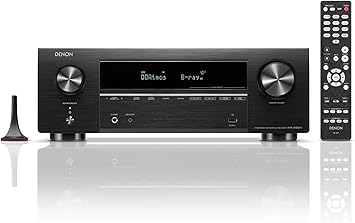
Denon AVR-X1800H 7.2 Channel AV Stereo Receiver
Best for: An awkward room, or a system you expect to keep and grow for a decadePros
- Audyssey MultEQ XT runs a higher resolution correction filter than the MultEQ in the S770H
- 80W per channel and a stiffer power supply than the S-series, with better behavior on difficult speakers
- Same full HDMI 2.1 gaming feature set on three inputs, plus dual subwoofer outputs
- The X-series build quality and heatsinking are a visible step up if you open one
Cons
- $100 more than the S770H for differences most people hear only after a careful calibration
- Still just one HDMI output
- Audyssey's app costs extra if you want the editing tools that Dirac gives you for free on the Onkyo
Price as of Sep 19, 2026 — see current price on Amazon.
The step from the S770H to the X1800H is mostly about the calibration.
MultEQ XT corrects with substantially more filter resolution than plain MultEQ, particularly in the bass, which is where rooms do their worst damage. If your listening space has a hard reflective wall, an open plan on one side, or a bass null right where the couch sits, XT will measurably clean it up in a way the base version won't. Mine had a peak around 43Hz from a wall reflection, and the difference between the two correction tiers on that peak was not subtle.
If instead you're putting this in a rectangular, carpeted, curtained room with speakers in sensible positions, the honest answer is that you may never hear the difference and the S770H is the better buy.
The amplifier section is also genuinely different, not just rated differently. 80W versus 75W is a rounding error on paper, but the X-series power supply holds up better when several channels are working hard at once, which is exactly what a busy action scene does.
Same three HDMI 2.1 inputs, same VRR, ALLM and QFT, same 8K60 and 4K120 handling, same dual subwoofer outputs. Nothing about the gaming side of this receiver is different from the cheaper Denon.
How to Choose
Start with your room, not the spec sheet
This is the part that reverses most people's shortlist. If your room is difficult (open plan, hard floors, an odd seating position, a subwoofer that has to go where it fits rather than where it should), spend your money on correction quality and buy the Onkyo for Dirac Live or the X1800H for MultEQ XT. If your room is a well-behaved rectangle with soft furnishings, the S770H's plain MultEQ is enough and you should put the savings toward speakers.
Count your 4K120 sources honestly
All three give you three HDMI 2.1 inputs and three regular ones. Nearly everyone is fine. You'd have to be running a PS5, a Series X, a Switch 2 and a gaming PC at 4K120 simultaneously to run out, and if that's you, you're shopping above this price bracket anyway.
Power ratings are mostly noise
Manufacturers quote whatever flatters them: two channels driven, one channel driven, 6 ohms, 8 ohms, 1kHz only. The comparable figure is 8 ohms with two channels driven across the full 20Hz to 20kHz band, which is the column in the table above. The spread there (75W to 100W) is under 1.5dB of output difference. Speaker sensitivity swamps it. A 90dB speaker on the Denon will play louder than an 85dB speaker on the Onkyo, every time.
Check for pre-outs if you have any ambition
If there's any chance you'll add an external amplifier, or a second subwoofer, or move to a bigger room, the S770H's multichannel pre-outs and the dual sub outputs on the two Denons are the features that let the receiver survive the upgrade. It's the cheapest kind of future-proofing there is.
Budget for the rest of the system
A $649 receiver driving $200 of speakers is a worse system than a $649 speaker set on a $300 receiver. If you're building from scratch, our guides to bookshelf speakers, tower speakers and home theater subwoofers are where the rest of the budget should go. And if all of this sounds like more system than you want, a good soundbar is a completely legitimate answer.
Frequently asked questions
- Do I need an AV receiver if I already have a soundbar?
- No, and for a lot of rooms you shouldn't bother. A receiver makes sense when you want real discrete surround speakers, when you have more HDMI sources than your TV has inputs, or when you want room correction. If you want better TV sound with one box and one cable, a soundbar with a wireless subwoofer gets you most of the way for a fraction of the effort.
- Is 75W per channel enough for a living room?
- In a normally sized room with speakers rated at 87dB sensitivity or better, yes. The rating scale is unintuitive: doubling amplifier power buys you 3dB, while choosing speakers that are 5dB more sensitive buys you 5dB for free. Power matters most in large open rooms with insensitive speakers, which is where the Onkyo's 100W rating earns its keep.
- What is the real difference between Audyssey MultEQ and MultEQ XT?
- Filter resolution. XT applies a substantially more detailed correction curve, especially at low frequencies where room modes cause the worst peaks and nulls. In a well-behaved room the two land close together. In a difficult room, XT audibly cleans up bass that plain MultEQ leaves lumpy. That difference is essentially what the $100 between the AVR-S770H and the AVR-X1800H buys.
- Does Dirac Live really beat Audyssey?
- In this price class, yes. Dirac corrects impulse response as well as frequency response and lets you shape the target curve yourself without paying for an add-on app. It usually appears on receivers well above $1,000, so finding it on the $649 Onkyo TX-NR6100 is the single best value in this comparison. It also takes longer to run and rewards a proper microphone position.
- Will these receivers pass 4K 120Hz from a PS5 and Xbox Series X?
- Yes. All three have three HDMI 2.1 inputs supporting 8K60 and 4K120 with VRR, ALLM and QFT. Use one of those specific inputs, not the standard ones, and enable the 8K or Enhanced mode for that input in the menu. Skipping that menu step is the most common reason people think their new receiver is limiting their console.
- Should I buy a 7.2 receiver if I only have five speakers?
- Yes. The two spare channels cost almost nothing at this price and they give you a free upgrade path to height speakers for Atmos or to a 7.1 layout later. Buying a 5.2 receiver to save $50 is the kind of saving people regret within a year.
Bottom Line
The Onkyo TX-NR6100 at $649 is the best sound per dollar here, because Dirac Live at this price is an anomaly and that second HDMI output is genuinely useful. Go with the Denon AVR-S770H at $749 if a painless setup and HEOS streaming matter more to you than squeezing the last few percent out of your room. And the AVR-X1800H at $849 earns its extra hundred only in a difficult room, which is the one case where you'll actually hear where the money went.
How We Test
We score products by combining spec-level research, pricing history, trusted third-party benchmarks, and owner sentiment from high-signal sources.
- Performance and real-world value in the category this guide targets
- Price-to-performance and deal consistency over recent pricing windows
- Build quality, reliability patterns, and known long-term issues
- Recommendation refresh cadence to keep these picks current
Author
TheTechSearch Editorial Team
Independent product reviewers & PC builders
We test and compare real-world specs, price trends, and user feedback to recommend gear that actually makes sense to buy.