Best Gaming Soundbars 2026
The best soundbars for gaming in 2026, picked for low-latency audio, Dolby Atmos performance, and PS5/Xbox Series X compatibility. Expert picks, pros and con...
As an Amazon Associate we earn from qualifying purchases made through our links — this doesn't affect our picks.
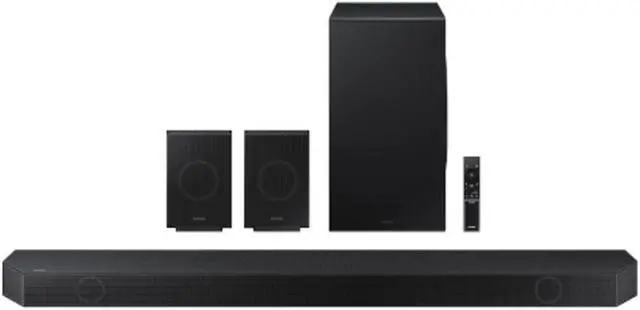
Samsung HW-Q990D 11.1.4ch Soundbar with Rear Speakers
Our top recommendation for this category
Price as of Aug 28, 2026 — see current price on Amazon.
Your TV's built-in speakers are actively working against your gaming. Most flat-panel TVs pack their speakers into the bottom bezel pointing downward, delivering audio that sounds like it's coming from the floor instead of from your game. A decent gaming soundbar fixes that, but not every soundbar is built for gaming, and that distinction matters more than most people realize.
Gaming soundbars need a few things that audio-focused soundbars sometimes don't prioritize: low-latency modes that sync audio with fast-action games, HDMI 2.1 eARC for lossless passthrough from a PS5 or Xbox Series X, and ideally Dolby Atmos and DTS:X support for the spatial audio both modern consoles output natively. Get all three and you'll hear footsteps, positional cues, and environmental audio in a way that TV speakers simply can't reproduce.
The five options below range from a $250 budget pick to a $1,300 flagship. Here's what I'd actually buy at each price.
Top gaming soundbars at a glance
| Soundbar | Channels | Dolby Atmos | HDMI 2.1 eARC | Game Mode | Price | |
|---|---|---|---|---|---|---|
| Samsung HW-Q990D | 11.1.4ch | Yes | Yes | Game Mode Pro | ~$1,299 | Check Price |
| Sony HT-A7000 | 7.1.2ch | Yes | Yes | Game Mode | ~$899 | Check Price |
| Sonos Arc Ultra | 9.1.4ch | Yes | eARC only | Yes | ~$899 | Check Price |
| Samsung HW-Q600B | 3.1.2ch | Yes | eARC | Game Pro Mode | ~$449 | Check Price |
| Denon DHT-S517 | 3.1.2ch | Yes | eARC | No dedicated | ~$249 | Check Price |
Best overall: Samsung HW-Q990D
Samsung HW-Q990D 11.1.4ch Soundbar with Rear Speakers
Pros
- Rear speakers included, true surround sound out of the box
- Game Mode Pro dramatically reduces audio latency for gaming
- Q-Symphony syncs with compatible Samsung TVs for added height channels
- SpaceFit Sound Pro auto-adjusts EQ to your room's acoustics
Cons
- $1,299 is a serious investment for a soundbar
- Rear speakers need power outlets, not fully wireless
Price as of Aug 28, 2026 — see current price on Amazon.
The Q990D is the most complete gaming audio setup you can get in a single box. Samsung bundles rear speakers, actual surround channels, not virtualized, which is what separates it from almost every other soundbar in this price range. Combined with the upward-firing drivers in the main bar, you get a genuine 11.1.4-channel audio system with no additional purchases required.
Game Mode Pro is the feature that makes Samsung's flagship line genuinely useful for gaming specifically. It reduces audio processing delay to under 30ms and optimizes the EQ for game audio characteristics, elevating mid-range cues where footsteps and reload sounds live, while keeping the low-end punchy without being muddy.
HDMI 2.1 eARC means you're getting full-bandwidth lossless audio passthrough from your PS5 or Xbox. No audio compression. The Q-Symphony feature is genuinely clever if you own a compatible Samsung TV, it uses the TV's built-in speakers as additional height channels, which adds spatial width without any extra hardware. Compatible with 2021+ Samsung TV models.
The main argument against: $1,299 is a significant spend. You can absolutely build a 5.1 speaker system for less. But if you're going soundbar specifically for a living room setup where full surround speakers aren't practical, the Q990D is as close as you get.
Best for PS5: Sony HT-A7000

Sony HT-A7000 7.1.2ch Soundbar
Pros
- Sony 360 Spatial Sound Mapping creates a wide, convincing surround field
- Deep bass from the built-in X-Balanced speaker units
- HDMI 2.1 eARC for full PS5 audio passthrough
- Expandable with optional Sony SA-RS5 rear speakers and SA-SW5 subwoofer
Cons
- Pricey without rear speakers included, starts to feel incomplete vs Q990D at similar cost
- Android TV app for setup feels slightly clunky
- Large footprint, needs a wide TV stand
Price as of Aug 28, 2026 — see current price on Amazon.
Sony and PlayStation have a natural relationship, and it extends to audio. The HT-A7000 supports Sony's 360 Spatial Sound Mapping, which uses the PS5's Tempest 3D Audio engine to create a calibrated surround field tailored to your specific room acoustics. It actually works, fire up Returnal or God of War Ragnarok with 360 Spatial Sound active and directional audio becomes noticeably precise.
The HT-A7000 runs HDMI 2.1 with eARC, so you're not losing any fidelity from the PS5's Dolby Atmos or DTS:X output. The bass from the built-in X-Balanced speaker units is strong enough that many users run it without a separate subwoofer, though Sony does sell optional SA-SW5 and SA-SW3 wireless subs if you want more low end.
Where Sony asks you to compare carefully against the Samsung: the Q990D includes rear speakers. At $899, the HT-A7000 is the soundbar only. Adding Sony's SA-RS5 rear speakers ($350) pushes total cost close to the Q990D's territory. If you're strictly PS5-focused and don't want rear speakers, the HT-A7000 is a better call. If you might add them later, do the math before you buy.
Best for Sonos ecosystem: Sonos Arc Ultra

Sonos Arc Ultra Soundbar
Pros
- Sound Motion technology delivers genuinely impressive bass without a subwoofer
- 9.1.4 channel configuration with up-firing drivers for Atmos height effects
- Trueplay room calibration via the Sonos app creates accurate audio for your space
- Pairs natively with Sonos Era 300 speakers for proper surround if you want it
Cons
- eARC only, no HDMI 2.1 input, which limits video passthrough flexibility
- No HDMI 2.1 means you're routing video directly to your TV
- Sonos app required for setup and some features
Price as of Aug 28, 2026 — see current price on Amazon.
Sonos designed the Arc Ultra primarily as a premium home theater and music soundbar, but it's an excellent gaming option for anyone who's already in the Sonos ecosystem or prioritizes audio quality across all content types. The Sound Motion technology, which uses a mechanical actuator to move the soundbar housing and create bass, is legitimately impressive. Reviewers comparing it with soundbar-plus-sub setups say it holds up better than it has any right to.
For gaming specifically: the 9.1.4 channel layout with four up-firing drivers creates convincing Atmos height effects. Explosions feel like they're above you. Helicopter audio in open-world games sweeps overhead in a way that puts you in the game. Trueplay calibration takes about three minutes and measurably improves accuracy.
The limitation for gaming setups: no HDMI 2.1 input means your PS5 or Xbox needs to connect directly to your TV's eARC-capable HDMI port, not through the soundbar. This is fine for most setups but adds cable routing consideration. If video passthrough through the soundbar matters to you, Sonos isn't the pick.
Best mid-range: Samsung HW-Q600B
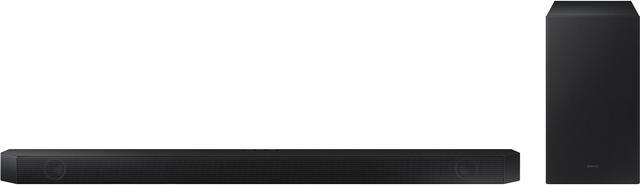
Samsung HW-Q600B 3.1.2ch Soundbar
Pros
- Game Pro Mode, same gaming-specific audio optimization as the flagship Q990D
- 3.1.2ch with up-firing drivers delivers real Atmos height effects, not just virtualized
- Wireless subwoofer included at this price point
- Q-Symphony compatible with Samsung TVs from 2021 onward
Cons
- No rear speakers, surround is virtualized, not discrete
- Wireless subwoofer placement limited to about 33 feet from main bar
Price as of Aug 28, 2026 — see current price on Amazon.
The HW-Q600B is where Samsung's value proposition peaks. You get the same Game Pro Mode as the flagship Q990D, a wireless subwoofer included, and two up-firing drivers for real Atmos height effects, all for under $450. The 3.1.2-channel layout means surround is virtualized rather than discrete, but Samsung's DSP virtualization has gotten good enough that the difference is smaller than you'd expect for most content.
For a gaming-focused mid-range setup, this is genuinely hard to beat. Game Pro Mode cuts latency and optimizes the audio signature for games in the same way the Q990D does. The wireless subwoofer hits hard for the price. And Q-Symphony integration means if you own or ever buy a compatible Samsung TV, you get bonus height channels for free.
The step down from the Q990D is significant only if you need true discrete surround. For a couch gaming setup in a normal-sized room where physical rear speakers aren't practical, the Q600B does most of what the Q990D does for $850 less.
Best budget: Denon DHT-S517
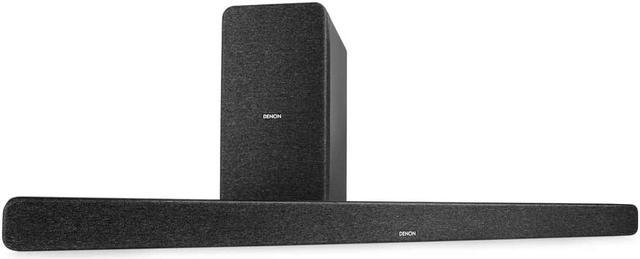
Denon DHT-S517 3.1.2ch Soundbar with Wireless Subwoofer
Pros
- Wireless subwoofer included at $249, rare at this price
- Dolby Atmos and DTS:X support from a genuinely premium audio brand
- eARC input handles PS5/Xbox audio passthrough
- Denon's sound tuning history shows, this sounds more accurate than most budget picks
Cons
- No dedicated game mode, general audio processing isn't optimized for gaming
- Up-firing drivers are present but limited in height effect creation
- Bluetooth setup can require multiple attempts on some phones
Price as of Aug 28, 2026 — see current price on Amazon.
Denon isn't a name you typically see on budget soundbars, and that heritage shows in the DHT-S517. This is a $249 soundbar that sounds like a $400 soundbar. The frequency response is balanced, the wireless subwoofer is tight and musical (not just loud), and the eARC input handles PS5/Xbox audio without any fuss.
The compromise for gaming specifically: there's no dedicated game mode. You can use the Music or Movie preset and they're both reasonable for games, but you're not getting the latency optimization or gaming-specific EQ curve that Samsung's Game Pro Mode or Sony's Game Mode provide. For competitive gaming where latency matters, that's a real tradeoff. For casual and single-player gaming where you want great overall audio quality, Denon's tuning holds up.
At $250 with a wireless subwoofer included, there's not a better sounding option in this price range. Spend $249 here rather than $299 on a Samsung or LG budget soundbar without the subwoofer.
What to look for in a gaming soundbar
Game modes and latency
This is the feature that separates gaming soundbars from general-purpose models. Standard audio processing introduces 50-100ms of delay between what you see and what you hear. That's imperceptible in movies; it's noticeable in fast-action games. Game modes bypass or reduce heavy DSP processing to cut that latency to under 30ms. Samsung's Game Pro Mode and Sony's Game Mode are the best implementations. If a soundbar doesn't mention latency or a dedicated game mode, assume it's not optimized for gaming.
HDMI 2.1 eARC vs older eARC
The PS5 and Xbox Series X output audio at the full bandwidth of Dolby Atmos TrueHD and DTS:X Master Audio through HDMI 2.1 eARC. An older HDMI ARC connection compresses that signal. The difference in a well-tuned room is audible, you get more detail, a wider soundstage, and better dynamic range through eARC. Every soundbar in this roundup supports eARC, and all but the Sonos Arc Ultra support HDMI 2.1 for video passthrough too.
Channels: what the numbers actually mean
A 3.1.2ch soundbar has left, right, and center front channels (3), a subwoofer (1), and two up-firing drivers for height effects (2). The height channels bounce sound off your ceiling to simulate overhead audio, this is how Dolby Atmos works in soundbar form. More channels generally means more precise placement, but a well-tuned 3.1.2ch like the Q600B can outperform a poorly-tuned 5.1.2ch in perceived surround quality.
Room size and subwoofer
A soundbar for a small bedroom setup (under 150 sq ft) doesn't need a massive subwoofer. A living room setup over 300 sq ft benefits from a stronger sub or an external one. Most soundbars in this list include a wireless subwoofer, only the Sony HT-A7000 doesn't include one at base price, relying on its built-in drivers for bass.
Frequently asked questions
- Does a gaming soundbar make a real difference over TV speakers?
- Yes, significantly. TV speakers typically deliver 10-15W in a downward-facing configuration with no subwoofer. A 3.1.2ch soundbar like the Denon DHT-S517 delivers 170W across dedicated drivers with a separate subwoofer. The difference in positional audio, dialogue clarity, and bass is immediately apparent, not subtle.
- Can I use a soundbar with a gaming monitor instead of a TV?
- Yes, though HDMI eARC requires an HDMI connection, which most gaming monitors don't have an eARC port for. You'd typically connect your PC or console to the monitor and the monitor's audio output (optical or 3.5mm) to the soundbar. Alternatively, plug the soundbar directly into the PC's HDMI output. You lose some audio features this way, but it works.
- Do I need Dolby Atmos on a soundbar or is it marketing?
- It's real but context-dependent. On a 3.1.2ch soundbar, Atmos height effects are created by bouncing sound off your ceiling, it works well in rooms with 8-10 foot ceilings and works poorly in rooms with very high or angled ceilings. In a typical living room, the height effects are noticeable and add immersion to supported game titles and films.
- Will a gaming soundbar help my competitive gaming?
- For positional audio in competitive FPS games, footsteps, reload sounds, directional cues, a soundbar with a dedicated game mode and wide soundstage beats TV speakers. But if competitive gaming is your primary use case, a quality gaming headset still wins on precision. Soundbars are better for single-player, co-op, and casual gaming where speakers are preferred.
- What's the difference between eARC and regular ARC?
- ARC (Audio Return Channel) can handle compressed 5.1 audio like Dolby Digital. eARC (Enhanced ARC) handles the full lossless audio formats: Dolby TrueHD, DTS:X Master Audio, and Dolby Atmos. For the PS5 and Xbox Series X, which output at these higher formats, eARC is the right connection to use.
- Should I get a soundbar or a 5.1 surround sound system?
- For most living rooms, a soundbar with rear speakers (like the Samsung HW-Q990D) is the better practical choice: single power connection, no speaker wire runs, less clutter. A traditional 5.1 system with a receiver and discrete speakers offers better audio quality at equivalent or higher cost, but requires permanent speaker placement and more cable management. If you rent, soundbar. If you own and want to invest in room audio properly, 5.1 system.
Bottom line
For most setups, the Samsung HW-Q600B at $450 is the sweet spot, Game Pro Mode, Dolby Atmos, a wireless subwoofer, and Samsung's proven DSP tuning for under $500. The flagship HW-Q990D is worth the step up if you want the included rear speakers for true discrete surround. The Denon DHT-S517 at $250 is the right call if budget is the priority and you don't need a dedicated game mode.
If you're deep in the PS5 ecosystem or a heavy music listener, the Sony HT-A7000 and Sonos Arc Ultra both justify their $899 price points in different ways, Sony for PlayStation integration and expandability, Sonos for overall audio quality and multi-room capability.
Whatever you pick: connect via HDMI eARC, enable game mode, and compare it to your TV speakers for five minutes. You won't go back.
How We Pick
We pick products by combining spec-level research, price checks, trusted third-party benchmarks, and owner sentiment from high-signal sources.
- Performance and real-world value in the category this guide targets
- Price-to-performance and deal consistency over recent pricing windows
- Build quality, reliability patterns, and known long-term issues
- Recommendation refresh cadence to keep these picks current
Author
TheTechSearch Editorial Team
Independent product reviewers & PC builders
We compare real-world specs, reviews and owner reports, price trends, and user feedback to recommend gear that actually makes sense to buy.