Do You Need a Satellite Messenger if Your Phone Has Satellite SOS?
Phone satellite SOS covers a lot now. Here's when an iPhone or Pixel is enough, when a Garmin inReach earns its subscription, and which one to buy. Expert pi...
As an Amazon Associate we earn from qualifying purchases made through our links — this doesn't affect our picks.
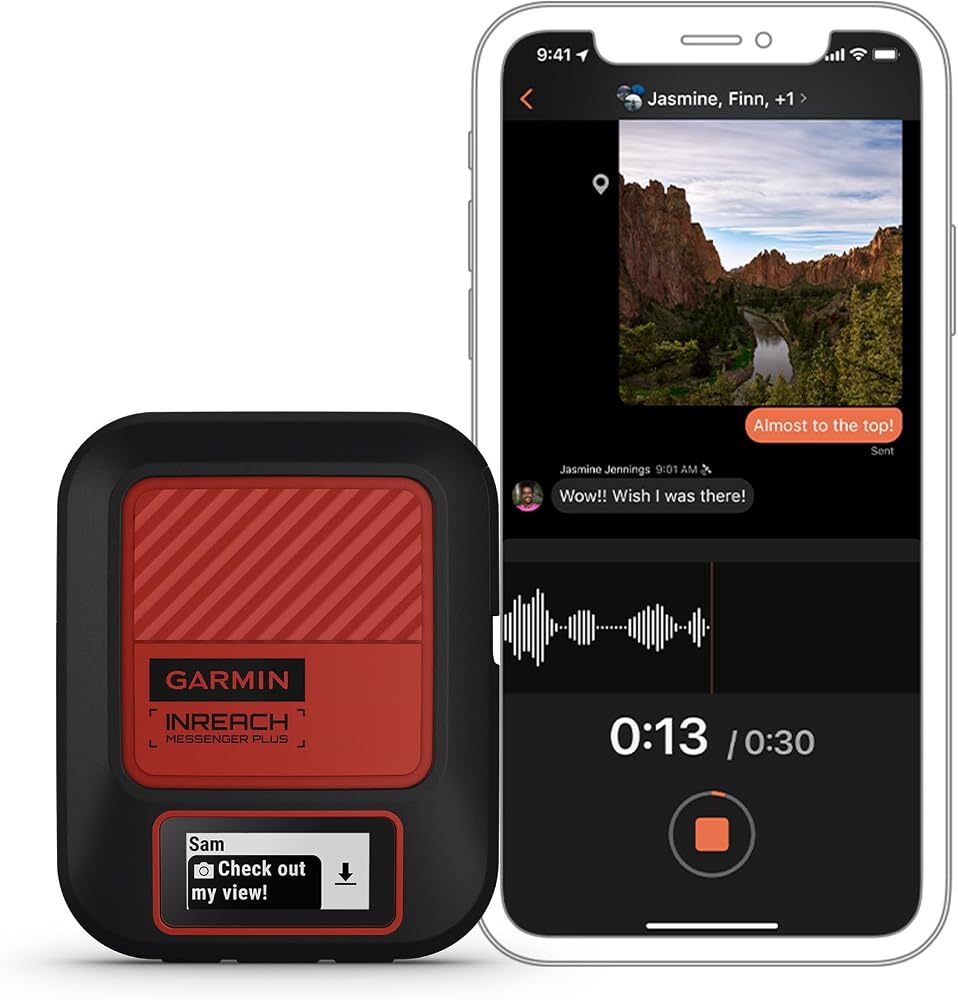
Garmin inReach Messenger Plus
Our top recommendation for this category
Price as of Oct 10, 2026 — see current price on Amazon.
In this guide
- What Your Phone Can Already Do
- Where Phone Satellite Features Fall Short
- So Who Actually Needs One?
- The Real Cost Is the Subscription
- Garmin inReach Messenger Plus: Best for Most People
- Garmin inReach Mini 3 Plus: Best if Your Phone Might Not Survive
- Garmin inReach Mini 3: Touchscreen Without the Media Extras
- Garmin inReach Messenger: Cheapest Way In
- Garmin inReach Mini 2: The Older Navigator
- How to Choose in Thirty Seconds
- Bottom Line
Short answer: if you day-hike popular trails in the US or Canada and carry an iPhone 14 or newer, you probably don't. Your phone can already reach emergency services by satellite, and it costs nothing for the first two years.
But the people who should own a dedicated satellite messenger are easy to spot. They go out for days, not hours. They travel abroad, paddle, ride or fly into places with tree cover and no towers. Or somebody at home wants a dot on a map every ten minutes. For them, a phone is a backup, not a plan.
Here's how to tell which group you're in, and which Garmin inReach to buy if it's the second one.
| Device | Messages | Screen | Garmin battery claim | Price | |
|---|---|---|---|---|---|
| Garmin inReach Messenger Plus | Text, photo, voice | Small mono display | Up to 600 hrs, 10-min tracking | $385.00 | Check Price |
| Garmin inReach Mini 3 Plus | Text, photo, voice | 1.9" color touch | Up to 330 hrs, 10-min tracking | $445.75 | Check Price |
| Garmin inReach Mini 3 | Text only | 1.9" color touch | About 2 weeks, 10-min tracking | $389.99 | Check Price |
| Garmin inReach Messenger | Text only | Small mono display | Up to 28 days, 10-min tracking | $273.10 | Check Price |
| Garmin inReach Mini 2 (Orange) | Text only | Mono, button-driven | Up to 14 days, 10-min tracking | $324.89 | Check Price |
What Your Phone Can Already Do
A lot more than it could three years ago. That's the honest starting point.
Every iPhone 14 and later has Emergency SOS via satellite. You answer a short questionnaire, the phone guides you to point it at a satellite, and your message and location go to a relay center that contacts emergency services. Apple includes it free for two years from activation. Newer iOS versions add Messages via satellite in the US, Find My location sharing and roadside assistance.
Google's Pixel 9 and later offer Satellite SOS in the US too. And carriers have joined in: T-Mobile's T-Satellite service, built on Starlink, lets many recent phones send texts where there's no tower.
So the "you'll die without an inReach" pitch doesn't hold up anymore. For a ranger-patrolled trail on a clear afternoon, the phone in your pocket is a real safety net.
Where Phone Satellite Features Fall Short
The limits show up in exactly the situations where you'd want help most.
It needs open sky. Apple's own support page says a message "might take 30 seconds or more to send" with a clear view of the sky and horizon, and "up to several minutes" under light or medium foliage. Deep forest, slot canyons and steep valleys are where hikers actually get hurt.
It stops at high latitudes. Apple notes it may not work above 62° latitude, which cuts out much of Alaska, northern Canada and Scandinavia. Garmin's inReach runs on Iridium, a 66-satellite network with pole-to-pole coverage.
It lives on your phone's battery. Your phone is also your map, camera and flashlight. A cold night or a long day of GPS navigation can leave it at 4% right when you need it. A Messenger Plus is rated by Garmin for up to 600 hours in 10-minute tracking mode. That's weeks, not hours.
It's fragile. One slip onto granite and the screen's gone. Every inReach is built to an IPX7 rating and is meant to hang off a pack strap.
Nobody's watching your track. Phone features mostly start when you start them. An inReach can send your position every few minutes to a MapShare page, so if you stop answering, people at home already know where to send help.
The SOS is less interactive. Garmin's SOS goes to Garmin Response, a 24/7 coordination center that texts back and forth with you, tells you who's coming, and stays on the thread with your emergency contacts. That two-way loop is the thing search-and-rescue teams praise most.
So Who Actually Needs One?
You likely do if any of these sound like you:
- Multi-day trips in the backcountry, where your phone can't be both navigator and lifeline
- International travel outside the countries your phone's service covers
- Solo trips where someone at home wants live tracking and check-ins
- Paddling, sailing, backcountry skiing or riding where water, cold or crashes can kill a phone
- Remote work, like surveying, guiding or ranch work, far from towers on a regular basis
- Anyone above roughly 62° latitude
You probably don't if you mainly day-hike busy trails in the US or Canada, stay within a few miles of a road, and your phone has satellite SOS. Spend the money on a good power bank and a paper map instead.
The Real Cost Is the Subscription
The device is a one-time cost. The plan isn't, and that's what makes people hesitate.
Garmin's consumer plans run from a basic Enabled tier to Essential, Standard and Premium. Essential includes 50 text messages and 10 photo or voice messages, Standard 150 texts and 25 photo or voice messages, and Premium unlimited texting with 50 photo or voice messages. SOS is included on every plan. Garmin advertises plans from about $15 a month, plus a one-time activation fee.
The good news: you can suspend a plan for up to 12 months at no cost. If you only head out in summer, you pay for summer.
Over five years of seasonal use, a messenger plus a mid-tier plan runs several hundred dollars. Measure that against what it buys. A phone that may or may not connect, versus a device that was designed only to connect.
Garmin inReach Messenger Plus: Best for Most People
Garmin inReach Messenger Plus
Pros
- Sends texts, photos and 30-second voice messages over Iridium
- Garmin rates it for up to 600 hours in 10-minute tracking mode
- Interactive SOS to Garmin Response, 24/7
- Small enough to clip to a shoulder strap
Cons
- Photos and voice need the Garmin Messenger phone app
- Tiny display makes standalone texting slow
Price as of Oct 10, 2026 — see current price on Amazon.
The Messenger Plus is the one to get if you'll mostly use it alongside your phone. It pairs with the Garmin Messenger app, so you type on your phone's keyboard and the inReach handles the satellite side. When you get back in cell range, the same conversation carries over.
What sets it apart from the older Messenger is media. It can send photos and short voice messages over Iridium's newer IMT service. A photo of an injury or of the trail junction you're stuck at says more than 160 characters ever will.
Battery is the other headline. Garmin's spec of up to 600 hours in 10-minute tracking works out to roughly 25 days, far beyond the Mini 3 Plus. Garmin lists it at $399.99.
Garmin inReach Mini 3 Plus: Best if Your Phone Might Not Survive
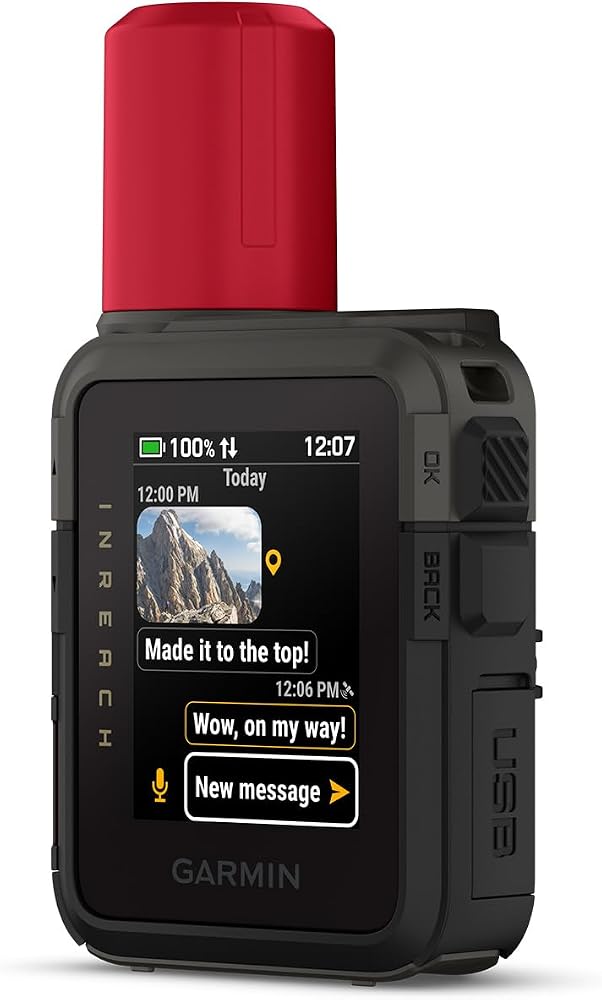
Garmin inReach Mini 3 Plus
Pros
- 1.9-inch color touchscreen for texting without a phone
- Built-in speaker and mic for 30-second voice messages
- Photo messaging and messages up to 1,600 characters
- Reads voice-message transcriptions on the device
Cons
- Shorter battery than the Messenger Plus, about 330 hours in 10-minute tracking
- The most expensive device in this guide
Price as of Oct 10, 2026 — see current price on Amazon.
The Messenger Plus assumes your phone is alive. The Mini 3 Plus doesn't.
Its 1.9-inch color touchscreen is big enough to type replies, read messages and check your position on the device itself. That's a real upgrade over the Mini 2's tiny monochrome screen and button pecking. Built-in speaker and microphone mean you can record and play voice messages without a phone at all.
DC Rainmaker's review lists the Plus at 125 g with its carabiner, only a few grams more than the base Mini 3. Garmin lists it at $499.99. If you paddle, ski or climb, where a phone in a dry bag is a phone you can't reach, this is the one.
Garmin inReach Mini 3: Touchscreen Without the Media Extras
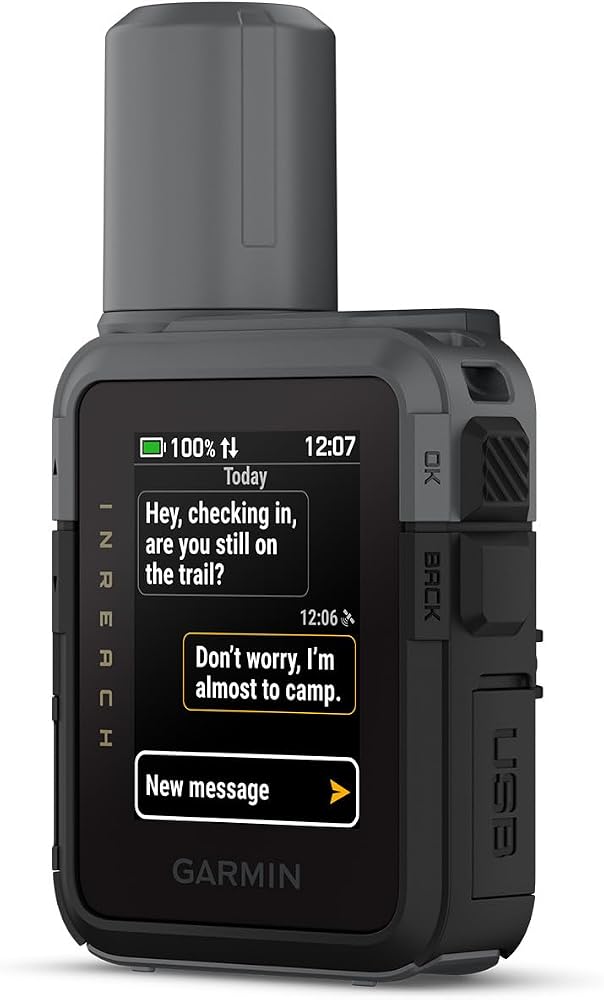
Garmin inReach Mini 3
Pros
- Same 1.9-inch color touchscreen as the Plus
- Works fully without a paired phone
- Interactive SOS, tracking and weather forecasts
Cons
- Text only, 160 characters per message
- No voice or photo messages
Price as of Oct 10, 2026 — see current price on Amazon.
The base Mini 3 keeps the screen and drops the IMT radio that handles photos and voice. You get classic 160-character texting, SOS, tracking and weather requests, all from the device itself.
That's plenty for a lot of people. If you only want to say "camp at the lake, all good" each night and have a button for emergencies, voice notes are a nice-to-have. Garmin lists it at $449.99.
Garmin inReach Messenger: Cheapest Way In
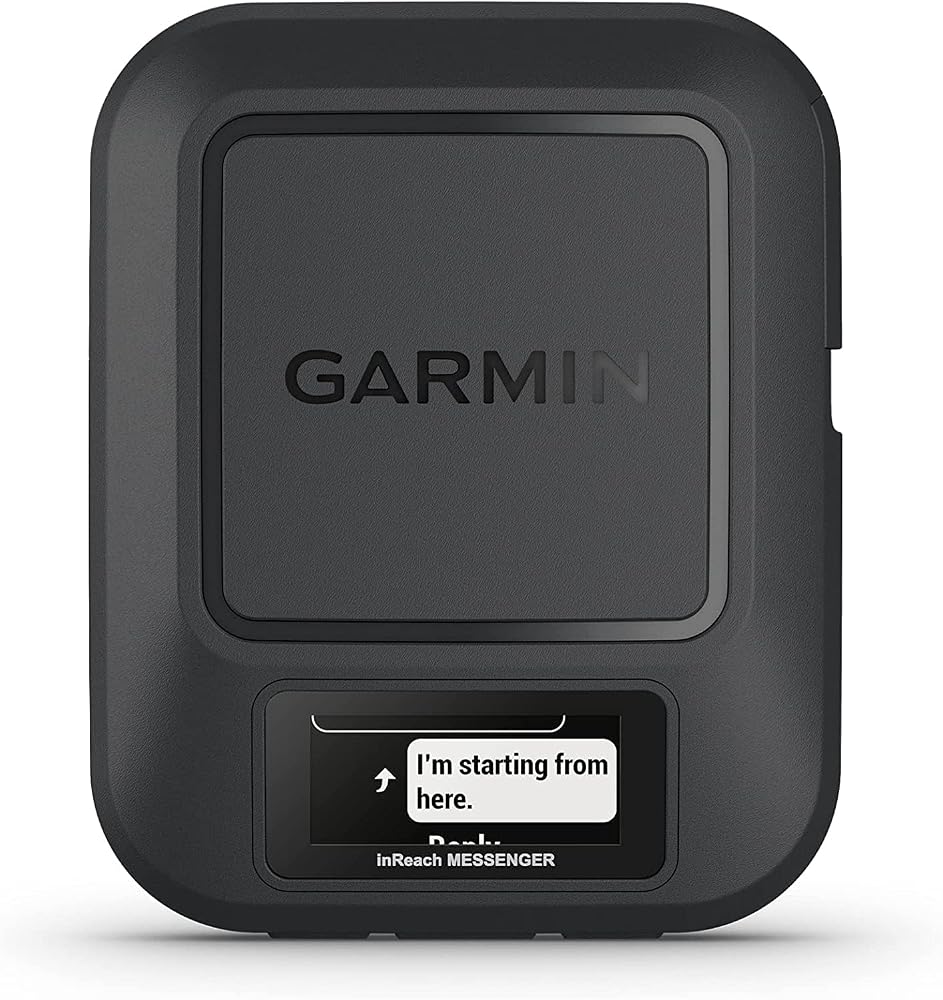
Garmin inReach Messenger
Pros
- Lowest price of any inReach here
- Garmin claims up to 28 days in 10-minute tracking mode
- Same Garmin Messenger app and interactive SOS
Cons
- Text only, no photo or voice
- Tiny screen, really meant to be run from a phone
Price as of Oct 10, 2026 — see current price on Amazon.
The original Messenger is the right call if the subscription is what you're worried about and you'd rather keep the hardware cost low. It does the core job: two-way texting, tracking, check-ins and SOS, all over Iridium.
It's phone-first, like the Plus, and Garmin's 28-day tracking claim is even a little longer than the Plus's. Garmin lists it at $299.99. Skip it only if you want photo or voice messages.
Garmin inReach Mini 2: The Older Navigator
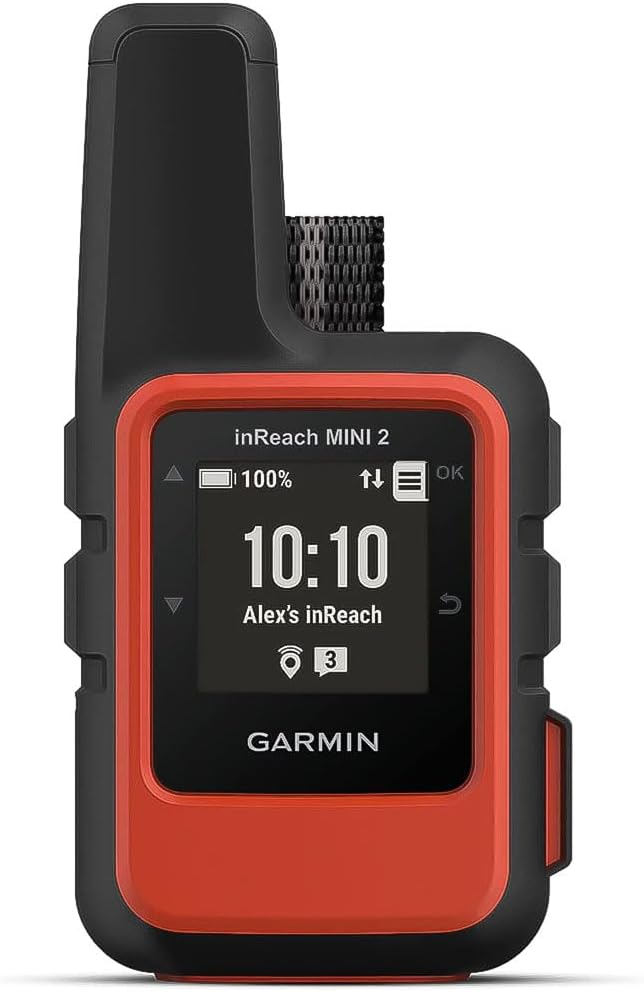
Garmin inReach Mini 2 (Orange)
Pros
- About 100 g, the lightest device here
- TracBack routing to retrace your path
- Physical buttons work with gloves
Cons
- Small monochrome screen, slow to type on
- Costs more than the newer, phone-first Messenger
Price as of Oct 10, 2026 — see current price on Amazon.
The Mini 2 was the default backcountry recommendation for years, and it still does the job. It's light, it has real buttons, and its TracBack feature guides you back along the route you came in on.
But the newer models have passed it. The Mini 3 adds a usable screen, and the Messenger costs less. Buy the Mini 2 if you want physical buttons for gloved hands. Garmin lists it from $349.99.
How to Choose in Thirty Seconds
- Mostly hike with a phone, want photos and voice: Messenger Plus
- Need it to work if your phone dies or gets soaked: Mini 3 Plus
- Want a screen but only need text: Mini 3
- Lowest cost, phone-first: Messenger
- Gloves, buttons and a feather-light pack: Mini 2
Whatever you pick, set up your emergency contacts and send a test message from your backyard before the trip. A satellite device you've never used is a puzzle during an emergency.
Frequently asked questions
- Is iPhone satellite SOS as good as a Garmin inReach?
- For emergencies in open terrain inside its coverage area, it works. It's slower under trees, may not work above about 62° latitude, runs off your phone battery and doesn't offer continuous tracking. An inReach uses the pole-to-pole Iridium network and has its own battery.
- Do I have to pay a monthly fee for an inReach?
- Yes, any inReach needs an active Garmin plan to send messages or SOS. Plans start around $15 a month, and you can suspend service for up to 12 months at no cost between trips.
- Can an inReach text a normal phone number?
- Yes. It sends to phone numbers and email addresses, and replies come back to the device or the Garmin Messenger app.
- What happens when I press SOS?
- The message goes to Garmin Response, a 24/7 coordination center. Staff reply on the device, confirm your situation and location, contact local search and rescue, and keep your emergency contacts updated.
- Is a personal locator beacon (PLB) a cheaper option?
- A PLB has no subscription and sends a one-way distress signal to government rescue satellites. It can't send or receive messages, so nobody can tell you help is coming or ask what's wrong.
Bottom Line
A phone with satellite SOS is enough for day hikes on busy, open trails in the US and Canada. Once trips get longer, wetter, colder, more remote or international, a dedicated satellite messenger stops being a luxury. The Garmin inReach Messenger Plus is the best fit for most people at $385.00, the Mini 3 Plus is the pick when your phone might not make it, and the original Messenger at $273.10 is the cheapest way to get Garmin's two-way SOS. If you're also thinking about keeping a phone, lights and a stove running on longer trips, read our guide on whether a portable power station is worth it.
How We Test
We score products by combining spec-level research, pricing history, trusted third-party benchmarks, and owner sentiment from high-signal sources.
- Performance and real-world value in the category this guide targets
- Price-to-performance and deal consistency over recent pricing windows
- Build quality, reliability patterns, and known long-term issues
- Recommendation refresh cadence to keep these picks current
Author
TheTechSearch Editorial Team
Independent product reviewers & PC builders
We test and compare real-world specs, price trends, and user feedback to recommend gear that actually makes sense to buy.