Is a Smart Telescope Worth It? Who Should Buy One and Who Shouldn't
Smart telescopes turn a phone into a deep-sky camera in minutes. Here's who they suit, who should buy a Dobsonian instead, and the three worth buying.
As an Amazon Associate we earn from qualifying purchases made through our links — this doesn't affect our picks.
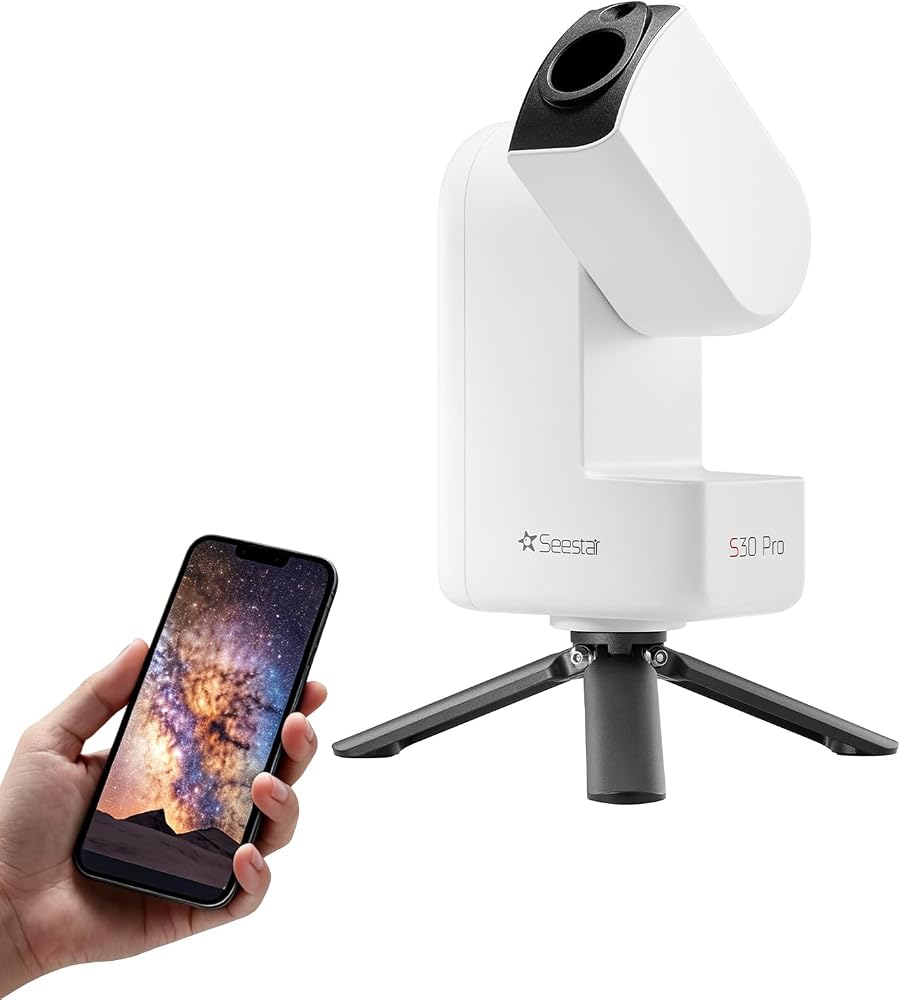
ZWO Seestar S30 Pro
Our top recommendation for this category
Price as of Oct 11, 2026 — see current price on Amazon.
Short answer: yes, if what you want is pictures of galaxies and nebulae from your own backyard without learning astrophotography first. A smart telescope is a small camera, lens, motorized mount and computer in one box. You set it on a tripod, tap a target on your phone, and watch the image build up on screen.
No, if you want to put your eye to an eyepiece and see Saturn's rings live. These things are cameras. They're excellent at faint, wide objects and honestly mediocre at planets.
That split decides almost everything. Here's how to tell which side you're on, and which of the three best-value models to buy if it's the first one.
| Telescope | Main lens | Sensor | Battery | Price | |
|---|---|---|---|---|---|
| ZWO Seestar S30 Pro | 30mm, 160mm focal length | Sony IMX585, 8.3MP | 6,000mAh, about 6 hrs | $699.00 | Check Price |
| DWARFLAB Dwarf 3 | 35mm, 150mm focal length | Sony IMX678, 8.3MP | 10,000mAh | $549.00 | Check Price |
| DWARFLAB Dwarf mini | 30mm, 150mm focal length | Sony IMX662, 1080p | 7,000mAh, about 4 hrs | $419.00 | Check Price |
What a Smart Telescope Actually Does
A traditional imaging setup is a pile of separate parts. There's a telescope, an equatorial mount, a dedicated astronomy camera, a laptop, a guide scope and a lot of cables. Then you learn polar alignment, focusing, guiding, calibration frames and stacking software. That's months of evenings before you get a picture worth sharing.
A smart telescope folds all of it into one unit. It photographs a patch of sky, matches the stars against a catalog to work out exactly where it's pointing (plate solving), and drives itself to whatever you pick in the app. Then it takes a run of short exposures and stacks them in real time. Every few seconds the image on your phone gets cleaner.
That live stacking is the whole trick. A 10-second frame of the Orion Nebula looks like noise. Fifteen minutes of stacked frames looks like a magazine photo. And you didn't touch software once.
Setup is usually a few minutes. Level the tripod, power it on, connect your phone and let it calibrate. AstroBackyard's comparison of smart and traditional scopes puts the difference bluntly: fast setup and fewer pieces to manage, with results on night one.
Where Smart Telescopes Fall Short
They're good at a specific job. Outside that job, the limits show up fast.
Planets look small. These scopes use short focal lengths, roughly 150mm to 260mm. That's perfect for framing a whole nebula and far too short for planetary detail. Jupiter comes out as a bright dot with a hint of bands. An inexpensive 8-inch Dobsonian at the same money will show Jupiter's cloud belts and Saturn's rings live, through an eyepiece, with your own eye.
There's no eyepiece. You're looking at a phone screen. Some people find that disappointing in a way they didn't expect. Others never miss it. Know which you are before spending $500.
You can't upgrade it. Optics, camera and software ship as one sealed product. A traditional rig grows with you, one part at a time. With a smart scope you outgrow the whole thing or you don't.
The app is the product. If the company stops updating it, your telescope stops improving. ZWO and DwarfLab both ship regular firmware and app updates today, which is part of why they lead the category.
Who Should Buy One
You're a good fit if most of these sound like you:
- You live under suburban or city skies. Live stacking plus built-in light-pollution filters pull nebulae out of skies where they're invisible to the eye.
- You want photos, not just a look. Everything you capture is saved and shareable.
- You have short windows. A 20-minute gap in the clouds is enough to get a usable image.
- You don't want a second hobby in software. Stacking, stretching and color balance happen on the device.
- You travel or have no storage space. All three picks below fit in a backpack.
Who Should Skip It
Buy a manual Dobsonian instead if you mainly want planets, the Moon at high magnification, or the experience of finding objects yourself. More aperture per dollar is the Dobsonian's whole pitch, and for visual observing it still wins.
And if you already shoot with a mirrorless camera and a tracking mount, a smart scope is more of a convenient second rig than an upgrade. Our mirrorless camera guide compares bodies on low-light performance, which is what matters for wide-field night sky shots.
ZWO Seestar S30 Pro: Best for Most People
ZWO Seestar S30 Pro
Pros
- Sony IMX585 telephoto sensor with large 2.9-micron pixels
- Second 4K wide-angle camera for the Milky Way and star trails
- Built-in light-pollution filter and EQ mode support
- Seestar app is the simplest in the category
Cons
- 30mm aperture is small, so faint targets need longer sessions
- Costs $150 more than the Dwarf 3
Price as of Oct 11, 2026 — see current price on Amazon.
The S30 Pro is the one to get if you want the least friction between opening the box and seeing a nebula. ZWO's Seestar app does most of the thinking. It suggests targets that are up tonight, handles focus and alignment, and keeps stacking until you tell it to stop.
Inside, the main camera uses Sony's IMX585, a sensor with 2.9-micron pixels that gather more light per pixel than most small-scope sensors. It sits behind 30mm, 160mm optics. A second camera with an IMX586 and a 6mm lens covers wide-field shots, like the summer Milky Way core or star trails over a roofline.
ZWO lists 128GB of internal storage, a 6,000mAh battery rated for about six hours, and a weight of 1.65 kg. It also supports an equatorial mode on a tilted tripod head. EQ mode cuts the field rotation that limits exposure length on an alt-az mount, so long sessions on one object come out cleaner.
ZWO lists the S30 Pro at $699. If your budget stretches to $999, ZWO's newer S50 Pro steps up to 50mm optics and a rated nine hours of battery, but it's a different price class.
DWARFLAB Dwarf 3: Best Value
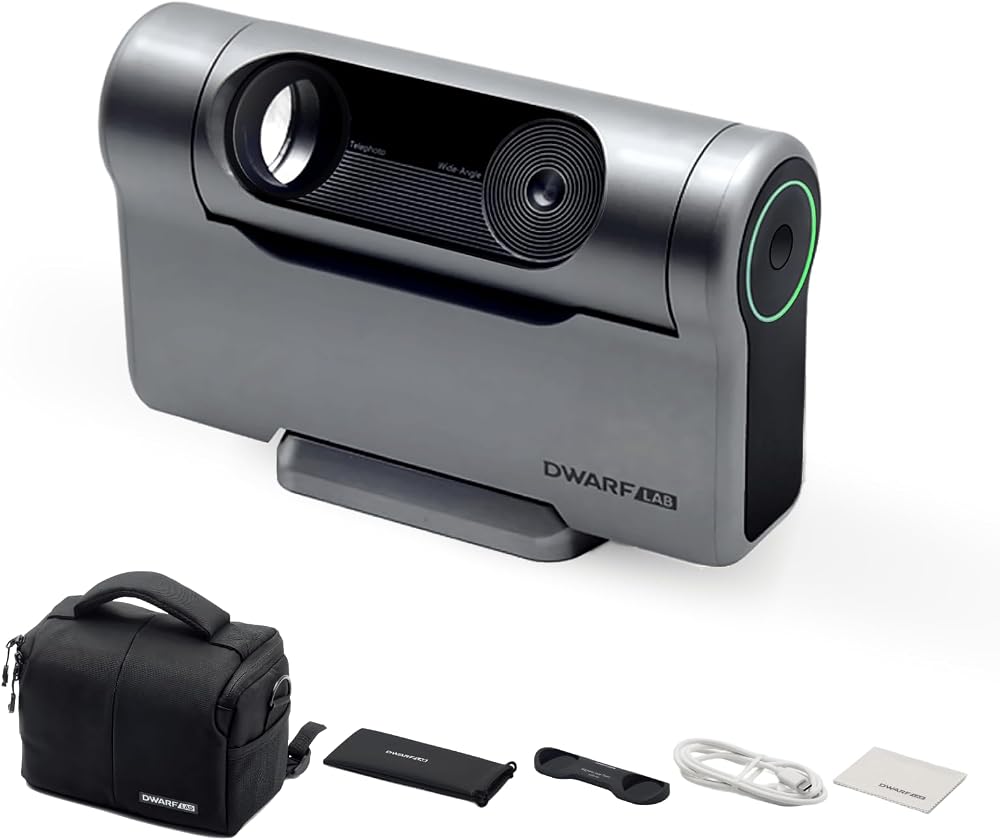
DWARFLAB Dwarf 3
Pros
- Largest aperture here at 35mm
- 8.3MP Sony IMX678 telephoto sensor
- AZ and EQ tracking modes
- Doubles as a wildlife and panorama camera in daylight
Cons
- App has more settings to learn than Seestar's
- Short 150mm focal length makes small galaxies tiny
Price as of Oct 11, 2026 — see current price on Amazon.
The Dwarf 3 gives you a slightly bigger lens than the S30 Pro for $150 less. Its telephoto side is 35mm wide with a 150mm focal length, feeding a Sony IMX678 sensor at 3840 x 2160. More aperture means more light per second, and that adds up over a 30-minute stack.
DwarfLab built it as a dual-purpose camera, and that matters if the sky is cloudy half the year. In daylight it tracks birds and wildlife, shoots time-lapses, and stitches gigapixel panoramas. Not many telescopes earn their keep on overcast weekends.
It has a 10,000mAh battery, 128GB of storage and both alt-az and equatorial modes. Space.com's reviewer called it the ideal smart telescope for beginner astrophotographers. The trade-off is the app. It exposes more controls than Seestar's, which advanced users like and first-timers sometimes find busy.
DwarfLab lists the Dwarf 3 at $549.
DWARFLAB Dwarf mini: Cheapest Way In
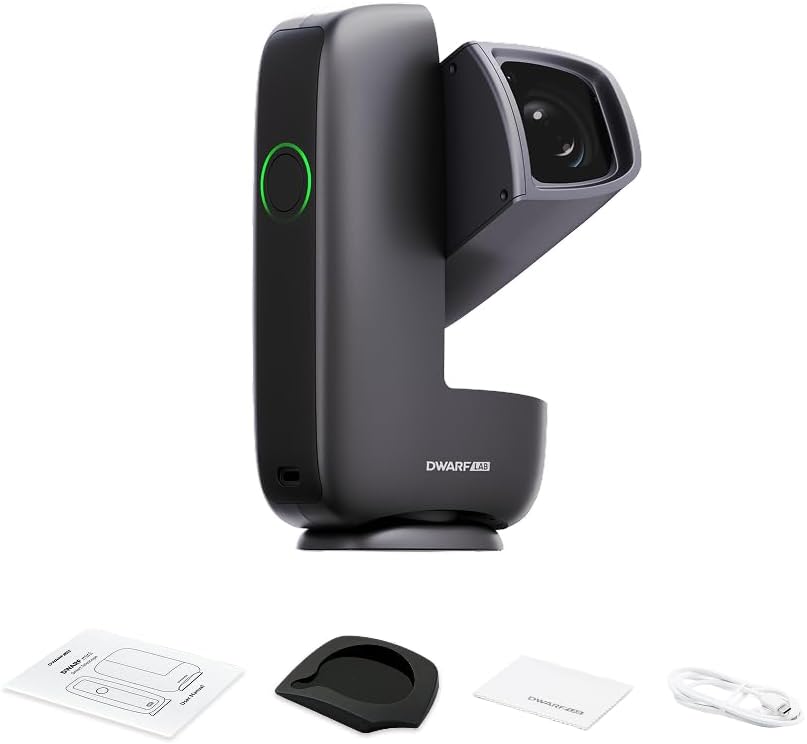
DWARFLAB Dwarf mini
Pros
- About 840 g, small enough for a jacket pocket
- Same 30mm, 150mm optics class as bigger rivals
- AZ and EQ modes with up to 90-second exposures
Cons
- 1080p sensor, so images can't be cropped much
- Rated about four hours of battery
Price as of Oct 11, 2026 — see current price on Amazon.
The Dwarf mini is for the person who wants to try this without a $550 commitment, or who flies a lot. It weighs about 840 g and goes anywhere.
The catch is resolution. Its Sony IMX662 sensor outputs 1080p, roughly 2 megapixels. On a phone screen the results still look great. Printed large or cropped tight, they show their limits fast. Battery is a 7,000mAh pack rated for around four hours, and storage is 64GB.
DwarfLab lists the mini at $419. If you suspect you'll get hooked, the Dwarf 3 is only $130 more and is the better long-term buy.
How to Decide in One Minute
- Want the easiest app and the best deep-sky sensor under $700: Seestar S30 Pro
- Want the most aperture per dollar plus a daytime wildlife camera: Dwarf 3
- Want the lightest, cheapest way to find out if you like it: Dwarf mini
- Want planets through an eyepiece: none of these, get a Dobsonian
Whatever you pick, give it a first night with a bright, easy target like the Orion Nebula or the Andromeda Galaxy. Let it stack for at least 15 minutes before you judge the result. The first 30 seconds always look underwhelming.
Shopping for someone else? A smart telescope makes a memorable gift for the person who already owns every gadget. Our best tech gifts guide covers easier picks at lower prices.
Frequently asked questions
- Can you see planets with a smart telescope?
- Yes, but they're small. With focal lengths of 150mm to 260mm, Jupiter and Saturn show up as bright dots with little detail. Smart telescopes are built for nebulae, galaxies and star clusters. For planets, a traditional telescope with an eyepiece is much better.
- Do smart telescopes work in light-polluted cities?
- Better than you'd expect. Live stacking averages out sky glow, and the Seestar S30 Pro, Dwarf 3 and Dwarf mini all include light-pollution filtering. Bright emission nebulae work well from suburbs. Faint galaxies still benefit from darker skies.
- Do I need a subscription?
- No. The Seestar and Dwarf apps are free to use with the telescope, and images are saved to the device's internal storage and your phone.
- How long does it take to get a good image?
- Bright targets like the Orion Nebula look good within 10 to 15 minutes of stacking. Fainter galaxies can take 30 to 60 minutes or more. You can watch the image improve the whole time.
- Is a smart telescope better than a regular telescope for beginners?
- For photography, yes, by a wide margin. For learning the sky and visual observing, a simple manual Dobsonian teaches more and shows planets better. The right choice depends on whether you want to look or to photograph.
Bottom Line
A smart telescope is worth it if you want deep-sky photos from your own backyard and have no interest in becoming a part-time image-processing technician. It isn't worth it if planets and eyepiece views are what you're after. For most buyers, the ZWO Seestar S30 Pro at $699.00 is the easiest to live with. The DWARFLAB Dwarf 3 at $549.00 gives more aperture for less and works as a wildlife camera too, and the Dwarf mini at $419.00 is the low-risk way to find out whether the hobby sticks.
How We Test
We score products by combining spec-level research, pricing history, trusted third-party benchmarks, and owner sentiment from high-signal sources.
- Performance and real-world value in the category this guide targets
- Price-to-performance and deal consistency over recent pricing windows
- Build quality, reliability patterns, and known long-term issues
- Recommendation refresh cadence to keep these picks current
Author
TheTechSearch Editorial Team
Independent product reviewers & PC builders
We test and compare real-world specs, price trends, and user feedback to recommend gear that actually makes sense to buy.