Is a Smart Thermostat Worth It in 2026?
What a smart thermostat really saves, how long it takes to pay for itself, the homes where it's a waste, and the five worth buying if the answer is yes.
As an Amazon Associate we earn from qualifying purchases made through our links — this doesn't affect our picks.

ecobee Smart Thermostat Premium
Our top recommendation for this category
Price as of Oct 5, 2026 — see current price on Amazon.
Usually, yes. But not for the reason the box says. A smart thermostat saves real money only when it replaces a thermostat nobody programs, and the savings are modest: ENERGY STAR puts the average at about 8% of heating and cooling bills, or roughly $50 a year.
That's enough for a $57 thermostat to pay for itself in about a year. A $240 one takes closer to five, unless your utility kicks in a rebate or your bills are well above average. So the honest answer depends on two things: what you pay to heat and cool, and how you use the thermostat you have now.
The Short Answer
| Your situation | Verdict | |---|---| | Old manual or never-programmed thermostat | Worth it | | High heating or cooling bills | Worth it | | Your utility offers a rebate | Worth it, often close to free | | You already program a schedule and stick to it | Marginal | | Electric baseboard heat (120V or 240V) | These models won't work | | Variable-speed heat pump | Use the maker's thermostat | | Renting, landlord won't allow changes | Skip it |
Where the Savings Actually Come From
A smart thermostat doesn't make your furnace more efficient. It does one thing: it stops heating and cooling an empty house. Everything else is a way of making that happen without you thinking about it.
Schedules people actually keep
Programmable thermostats have existed for decades. The problem was always the programming. Most people set one up, hit a holiday or a schedule change, override it, and never fix it. A smart thermostat lets you build the schedule in an app, and the better ones adjust it on their own.
Knowing when nobody's home
This is where most of the savings live. Geofencing uses your phone's location to set the house back when the last person leaves. ecobee's Premium adds a radar occupancy sensor in the thermostat itself, and its SmartSensor checks a second room. Nest's Learning Thermostat builds a schedule from the adjustments you make in the first week or so.
Seeing your own usage
Monthly runtime reports sound boring. They're not. Seeing that the AC ran nine hours on a mild day is often what gets people to change a setpoint they've ignored for years.
How Much Will You Save?
Here's the number to anchor on. ENERGY STAR certifies smart thermostats on savings measured across real installations, not lab claims, and its figure is about 8% of heating and cooling costs, around $50 a year on average. Homes with big bills or harsh climates save more. ENERGY STAR says high-bill homes can see up to about $100.
Manufacturers quote higher numbers. ecobee says up to 26% on heating and cooling. Those are "up to" figures from the best cases, so plan around the ENERGY STAR average and treat anything above it as a bonus.
Simple payback math
Take your yearly heating and cooling spend and multiply by 0.08. That's a reasonable savings estimate.
- Spend $800 a year: about $64 back each year
- Spend $1,500 a year: about $120 back
- Spend $2,500 a year: about $200 back
Now divide the thermostat's price by that number. A $165 ecobee in a $1,500-a-year house pays for itself in under a year and a half. The same thermostat in an efficient condo that spends $600 a year needs more than three.
Check for a rebate first
Many utilities sell or discount ENERGY STAR thermostats through their own marketplaces, and some cut the price to almost nothing. Google's Nest Learning Thermostat, for example, is listed on several utility stores. Check yours before you buy anywhere else. A rebate can turn a five-year payback into a one-year one.
When a Smart Thermostat Isn't Worth It
You already run a tight schedule
If you program setbacks for nights and workdays and actually stick to them, you've already captured most of the savings. A smart model adds remote control and nicer reports. It won't add much on the bill.
Electric baseboard heaters
Every thermostat in this guide is a low-voltage (24V) unit for central HVAC. Line-voltage baseboard heaters run at 120V or 240V and need a different kind of thermostat entirely. Installing a 24V model there doesn't work and isn't safe.
Variable-speed heat pumps
ENERGY STAR's own guidance says homes with variable-capacity heat pumps or air conditioners generally do best with the manufacturer's recommended thermostat. Those systems talk to their own controls in ways a generic smart thermostat can't. If you have one, ask your installer before swapping anything.
No C-wire and no patience
Smart thermostats need steady power. That usually comes from a C-wire (common wire) at the wall plate. ecobee's Premium and Enhanced ship with a Power Extender Kit for homes without one. The Amazon Smart Thermostat and Honeywell T6 Pro need a C-wire or a separate adapter. It's a 20-minute job for most people, but it does mean opening the furnace panel.
What You Actually Get for More Money
The $57 Amazon Smart Thermostat and the $240 Nest Learning Thermostat save roughly the same energy if you set them up well. The extra money buys two things: better occupancy detection, so the savings happen without you, and nicer hardware.
Room sensors are the upgrade that matters most. A single thermostat in a hallway reads the hallway. If your bedroom runs three degrees colder than the hall, a remote sensor lets the system aim for the room you're actually in. The ecobee Premium and Nest Learning (4th gen) both include one sensor.
The Five Smart Thermostats Worth Buying
These five cover every budget and system type. For deeper model-by-model detail, see the best smart thermostats roundup.
| Thermostat | Price | Room sensor | C-wire | Best for | |
|---|---|---|---|---|---|
| ecobee Smart Thermostat Premium | $209.99 | 1 included | Adapter in box | Most homes | Check Price |
| Google Nest Learning Thermostat (4th Gen) | $239.99 | 1 included | Check Google tool | Hands-off | Check Price |
| ecobee Smart Thermostat Enhanced | $164.99 | Optional | Adapter in box | Value | Check Price |
| Honeywell Home T6 Pro Wi-Fi | $133.99 | No | Required | Multi-stage | Check Price |
| Amazon Smart Thermostat | $56.99 | No | Required | Fast payback | Check Price |
ecobee Smart Thermostat Premium: the best all-rounder
ecobee Smart Thermostat Premium
Pros
- SmartSensor for a second room in the box
- Built-in radar occupancy sensing
- Indoor air quality monitor
- Power Extender Kit for homes without a C-wire
Cons
- Pricier than the Enhanced for features some homes won't use
- Built-in speaker is fine, not great
Price as of Oct 5, 2026 — see current price on Amazon.
The Premium is the easiest thermostat here to recommend without knowing much about your house. It ships with a SmartSensor, so the system can heat or cool the room you're in instead of the hallway. The radar sensor in the thermostat itself notices when people are around, which makes the away setbacks more reliable than phone location alone.
It also has an indoor air quality monitor and a choice of Alexa or Siri built in. Nice extras. The sensor and occupancy detection are the parts that actually move your bill. At $209.99 on Amazon it matches ecobee's own store price.
Google Nest Learning Thermostat (4th Gen): the one you forget about
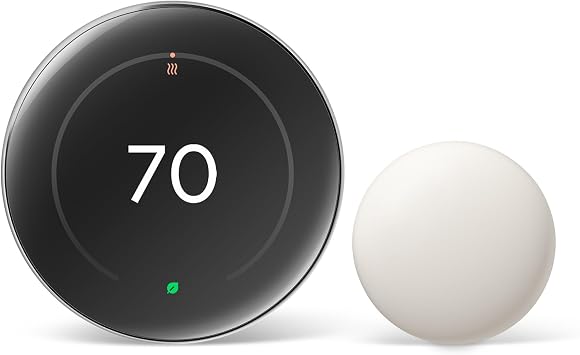
Google Nest Learning Thermostat (4th Gen)
Pros
- Builds its own schedule from your adjustments
- Nest Temperature Sensor (2nd gen) included
- Matter support for non-Google smart homes
- Google Home app with a wiring compatibility checker
Cons
- Most expensive pick
- No air quality monitor
- Some homes need a C-wire or Google's power accessory
Price as of Oct 5, 2026 — see current price on Amazon.
Nest's whole pitch is that you don't build a schedule. You turn it up and down for the first week or so, and the Learning Thermostat works out the pattern. For households that never touched the old thermostat's program, that's the feature that captures the savings.
The 4th gen adds a bigger display, a temperature sensor in the box and Matter support, so it isn't locked to Google Home. Google's own store lists it at $279.99. The Amazon listing is $239.99 for the same bundle with the sensor.
ecobee Smart Thermostat Enhanced: the value pick

ecobee Smart Thermostat Enhanced
Pros
- Same app and scheduling as the Premium
- Works with SmartSensors if you add them later
- Power Extender Kit included
- ENERGY STAR certified
Cons
- No sensor in the box
- No air quality monitor or radar
Price as of Oct 5, 2026 — see current price on Amazon.
Same ecobee software, $45 less. You lose the bundled sensor, the radar and the air quality monitor. If your thermostat already sits in the room you care about, or your house heats evenly, the Enhanced gets you the schedules and geofencing for less. You can add SmartSensors later. At $164.99 it matches ecobee's own price.
Honeywell Home T6 Pro Wi-Fi: for multi-stage systems

Honeywell Home T6 Pro Wi-Fi
Pros
- Handles up to 2 heat / 2 cool conventional or 2 heat / 1 cool heat pump
- Geofencing and app schedules
- A model HVAC installers know well
- Plain, readable touchscreen
Cons
- Needs a C-wire or adapter
- No learning or occupancy sensing
Price as of Oct 5, 2026 — see current price on Amazon.
The T6 Pro is the thermostat a lot of HVAC installers already carry, and that's the point of it. It handles two-stage furnaces and single-speed heat pumps with backup heat cleanly, with geofencing and app schedules on top. It doesn't learn anything. If you just want reliable remote control and a schedule on a staged system, that's fine. At $133.99 it sits in line with Best Buy's $134.99.
Amazon Smart Thermostat: the fastest payback

Amazon Smart Thermostat
Pros
- Cheapest way into ENERGY STAR savings
- Built on Honeywell Home technology
- Simple Alexa app setup
- Pays back in about a year at average savings
Cons
- C-wire required (adapter sold separately)
- Controlled through Alexa, not a standalone app
- No room sensors
Price as of Oct 5, 2026 — see current price on Amazon.
This is the purest version of the math. At $56.99, about the same as ENERGY STAR's average yearly savings, it pays for itself in roughly a year even in a modest home. You give up sensors, learning and a standalone app. Everything runs through Alexa. If you already have Echo speakers and a C-wire, it's hard to argue against. Amazon's list price is $79.99.
How to Decide in Five Minutes
Look at last winter's bills
Add up a year of heating and cooling. Multiply by 0.08. If the result is under $40, buy the cheapest model or skip it. Over $100, any of these pays back fast.
Pull the thermostat off the wall
Take a photo of the wires before anything else. Thick wires marked 120V or 240V mean line voltage, and none of these will work. A wire on the C terminal means any pick here installs easily. No C-wire points you to ecobee, which includes an adapter in the box.
Check your utility's store
Search your utility's name plus "thermostat rebate." Do this before you compare prices anywhere else.
Be honest about the app
If you'll never open an app, buy the Nest. It does the work without you. If you like control, the ecobee app is the better one.
Frequently asked questions
- Do smart thermostats really save money?
- Yes, but modestly. ENERGY STAR puts the average at about 8% of heating and cooling bills, roughly $50 a year, based on real installations. High-bill homes can save around $100 a year.
- How long does a smart thermostat take to pay for itself?
- Divide the price by about 8% of your yearly heating and cooling spend. A $57 Amazon Smart Thermostat pays back in about a year on average savings. A $210 ecobee Premium takes two to four years in most homes, faster with a utility rebate.
- Do I need a C-wire for a smart thermostat?
- Most need steady power. ecobee's Premium and Enhanced include a Power Extender Kit for homes without a C-wire. For the Nest Learning Thermostat, run Google's compatibility checker first, since some systems need a C-wire or Google's power accessory. The Amazon Smart Thermostat and Honeywell T6 Pro need a C-wire or an adapter.
- Do smart thermostats work with electric baseboard heat?
- Not these. All five in this guide are low-voltage 24V thermostats for central heating and cooling. Baseboard heaters run at 120V or 240V and need a line-voltage thermostat made for them.
- Is ecobee or Nest better?
- Nest is better if you want the thermostat to build its own schedule and never open an app. ecobee is better if you want room sensors, radar occupancy detection and more control. Both include one remote sensor in their top models.
- Is a smart thermostat worth it for a renter?
- Only with the landlord's permission and if you keep the old thermostat to reinstall when you move out. The savings on a small apartment are usually small, so the cheaper models make more sense.
Bottom Line
A smart thermostat is worth it when it replaces a thermostat nobody programs, and when your heating and cooling bills are big enough for 8% to matter. For most homes, the ecobee Smart Thermostat Premium is the pick, because its room sensor and occupancy detection make the savings happen without effort. Want it to run itself? Get the Nest Learning Thermostat. On a tight budget, the $56.99 Amazon Smart Thermostat pays back fastest. And if you have baseboard heat or a variable-speed heat pump, skip all five and talk to an installer instead.
How We Test
We score products by combining spec-level research, pricing history, trusted third-party benchmarks, and owner sentiment from high-signal sources.
- Performance and real-world value in the category this guide targets
- Price-to-performance and deal consistency over recent pricing windows
- Build quality, reliability patterns, and known long-term issues
- Recommendation refresh cadence to keep these picks current
Author
TheTechSearch Editorial Team
Independent product reviewers & PC builders
We test and compare real-world specs, price trends, and user feedback to recommend gear that actually makes sense to buy.