RTX 5070 Ti vs RTX 5080: Which GPU Should You Actually Buy in 2026?
The RTX 5080 is 15-17% faster but costs more. Which Blackwell GPU makes sense for your setup? We break down the numbers and tell you exactly when the upgrade...
As an Amazon Associate we earn from qualifying purchases made through our links — this doesn't affect our picks.

ASUS ROG Strix GeForce RTX 5070 Ti OC Edition 16GB GDDR7
Our top recommendation for this category
Price as of Sep 15, 2026 — see current price on Amazon.
Nvidia's Blackwell generation gave us two flagship cards that sit closer together in price than any high-end pairing I can remember. The RTX 5070 Ti starts at $979 (Founders Edition), the RTX 5080 starts at $1,249, and if you're shopping premium AIB models, the gap can shrink to as little as $130. That makes the usual "buy the cheaper one" advice too simple. Which card you should actually pick depends on what you're gaming at, whether you'll use DLSS 4, and how much you care about native 4K.
I've gone through the benchmarks so you don't have to.
| Product | Price | 1440p Avg FPS | 4K Avg FPS | TDP | VRAM | |
|---|---|---|---|---|---|---|
| ASUS ROG Strix RTX 5070 Ti OC | $1,649.97 | 163 FPS | 97 FPS | 300W | 16GB GDDR7 | Check Price |
| ASUS TUF Gaming RTX 5080 OC | $1,779.99 | 187 FPS | 114 FPS | 360W | 16GB GDDR7 | Check Price |
RTX 5070 Ti: The Sweet Spot for Most Gamers
At 1440p, the RTX 5070 Ti is genuinely difficult to argue against. A 13-game average of 163 FPS at 1440p Ultra puts you well above 144Hz territory in almost everything. Cyberpunk 2077 at 1440p Ultra with ray tracing? You're looking at 120-180 FPS depending on the scene. Alan Wake 2? Smooth. The ROG Strix OC version I've been looking at pushes clocks to 2,760 MHz, which adds a few extra frames over the Founders Edition.
The 300W TDP is the other reason to pay attention here. You can run this card on a quality 750W PSU without sweating it. A lot of existing builds can drop in the 5070 Ti without touching the power supply.
Honest drawback: native 4K without upscaling is where the 5070 Ti shows its ceiling. Averaging 97 FPS at 4K Ultra across a mixed game slate sounds fine until you hit something genuinely demanding. In Cyberpunk at 4K native with full path tracing, you're looking at 55-65 FPS. Playable, but the headroom is tighter.
ASUS ROG Strix GeForce RTX 5070 Ti OC Edition 16GB GDDR7
Pros
- 163 FPS avg at 1440p Ultra
- 300W TDP fits existing 750W builds
- 3.2-slot cooling keeps it quiet under load
Cons
- 97 FPS avg at 4K, tight headroom for path tracing
- ROG Strix premium pricing
- VRAM same as 5080
Price as of Sep 15, 2026 — see current price on Amazon.
RTX 5080: When the Extra Cost Makes Sense
The RTX 5080 is roughly 15% faster at 1440p and 17.5% faster at 4K. In absolute numbers, that's 187 FPS vs 163 FPS at 1440p Ultra, and 114 FPS vs 97 FPS at 4K. The 4K gap matters more because that's where both cards start feeling pressure from demanding titles.
With DLSS 4 Multi Frame Generation running, the practical difference compresses dramatically. Both cards can clear 90 FPS at 4K with quality DLSS settings. But native 4K is where the 5080 pulls ahead in a way that actually changes how you play. If you're in a game that caps DLSS headroom or you just hate upscaling, that 17-18 extra frames per second at 4K is real.
The TDP jump to 360W is something to plan for. If your current PSU is 750W, you might be OK depending on your CPU, but an 850W unit removes all the math. This is the main reason I'd hesitate to recommend the 5080 as an impulse upgrade for existing builds.
The TUF Gaming variant I'm looking at sits at $1,779.99. That's $130 more than the ROG Strix 5070 Ti we just looked at. At that price delta, the 5080 becomes genuinely hard to dismiss.
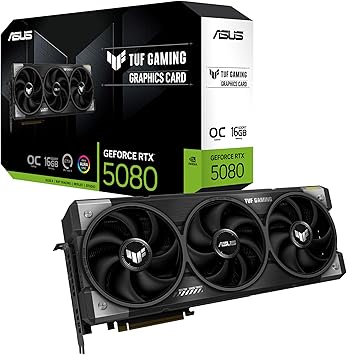
ASUS TUF Gaming GeForce RTX 5080 16GB GDDR7 OC Edition
Pros
- 187 FPS avg at 1440p Ultra
- 17.5% faster at 4K than 5070 Ti
- Only $130 more than the ROG Strix 5070 Ti right now
Cons
- 360W TDP, may need a PSU upgrade
- Smaller gains if you run DLSS 4 aggressively
- Pricier baseline than 5070 Ti Founders Edition
Price as of Sep 15, 2026 — see current price on Amazon.
The Performance Gap, Translated
Here's how it actually breaks down across common use cases.
Competitive multiplayer at 1440p high-refresh: Both cards destroy it. Running a 240Hz monitor? Either GPU can feed it. You're spending more for headroom you'll never touch in CS2 or Valorant. Get the 5070 Ti.
AAA singleplayer at 1440p max settings: Both are excellent. The 5080 gives you more comfortable headroom in the most demanding titles. But realistically, you're well above 120 FPS in either case, which is where diminishing returns kick in for most people.
Native 4K, no upscaling: This is the 5080's lane. The 14-18 FPS advantage at 4K is the largest in absolute terms. If you bought a 4K 144Hz display and want to use it natively at max settings in modern titles, the 5080 earns its premium here. The 5070 Ti is capable but runs closer to the edge in the most demanding scenes.
4K with DLSS 4 Quality: Both cards comfortably exceed 90 FPS. At this point the performance difference between them is far smaller than the price difference. The 5070 Ti wins this calculation.
Video and 3D rendering: Both use 16GB GDDR7 on a 256-bit bus, so VRAM-bound workloads are even. The 5080's extra CUDA cores will finish rendering jobs faster, but by a margin similar to the gaming gap. If you're rendering frames for a living and time is money, the 5080 makes sense. For occasional creative work, it probably doesn't.
The Price Trap (And How to Avoid It)
The "5070 Ti vs 5080" framing usually assumes you're comparing Founders Edition to Founders Edition: $979 vs $1,249, a $270 gap. At that comparison, the 5070 Ti wins cleanly unless you specifically need 4K native performance.
But that's not how most people actually shop. By the time you're considering an AIB premium card, a ROG Strix 5070 Ti ($1,649.97) can cost more than a TUF Gaming 5080 ($1,779.99). The gap is $130 instead of $270. And an ROG Astral 5080 costs substantially more than either.
The honest advice: compare the same AIB tier. If you want ROG Strix, compare ROG Strix to ROG Strix. If you want TUF, compare TUF to TUF. Mixing tiers gives you a misleading picture of the real trade-off.
At equivalent AIB tiers, the 5080 costs about $250-$350 more. At that gap, the 15-17% performance improvement is something you're paying a fairly steep premium for. But at a cross-tier comparison like ROG Strix 5070 Ti to TUF 5080, the $130 gap makes the 5080 look like a clear win.
Which GPU Should You Buy?
Buy the RTX 5070 Ti if:
- You game primarily at 1440p
- Your PSU is 750W or you'd rather not upgrade it
- You're happy using DLSS 4 for 4K sessions
- You want the better price-to-performance at the $979-$1,300 price range
Buy the RTX 5080 if:
- You game at native 4K and want max frame rates without leaning on upscaling
- You're comparing cross-AIB-tier and the gap is $200 or less
- You create content and will actually use the faster rendering speeds
- You're building a new system and the PSU is a fresh purchase anyway
Don't buy either right now if:
- Your current GPU is an RTX 4070 Super or RX 7800 XT and you mostly play at 1080p. The performance jump is real, but you won't feel it where you're playing.
- NAND pricing is keeping your SSD budget tight. A GPU upgrade on an older storage setup is unbalanced money.
Frequently asked questions
- Is the RTX 5080 worth the extra money over the RTX 5070 Ti?
- At Founders Edition pricing ($979 vs $1,249), the 5080 is worth it if you play native 4K seriously. For 1440p gaming, the 5070 Ti delivers better value. At premium AIB pricing where the gap shrinks to $130-$200, the 5080 becomes much harder to pass up.
- Can the RTX 5070 Ti run games at 4K?
- Yes, but with caveats. You're looking at 97 FPS average at 4K Ultra across a mixed game slate. Demanding titles like Cyberpunk 2077 at native 4K full path tracing land around 55-65 FPS. With DLSS 4 Quality enabled, both cards comfortably clear 90 FPS at 4K.
- What PSU do I need for the RTX 5070 Ti vs RTX 5080?
- The RTX 5070 Ti has a 300W TDP and Nvidia recommends a 750W PSU. The RTX 5080 draws 360W and needs at least 850W. If you're on a 750W PSU, the 5070 Ti is a cleaner fit. The extra 60W the 5080 draws isn't huge, but combined with a modern CPU, it's worth having the headroom.
- Do both cards support DLSS 4 and Multi Frame Generation?
- Yes. Both the RTX 5070 Ti and RTX 5080 are Blackwell architecture cards with full DLSS 4 support including Multi Frame Generation. DLSS 4 narrows the practical performance gap at 4K considerably.
- Is the RTX 5070 Ti better than the RTX 4090 at 1440p?
- In most modern titles, yes, the RTX 5070 Ti matches or beats the 4090 at 1440p, especially with DLSS 4 enabled. At 4K native, the 4090 still has more compute headroom, but the 5070 Ti is close and runs cooler and quieter.
- Which card is better for video editing in 2026?
- Both cards have identical VRAM (16GB GDDR7) and the same memory bandwidth, so VRAM-limited projects are a wash. The RTX 5080's ~15% extra shader performance does speed up rendering and export times. If you render commercially, that adds up. For occasional creative work, the 5070 Ti is more than capable.
Bottom Line
The RTX 5070 Ti is the right call for most people building or upgrading in 2026. At 1440p it has no ceiling, the 300W TDP is manageable, and the price delta between it and the 5080 is only "worth it" if you're serious about native 4K gaming.
That said, the 5080 is closer in price than it looks at first glance once you're comparing equivalent AIB tiers. If the cards you're actually looking at are within $150 of each other, the 17.5% 4K advantage is a real argument for stepping up. Just make sure your PSU is ready for 360W.
For content creators, the call is closer. The 5080's faster rendering is genuinely useful if you're paid for the time. For gaming only, the 5070 Ti is the smarter buy.
How We Test
We score products by combining spec-level research, pricing history, trusted third-party benchmarks, and owner sentiment from high-signal sources.
- Performance and real-world value in the category this guide targets
- Price-to-performance and deal consistency over recent pricing windows
- Build quality, reliability patterns, and known long-term issues
- Recommendation refresh cadence to keep these picks current
Author
TheTechSearch Editorial Team
Independent product reviewers & PC builders
We test and compare real-world specs, price trends, and user feedback to recommend gear that actually makes sense to buy.