Should I Build My Own Gaming PC or Buy a Prebuilt in 2026?
Honest 2026 breakdown of prebuilt vs DIY gaming PCs: the math, the tradeoffs, and when each makes sense for your budget. Expert picks, pros and cons, and sid...
As an Amazon Associate we earn from qualifying purchases made through our links — this doesn't affect our picks.

Skytech Blaze4 Mini Gaming PC
Our top recommendation for this category
Price as of Sep 1, 2026 — see current price on Amazon.
Here's the honest answer nobody wants to give you: it depends. But the calculus shifted in 2026 more than it has in years, thanks to RTX 5060 Ti prebuilts landing close to component prices. If you asked me this question in 2021, I'd have said build without hesitation. Now I actually have to think about it.
The short version: buy prebuilt if you want something working by this weekend and don't care about learning. Build your own if you want the best parts for the money, plan to upgrade over time, or just enjoy the process. Neither answer is wrong.
| Factor | DIY Build | Prebuilt |
|---|---|---|
| Typical cost for RTX 5060 Ti build | $850-1,050 in parts | $849-999 complete |
| Time to first boot | 4-8 hours | Same day unboxing |
| Warranty coverage | Per-part (6+ warranties) | 1-2 year system warranty |
| Upgrade flexibility | Full control | Limited by case/PSU |
| Risk if something breaks | You troubleshoot | Manufacturer handles it |
| Learning what you get | Total transparency | Sometimes vague spec sheets |
The 2026 Price Reality
Three years ago, a DIY RTX 3060 Ti build cost $150-200 less than the equivalent prebuilt. The GPU shortage meant prebuilt makers had allocation, and you didn't. That world is gone.
Right now, a Skytech Blaze4 Mini with an RTX 5060 Ti and Ryzen 5 8400F runs around $849. If you priced out the same chip, motherboard, RAM, SSD, case, PSU, and Windows 11 license separately, you'd land somewhere between $880-$1,050 depending on brand choices. The labor is free when you do it yourself, but so is Skytech's warranty on the prebuilt.
The gap has narrowed to the point where the decision isn't really about money anymore. It's about what you want from the experience.
When to Buy a Prebuilt (My Honest Take)
Look, there's no shame in buying prebuilt, even for people who have built plenty of PCs. Here's when it makes actual sense.
Speed is the real constraint. School starts in two weeks? Just moved and need a desk setup before next weekend? A first-time DIY build takes a full Saturday minimum, closer to two days if you run into BIOS issues or a DOA component. Prebuilt ships Wednesday and works Thursday. That's a real argument.
You don't want to become a hobbyist. AMD vs Intel socket compatibility, DDR5 vs DDR4, PCIe slot clearance for large GPU coolers, case airflow around AIO mounts. This is all learnable, but it takes hours of research before you even buy anything. If you just want to play games and not learn PC architecture, prebuilt is the right call.
One warranty contact matters to you. When a DIY build goes wrong, you're the IT department. A bad RAM stick? Return to Corsair. Faulty GPU? RMA to ASUS. Bad motherboard? Gigabyte's process. Each has different timelines. Some people are fine with that. Others find it genuinely miserable. Prebuilt gives you one number to call.
Under $600, prebuilts often win outright. Skytech and CyberPowerPC buy components in volume at prices you can't match retail.
When to Build Your Own
This is where I'll push back a little, because the "just buy prebuilt" wave has overshot.
You have specific taste in parts. A particular case for your desk aesthetic, an AIO cooler that runs quietly, RGB that actually matches your setup. None of that is possible with a stock prebuilt. And honestly, the case matters more than most people admit. You'll look at it every day.
Long-term upgrades are part of the plan. Prebuilts often ship with 650W PSUs and compact cases that won't take next-gen GPUs. If you're planning to buy an RTX 5060 Ti now and drop in an RTX 6070 in two years, you need control over the platform. A Skytech Mini doesn't give you that.
You're at the $1,200+ tier. This is where DIY really pulls ahead again. A $1,500 prebuilt often has the same GPU as a $1,100 parts build. The markup scales up faster than the components do. If your budget is four digits, build.
And honestly, if this stuff interests you, build. Watching the POST screen come up the first time after you assembled every piece yourself is a specific kind of satisfaction. If that sounds exciting rather than stressful, you're the target audience for DIY.
The Best Prebuilts Right Now
If you've read this far and decided prebuilt is the move, here's where to look in 2026. I'm specifically recommending machines with RTX 5060 or RTX 5060 Ti, the current-gen chips that will stay relevant the longest.
Skytech Blaze4 Mini Gaming PC
Pros
- RTX 5060 Ti 8GB is genuinely good for 1440p gaming
- Compact Mini form factor saves desk space
- 16GB DDR5 6000MHz is the sweet spot for Ryzen
- Windows 11 included, ready to boot
Cons
- Only 1TB storage, so you'll add a second drive eventually
- Ryzen 5 8400F has no iGPU (matters if GPU fails)
- Case upgrades are limited with compact design
Price as of Sep 1, 2026 — see current price on Amazon.
The Blaze4 Mini keeps showing up on deal trackers for good reason. Ryzen 5 8400F is a six-core chip that doesn't bottleneck the RTX 5060 Ti in any modern game. The compact Mini form factor is genuinely useful if desk space is tight. I'd buy a 2TB external drive on day one, but the core build is solid.

CyberPowerPC Gamer Xtreme VR Gaming PC
Pros
- Intel Core Ultra 5 225F is a step up in multi-threaded performance
- 2TB NVMe SSD included, enough room for a large game library
- RTX 5060 Ti 8GB handles 1440p at high settings
- WiFi ready out of the box
Cons
- 16GB DDR5 is fine now but 32GB would be ideal for 2027+
- CyberPowerPC's cable management inside can be rough
- No aftermarket AIO, stock cooling is adequate but not quiet under load
Price as of Sep 1, 2026 — see current price on Amazon.
The extra $50 over the Skytech gets you the Intel Core Ultra 5 225F and double the storage. If you're streaming while gaming, the extra cores matter. CyberPowerPC's warranty service has improved considerably over the last two years. This is the one I'd actually put in a living room setup.
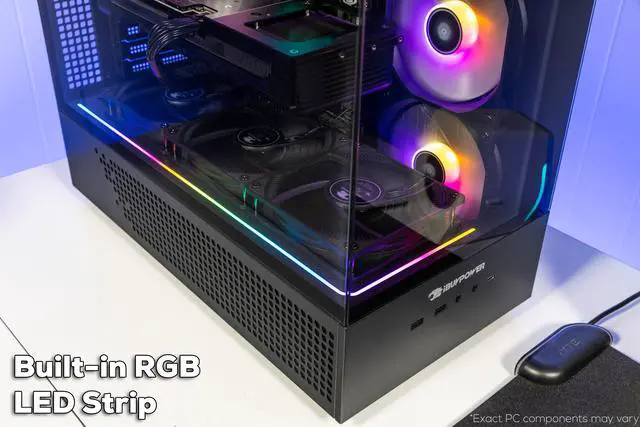
iBUYPOWER Slate Gaming PC Desktop
Pros
- Intel Core Ultra 7 265F is a serious multi-threaded CPU
- 32GB DDR5 is future-proof and handles creative apps too
- RTX 5060 8GB is still very capable for 1080p and 1440p gaming
- iBUYPOWER's build quality is notably better than budget prebuilts
Cons
- RTX 5060 (not Ti) means you're paying more for CPU/RAM upgrade, not GPU
- At $1,099 you could DIY an RTX 5060 Ti build for similar money
- 1TB NVMe will need expanding for a large game library
Price as of Sep 1, 2026 — see current price on Amazon.
This one's harder to recommend at face value. The CPU and RAM are great, but you're paying $1,099 for an RTX 5060 (non-Ti). If you specifically need the Core Ultra 7 and 32GB of DDR5 for video editing or streaming in addition to gaming, it makes sense. Pure gaming? The $899 CyberPowerPC gets you the same GPU tier and saves $200.
What the DIY Math Actually Looks Like
Here's a realistic parts list for a comparable RTX 5060 Ti build right now, using current prices from Newegg and Micro Center:
- GPU: RTX 5060 Ti 8GB: $389-419
- CPU: Ryzen 5 9600X or Core i5-14600K: $189-229
- Motherboard: B650 or B760: $129-159
- RAM: 16GB DDR5-5600: $55-70
- SSD: 1TB NVMe Gen4: $79-99
- Case: Mid-tower ATX: $79-99
- PSU: 750W 80+ Gold: $79-99
- Windows 11 Home: $119-139
That's $1,118-$1,313 with quality parts. More expensive than the $849 Skytech. That's not what the "always build" crowd wants to hear, but it's the current reality.
The DIY math improves if you already own some parts: old PSU that still works, spare SSD, a Windows license from a previous machine. Black Friday GPU deals also change the equation fast. And above $1,500, the gap reverses and building wins cleanly.
Buying Guide: What to Look for in a Prebuilt
Check the GPU Generation First
RTX 5060 / RTX 5060 Ti prebuilts are what you want in 2026. Anything with an RTX 4060 or older is last-generation stock being cleared out. That's not necessarily bad at a discount, but don't pay a premium for it.
Verify the PSU Wattage
Many budget prebuilts ship with a 650W PSU. That's fine for an RTX 5060 Ti, but it's the ceiling, so you won't be able to drop in an RTX 5070 Ti in a few years without replacing it. Look for 750W or 850W if future upgrades matter to you.
Confirm RAM Speed
DDR5 speed matters more on AMD Ryzen builds than Intel. If you see a Ryzen prebuilt with 16GB DDR5-4800, that's underclocked for the platform. Aim for DDR5-5600 or higher for Ryzen, DDR5-5200 minimum for Intel.
Read the Storage Fine Print
Some prebuilts advertise "1TB storage" but one SSD slot is used and a second slot is empty. Others ship with both PCIe 4.0 and PCIe 3.0 M.2 slots, and the faster one is already occupied. Check before you buy if you plan to add storage later.
Cooling Matters More Than It Used to
RTX 5060 Ti and Core Ultra chips run hotter than their predecessors under sustained load. Prebuilts that cut corners on cooling will thermal throttle during long gaming sessions. Look for 240mm AIO or a dual-tower air cooler on mid-range builds.
Frequently asked questions
- Is it still cheaper to build your own PC in 2026?
- Barely, and only if you shop carefully. An RTX 5060 Ti DIY build totals $1,100-$1,300 in parts for a complete system. You can buy a Skytech prebuilt with the same GPU for $849. The savings from DIY have mostly evaporated at the mid-range. The DIY advantage returns at $1,500+ where prebuilt markups grow faster.
- Are prebuilt gaming PCs any good now?
- Much better than five years ago. Brands like Skytech, CyberPowerPC, and iBUYPOWER have improved build quality and warranty service significantly. The main remaining concern is cable management and premium PSU brands, but the core components are legitimate. Just verify GPU generation and RAM speed before buying.
- Can I upgrade a prebuilt gaming PC later?
- Most mid-tower prebuilts can be upgraded, but it depends on the case size and PSU. The Skytech Blaze4 Mini's compact form limits future GPU options. A standard mid-tower CyberPowerPC or iBUYPOWER has more room to grow. Always check the case dimensions and PSU wattage before assuming you can drop in next-gen parts.
- How long does it take to build a gaming PC from scratch?
- Your first build realistically takes 5-8 hours including cable management, BIOS setup, and OS installation. Experienced builders do it in 2-3 hours. Budget a full Saturday if it's your first time, and watch a current-year build guide for your specific case before you start.
- What GPU should I look for in a prebuilt in 2026?
- RTX 5060 or RTX 5060 Ti for the mid-range. The RTX 5060 Ti 8GB handles 1440p gaming well and includes DLSS 4 Multi Frame Generation support. Avoid prebuilts with RTX 4060 or older unless the price is significantly discounted. You're getting last-gen parts at a time when RTX 5060 prebuilts are available in the same price range.
- What's the main risk of building your own PC?
- Compatibility mistakes and DOA components. Not every M.2 slot supports PCIe 5.0. Not every motherboard has the memory clearance for a tall air cooler. And occasionally a component arrives dead: processors rarely, GPUs sometimes, motherboards occasionally. Each DOA component means a return and wait. Budget an extra week of patience for a first build.
Bottom Line
In 2026, prebuilt gaming PCs have genuinely closed the gap. If you want a machine that works out of the box, the Skytech Blaze4 Mini at $849 or the CyberPowerPC Gamer Xtreme at $899 are real options, not compromises. Building your own still wins on customization, long-term upgradeability, and the satisfaction of knowing exactly what's inside every slot. But "building is always cheaper" isn't true anymore at the mid-range. Make the choice that fits how you actually want to spend your time.
How We Pick
We pick products by combining spec-level research, price checks, trusted third-party benchmarks, and owner sentiment from high-signal sources.
- Performance and real-world value in the category this guide targets
- Price-to-performance and deal consistency over recent pricing windows
- Build quality, reliability patterns, and known long-term issues
- Recommendation refresh cadence to keep these picks current
Author
TheTechSearch Editorial Team
Independent product reviewers & PC builders
We compare real-world specs, reviews and owner reports, price trends, and user feedback to recommend gear that actually makes sense to buy.