Are Bone Conduction Headphones Worth It in 2026?
Who bone conduction headphones are really for, where they fall short on sound, and which Shokz and Suunto models are worth buying from $69 to $229.95.
As an Amazon Associate we earn from qualifying purchases made through our links — this doesn't affect our picks.

Shokz OpenRun Pro 2 (Blue)
Our top recommendation for this category
Price as of Sep 28, 2026 — see current price on Amazon.
Yes, if you run, ride or walk near traffic and want to hear it. No, if you mostly listen at a desk, on a plane or on a loud train, and you care about bass.
That's the short version. Bone conduction headphones are brilliant at one job: playing music while leaving your ears completely open. They are mediocre at almost everything else a pair of earbuds does. So the real question isn't whether they're good. It's whether your listening happens in the one place they win.
The Short Answer
| Your situation | Verdict | |---|---| | Road running or cycling where you need to hear cars | Worth it. This is the whole reason they exist. | | Earbuds hurt, itch or fall out of your ears | Worth it. Nothing sits in the canal. | | Lap swimming with your own music | Worth it, but only a model with onboard MP3 storage. | | Office calls where you still want to hear coworkers | Worth it, with a caveat about sound leaking out. | | Commuting on a subway, bus or plane | Skip them. You can't hear quiet passages over the noise. | | You want deep bass and detail for critical listening | Skip them. Get proper headphones instead. |
How Bone Conduction Actually Works
Normal headphones push air into your ear canal. The eardrum vibrates, passes that to three tiny bones in the middle ear, and the cochlea turns it into signal.
Bone conduction skips the first step. Two small transducers rest on your cheekbones, just in front of the ears, and vibrate. Those vibrations travel through the skull straight to the cochlea. Your ear canal stays open the whole time, so traffic, a coach shouting splits or a coworker saying your name all come through normally.
It isn't new, either. Audiologists have used bone conduction for decades in hearing tests and in bone-anchored hearing systems for people with conductive hearing loss. The consumer headband version is just that principle made small and wireless.
One thing it is not: a hearing protection device. Sound still reaches your cochlea, which is the part that gets damaged by loud volumes. Skipping the eardrum doesn't make 90 decibels safe.
When They're Worth It
You exercise outdoors near traffic. This is the killer use. A pair of sealed earbuds with good passive isolation can make a car approaching from behind nearly silent. With bone conduction, your ears are doing their normal job. Race rules on headphones vary a lot, so check before you pin on a bib, but an open ear is the easiest version to justify.
Some places care about this legally, too. California's vehicle code, for example, bars cyclists from wearing a headset or earplugs over both ears. A headband that sits on the cheekbones and leaves both ears uncovered is a different thing. Rules vary by state and city, so look up your own.
Earbuds don't fit you. Some people just have ear canals that reject every tip size. Others get irritation or infections from something sitting in the canal for hours. A bone conduction headband touches your head in two small spots and nothing else. That's a genuine quality-of-life fix, not a gimmick.
You swim laps. Bluetooth dies about an inch underwater, so swimming headphones need their own storage. The OpenSwim Pro below has 32GB for MP3 files and switches to Bluetooth when you're back on land. For pool swimmers who have been counting tiles in silence for years, this is the one category where nothing else really competes.
You need to stay reachable. Parents listening for a baby monitor, warehouse workers who need to hear forklifts, cyclists who want to talk to a riding buddy. Open ears matter in more places than a running trail.
When They're Not
The sound is thinner, and that's physics. Low frequencies need a lot of moving air, and a small transducer vibrating against bone can't fake that very well. Shokz's newer DualPitch design on the OpenRun Pro 2 adds a small air-conduction driver specifically to fill in the bass. It helps a lot. It still won't sound like a sealed pair of $150 earbuds.
Noise ruins them. Because nothing blocks the outside world, a bus engine or airplane cabin simply buries your music. Turning it up only makes the next problem worse.
They leak. At high volume, people near you can hear what you're playing. In a quiet office at a normal level, it's mostly fine. In a quiet library at 80% volume, everyone knows your podcast.
Some people feel the buzz. On heavy bass notes, older models especially produce a tickle on the cheekbones. It's worst at high volume. Newer models vibrate far less, but a small number of people never get used to it.
Bone Conduction vs Open-Ear Earbuds vs Transparency Mode
Bone conduction isn't the only way to keep your ears open anymore. Two alternatives are worth knowing about before you buy.
Open-ear air conduction. Models like Shokz's own OpenFit line hook over the ear and fire sound toward the canal from a small speaker. The bass is usually better than bone conduction, and there's no vibration at all. The trade-off is more sound leakage and a fit that can shift more during hard runs.
Earbuds with transparency mode. AirPods Pro and similar buds use microphones to pipe outside sound back in. They sound great. But transparency is processed audio, it can distort wind and sudden noises, and if the battery or firmware hiccups, you're sealed off. For road safety, a physically open ear is more reliable than a digital one.
If your priority is hearing cars, bone conduction still has the edge. If your priority is sound quality with some awareness, look at open-ear or transparency options instead.
What to Look For
Water rating. IP55 handles sweat and rain. IP67 survives a dunk. IP68 is for actual swimming, and only matters if you get in the pool.
Battery life. Most sports models land between 6 and 12 hours. That's plenty for a marathon but not for a full workday of calls, so check whether there's a fast-charge spec.
Charging port. USB-C is easier to live with than a proprietary magnetic cable you'll eventually lose. The OpenRun Pro 2 uses USB-C. The standard OpenRun uses a magnetic cable.
Mic quality. If you take calls on runs, dual mics with noise reduction make a real difference. Wind is the enemy here.
Band size. Several Shokz models come in a Mini size with a shorter band. If you have a smaller head, the standard band can flap against your neck.
The Bone Conduction Headphones Worth Buying
Prices below were checked on Amazon on 28 September 2026 and compared against each brand's own store.
| Model | Price | Battery | Water rating | Best for | |
|---|---|---|---|---|---|
| Shokz OpenRun Pro 2 (Blue) | $179.95 | 12 hours | IP55 | Best overall sound | Check Price |
| Shokz OpenRun | $129.95 | 8 hours | IP67 | Most runners | Check Price |
| Shokz OpenMove | $79.95 | 6 hours | IP55 | Trying the format cheaply | Check Price |
| Shokz OpenSwim Pro (Grey) | $229.95 | 9 hours Bluetooth, 6 hours MP3 | IP68 | Swimming | Check Price |
| Suunto Wing 2 (Black) | $179.00 | 12 hours plus powerbank | IP66 | Night runs and long days | Check Price |
| Suunto Sonic (Black) | $69.00 | 10 hours | IP55 | Best value right now | Check Price |
Shokz OpenRun Pro 2 (Blue)
Pros
- DualPitch adds an air-conduction driver for noticeably fuller bass
- Up to 12 hours of playback, 5-minute quick charge for about 2.5 hours
- USB-C charging instead of a proprietary cable
- Bluetooth 5.3 with multipoint and a companion EQ app
Cons
- IP55 only, so not for swimming
- The Amazon listing is a bundle with a reflective strip, which is nice but not something you'd pay extra for
Price as of Sep 28, 2026 — see current price on Amazon.
If you're buying one pair and you want it to still feel good in three years, this is it. The OpenRun Pro 2 is the first Shokz headset that doesn't ask you to accept thin sound as the price of open ears. The extra air-conduction driver handles low frequencies, which also means the bone conduction transducers don't have to buzz as hard. Less tickle, more bass.
It weighs about 30 grams, so you forget it's there after a mile. The card above links the blue version, which sells for the same $179.95 Shokz charges on its own store.
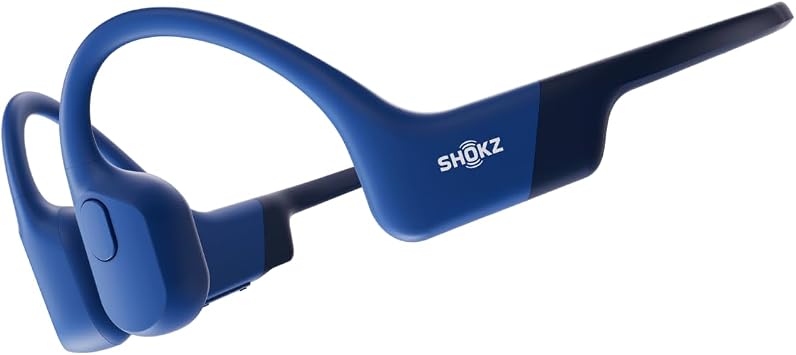
Shokz OpenRun
Pros
- IP67, so a downpour or a drop in a puddle is fine
- About 26 grams, one of the lightest in the category
- 8-hour battery with a 10-minute quick charge for 1.5 hours
- The long-running default pick for runners for a reason
Cons
- Magnetic charging cable, not USB-C
- Thinner bass than the Pro 2
Price as of Sep 28, 2026 — see current price on Amazon.
The OpenRun is the model most people picture when they hear "Shokz." It used to be called the Aeropex. It's lighter than the Pro 2, tougher against water, and $50 cheaper. What you give up is richness in the low end and a standard charging port. For road runners who mostly listen to podcasts, that's an easy trade.

Shokz OpenMove
Pros
- Cheapest way into the Shokz lineup at $79.95
- USB-C charging
- 29 grams with a titanium band
Cons
- Older 7th-gen transducers buzz more at high volume
- 6-hour battery is the shortest here
- IP55, fine for sweat but not submersion
Price as of Sep 28, 2026 — see current price on Amazon.
This is the "is this even for me?" pair. It uses an older generation of Shokz's bone conduction tech, so there's more vibration and less bass than the OpenRun. But if you're unsure you'll like the format at all, spending $80 to find out beats spending $180.
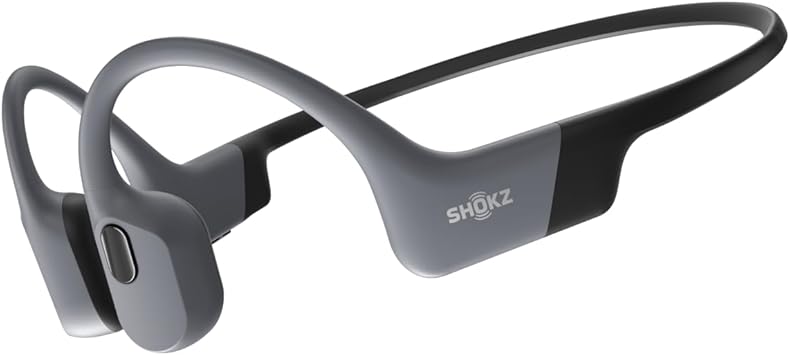
Shokz OpenSwim Pro (Grey)
Pros
- IP68, rated for 2 meters of water for 2 hours
- 32GB of onboard storage for MP3 files in the pool
- Bluetooth 5.4 on land, so it doubles as a running headset
- About 27 grams
Cons
- Most expensive pick here
- You have to load MP3 files yourself, since streaming apps won't work underwater
Price as of Sep 28, 2026 — see current price on Amazon.
Swimmers are the one group for whom bone conduction isn't just an option. It's basically the only option. Water carries vibration well, and with the included earplugs in, the sound actually gets louder and fuller because of the occlusion effect. The Pro version's big upgrade over the older OpenSwim is Bluetooth, so the same headset works for your run to the pool.

Suunto Wing 2 (Black)
Pros
- 12 hours of playback plus a charging powerbank in the box
- LED safety lights on the band for dawn and dusk runs
- Head-movement controls for skipping tracks without touching anything
- IP66 water and dust resistance
Cons
- About 35 grams, heavier than any Shokz here
- Bass is a step behind the OpenRun Pro 2
Price as of Sep 28, 2026 — see current price on Amazon.
Suunto's pitch is simple. Runners already buy its watches, and the Wing 2 is built for the same crowd. The LED lights are a real safety feature on dark roads. The powerbank that ships with it means ultra runners and long hikers can top up mid-effort. It sells for $179 on Amazon, the same price Suunto lists on its US store.

Suunto Sonic (Black)
Pros
- $69 on Amazon against a $129 list price at Suunto
- 10-hour battery, 5 minutes of charging for 90 minutes of play
- Multipoint Bluetooth and dual mics
- Titanium and silicone frame, about 30.6 grams
Cons
- IP55, so keep it out of the pool
- No LED lights or powerbank like the Wing 2
Price as of Sep 28, 2026 — see current price on Amazon.
At $69, the Sonic is the easiest recommendation here if you just want to try bone conduction without the entry-level compromises of the OpenMove. It beats the OpenMove on battery life, adds multipoint, and costs $11 less. That's only true while this price holds, though. At its $129 list price, the OpenRun is the better buy.
FAQ
Frequently asked questions
- Are bone conduction headphones bad for your hearing?
- Not more than regular headphones at the same volume. Sound still reaches the cochlea, which is what gets damaged by loud listening, so the usual advice applies: keep the volume moderate and take breaks. They don't protect your hearing, and they don't harm it any differently.
- Can other people hear my bone conduction headphones?
- At high volume, yes. The transducers leak some sound into the air. In a quiet room at around half volume, people next to you may hear a faint tinny sound. On a run or in a normal office, it's rarely noticeable.
- Do bone conduction headphones work if you are deaf in one ear?
- They can help some people with conductive hearing loss, because the vibration bypasses the outer and middle ear. They won't help with sensorineural loss in the cochlea. Anyone with hearing loss should ask an audiologist rather than rely on a consumer headset.
- Can you wear bone conduction headphones with glasses or a helmet?
- Usually, yes. The band sits behind the head and the hooks rest over the ears, alongside glasses arms. Most bike helmets fit over them. Very tight glasses frames can press on the hooks, so try both together if you can.
- Are bone conduction headphones good for the gym?
- They work, but a gym is where they are weakest. Loud music on the gym speakers competes with your own, and you don't need to hear traffic indoors. Earbuds or open-ear air conduction models usually make more sense there.
- What is the best cheap bone conduction headphone?
- Right now it's the Suunto Sonic at $69, which is well below its $129 list price and beats the $79.95 Shokz OpenMove on battery and features. If that price goes back up, the OpenMove is the cheapest decent option.
Bottom Line
Bone conduction headphones are worth it when hearing the world around you matters more than hearing every detail of the song. For road runners, cyclists, swimmers and people whose ears hate earbuds, they're one of the best purchases in audio. For commuters and anyone who listens critically, they're the wrong tool. If you're in the first group, get the Shokz OpenRun Pro 2. If you just want to try the idea, the Suunto Sonic at $69 is a low-risk way in. And if your workouts happen indoors, our guide to the best workout earbuds is a better place to start.
How We Test
We score products by combining spec-level research, pricing history, trusted third-party benchmarks, and owner sentiment from high-signal sources.
- Performance and real-world value in the category this guide targets
- Price-to-performance and deal consistency over recent pricing windows
- Build quality, reliability patterns, and known long-term issues
- Recommendation refresh cadence to keep these picks current
Author
TheTechSearch Editorial Team
Independent product reviewers & PC builders
We test and compare real-world specs, price trends, and user feedback to recommend gear that actually makes sense to buy.