Soundbar vs Bookshelf Speakers for a TV: Which One Actually Fits Your Room
Soundbar or stereo speakers for your TV? The answer is mostly decided by your sofa, your building and whether dialogue clarity matters more than music.
As an Amazon Associate we earn from qualifying purchases made through our links — this doesn't affect our picks.

Sonos Beam Gen 2
Our top recommendation for this category
Price as of Sep 20, 2026 — see current price on Amazon.
In this guide
- The Short Answer
- Why Dialogue Is the Real Dividing Line
- The Four Questions That Actually Decide It
- What Going Stereo Actually Costs You
- What Going Soundbar Actually Costs You
- The Picks
- Sonos Beam Gen 2
- Samsung HW-Q800F
- Edifier M90
- Klipsch The Fives II
- How to Choose Without Regretting It
- Bottom Line
- Related guides
Every soundbar brand publishes a page explaining why you want a soundbar. Every speaker brand publishes one explaining why you want speakers. Search the question and that's most of page one, plus a few forum threads where six people give six answers.
So here's the version nobody selling one box or two has an incentive to write.
The Short Answer
Get a soundbar if your seating is centred and fairly narrow, if a subwoofer would start an argument with a neighbour or a partner, or if the people you live with care how the room looks. Get a pair of powered speakers if your TV sits on a wide console with real estate on both sides. Music should matter to you roughly as much as television does. And you should want to upgrade one piece at a time, instead of replacing the lot every few years.
The dividing line is dialogue. Everything else is preference.
A soundbar has a physical centre channel pointed at your face. A stereo pair doesn't, and no amount of money fixes that. Which of those two facts matters more to you is the whole decision.
Why Dialogue Is the Real Dividing Line
Stereo puts voices in what engineers call a phantom centre. Both speakers play the same signal, your brain fuses them, and the actor appears to be speaking from the middle of the screen. It works, but it's an illusion with a measurable cost.
ITU-R BS.775-4, the multichannel layout standard updated in December 2022, places the left and right frontal loudspeakers "at the extremities of an arc subtending 60 degrees at the reference listening point." That's the familiar 30 degrees either side. At that geometry, the two arrivals at each ear are slightly offset in time, and they interfere.
Earl Vickers of STMicroelectronics, in his paper Fixing the Phantom Center, puts the lowest comb-filter notch "around 2 kHz for the standard speaker angles of plus or minus 30 degrees, and at higher frequencies for narrower angles." Two kilohertz is consonant territory. It's where the difference between "fifty" and "fifteen" lives.
And it shows up in testing. Shirley, Kendrick and Churchill, writing in the Journal of the Audio Engineering Society in 2007, 55(10), 852-863, found a small but statistically significant decrease in speech intelligibility when listeners used a phantom centre instead of a real centre speaker.
Small. Not catastrophic. But real, and it gets worse the moment you stop sitting exactly in the middle. Sit off to one side of a wide sofa and the phantom image slides toward the speaker you're closer to, taking the dialogue with it.
A soundbar simply doesn't have this problem, because it puts a driver in the middle and sends voices to it.
The Four Questions That Actually Decide It
Answer these honestly and the choice usually makes itself.
| Your situation | What it points to | | --- | --- | | Wide sofa, people sit at both ends | Soundbar, for the real centre channel | | One chair or a narrow two-seater, dead centre | Either works, stereo pulls ahead | | Apartment, thin floors, a sub would be trouble | Soundbar with the sub dialled down, or a sub-less stereo pair | | Music matters as much as film | Stereo speakers, comfortably | | You own a turntable | Stereo speakers, and look for a phono input | | Nobody else will tolerate visible boxes and cable | Soundbar | | You want to improve it gradually over years | Stereo speakers | | You want Dolby Atmos with height effects | Soundbar, and one with up-firing drivers |
The upgradability point is the one people underrate. As a long-running AVForums thread puts it, the issue with soundbars is that they're not upgradable. You buy the whole thing again. A stereo pair lets you add a subwoofer this year and better speakers in four years, keeping whatever still sounds good.
What Going Stereo Actually Costs You
Three things, and the first one surprises people.
Volume control. Most TVs have exactly one digital audio output, and on most sets the optical output is fixed level. The TV remote does nothing to it. Only the 3.5mm analogue output is reliably variable, and plenty of 2026 televisions no longer have one. HDMI ARC solves it, but only when CEC negotiates properly between your particular TV and your particular speakers. Edifier documents this explicitly for the M90: switch HDMI CEC on and the TV remote controls power, mute and volume. That's the feature to look for, and it's worth more than an extra 20 watts.
Dolby Atmos. A stereo pair won't reproduce height effects, and an AV receiver won't even engage Atmos without height speakers connected. If overhead sound is what you're after, this isn't the route.
The subwoofer you add later. This is the trap. Many active bookshelf speakers have no subwoofer output at all, and if your TV's audio out is fixed level you've got no clean way to add one afterwards. Check for a sub out before you buy.
What Going Soundbar Actually Costs You
Mostly the ceiling. A one-box system is as good as it will ever be on the day it arrives, and expanding it means buying into one brand's ecosystem at that brand's prices.
There's a connectivity catch too. The Sonos Beam Gen 2 has HDMI eARC and no HDMI input whatsoever, so every source has to route through the television. Samsung's own documentation warns that sources routed through a TV may output only 2-channel audio, which is a quietly important sentence if you were planning on Atmos from a console.
Worth knowing: eARC is what makes lossless formats possible over one cable. FlatpanelsHD pegs standard ARC at roughly 1 Mb/s against eARC's 37 Mb/s. HDMI.org itself publishes the supported formats but no bitrate figure, so credit those numbers to FlatpanelsHD.
The Picks
Four products, two per side of the argument. All four were verified live on Amazon with a buy box on 20 September 2026, and each is priced at or below its manufacturer list.
| Product | Type | Centre channel | Sub out or included | Price | |
|---|---|---|---|---|---|
| Sonos Beam Gen 2 | Compact soundbar | Yes, dedicated tweeter | Sub sold separately | $499.00 | Check Price |
| Samsung HW-Q800F | 5.1.2ch soundbar | Yes | Wireless sub included | $537.99 | Check Price |
| Edifier M90 | Powered stereo pair | No, phantom centre | Sub out | $299.99 | Check Price |
| Klipsch The Fives II | Powered stereo pair | No, phantom centre | Sub out | $1,399.99 | Check Price |
Sonos Beam Gen 2
Sonos Beam Gen 2
Pros
- Dedicated centre tweeter, so dialogue stays put
- Only 25.63 inches wide and 6.2 lb
- HDMI eARC, AirPlay 2, Ethernet and Wi-Fi
- Expands later with Sub Mini and Era 100 surrounds
Cons
- No upward-firing drivers, so Atmos height is virtual
- No HDMI input at all, everything routes through the TV
- Expansion is expensive, Sub Mini $429 and Era 100s $249 each
Price as of Sep 20, 2026 — see current price on Amazon.
The Beam is the small-room answer. Five class-D amplifiers drive one centre tweeter, four elliptical midwoofers and three passive radiators, and the centre tweeter is the entire reason it's here: voices come from a driver aimed at the sofa instead of an illusion floating between two boxes.
What Hi-Fi gave it five stars and called it the best Dolby Atmos soundbar in its size and price categories, which sounds like hyperbole until you notice how little competition there is at 25 inches wide.
Be clear-eyed about the Atmos, though. There are no up-firing drivers in this thing. Height is synthesised through psychoacoustic processing, and in a room with a normal ceiling it reads as a slightly taller soundstage rather than helicopters overhead. If genuine overhead effects are the goal, the Samsung below is the honest choice.
Samsung HW-Q800F
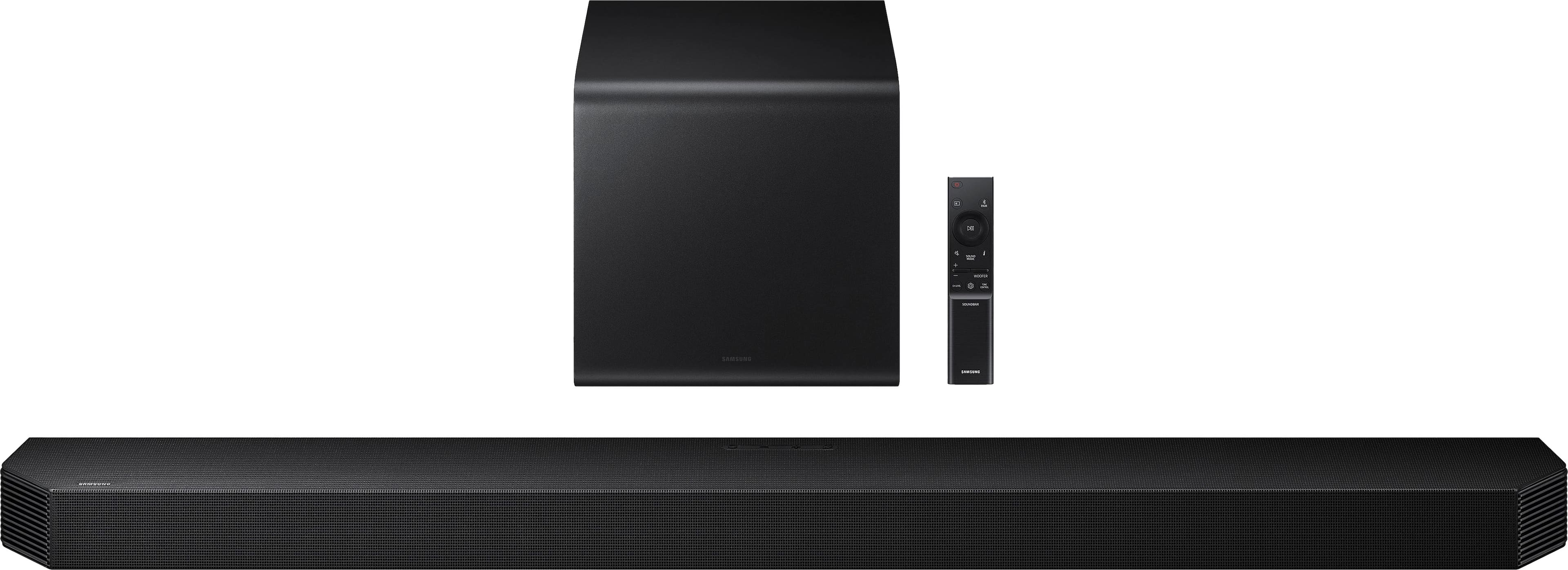
Samsung HW-Q800F
Pros
- True 5.1.2 channels across 11 drivers
- Wireless subwoofer included in the box
- An actual HDMI input plus HDMI out with eARC
- Q-Symphony pairs it with Samsung TV speakers
Cons
- HDMI passthrough is 4K/60 only, not 120Hz
- The 7.2 kg sub is a real object in a small flat
- Q-Symphony only pays off on a Samsung TV
Price as of Sep 20, 2026 — see current price on Amazon.
If you want the soundbar case made at full strength, this is it: 11 speakers in a 5.1.2 layout, height channels that physically fire upward, and a wireless subwoofer in the box instead of an upsell six months later.
It also has something the Sonos doesn't, namely an HDMI input, so a console or a player can feed the bar directly instead of being downmixed by the television.
One genuine caveat for gamers. TechRadar notes the HDMI passthrough tops out at 4K/60, not 120Hz, so a PS5 or Series X chasing 120fps needs to go straight to the TV and send audio back over eARC. That works fine. It's just worth knowing before you plan your cabling.
The $1,099.99 list price you'll see quoted is theoretical. Real street has been $550 to $600 for months, and $537.99 is a legitimately good number, and not a manufactured discount.
Edifier M90
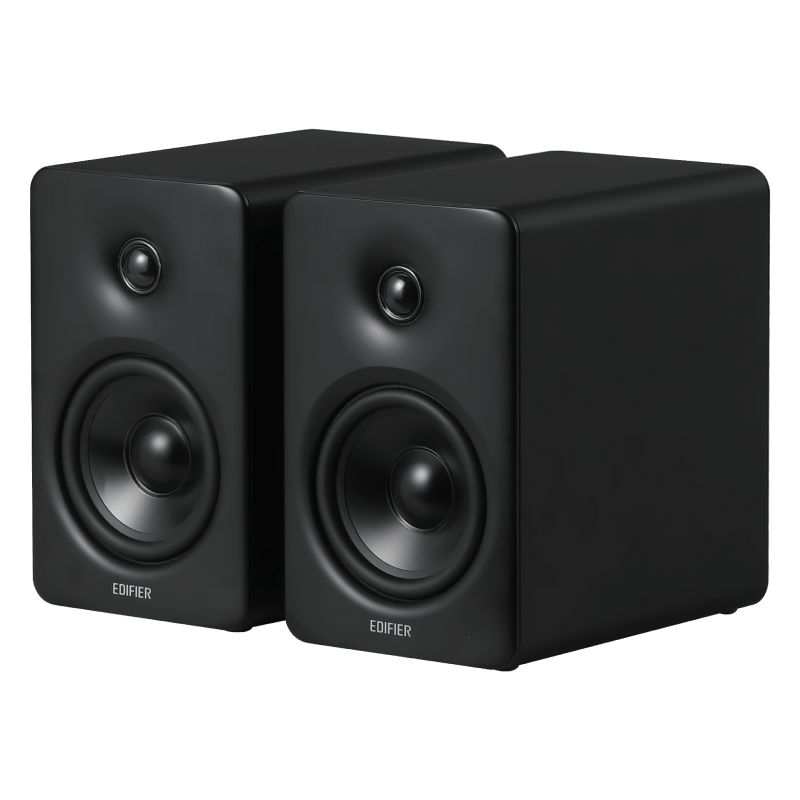
Edifier M90
Pros
- HDMI eARC with CEC, so the TV remote works
- Subwoofer output for adding low end later
- 100W RMS from 4 inch aluminium mid-bass drivers
- LDAC Bluetooth and USB-C for desk duty
Cons
- The HDMI eARC input is PCM stereo only
- Sub-bass rolls off around 50Hz without a sub
- No centre channel, so off-axis dialogue drifts
Price as of Sep 20, 2026 — see current price on Amazon.
This is the pair that makes the stereo argument affordable. Each speaker runs a 4 inch aluminium mid-bass driver and a 1 inch silk dome, 100W RMS total, split as 35W per side for mid-bass and 15W per side for treble.
The reason it belongs in a TV article at all is the HDMI eARC input with CEC. Turn CEC on and your TV remote handles power, mute and volume, which quietly removes the single most common objection to running speakers off a television.
Two honest limits. The eARC input takes PCM stereo only, so surround formats get downmixed by the TV before they arrive. And Prime Audio Reviews describes the sub-bass rolling off naturally around 50Hz, meaning explosions land with less weight than the Samsung's dedicated sub delivers. The SUB OUT is there for exactly that reason.
Klipsch The Fives II
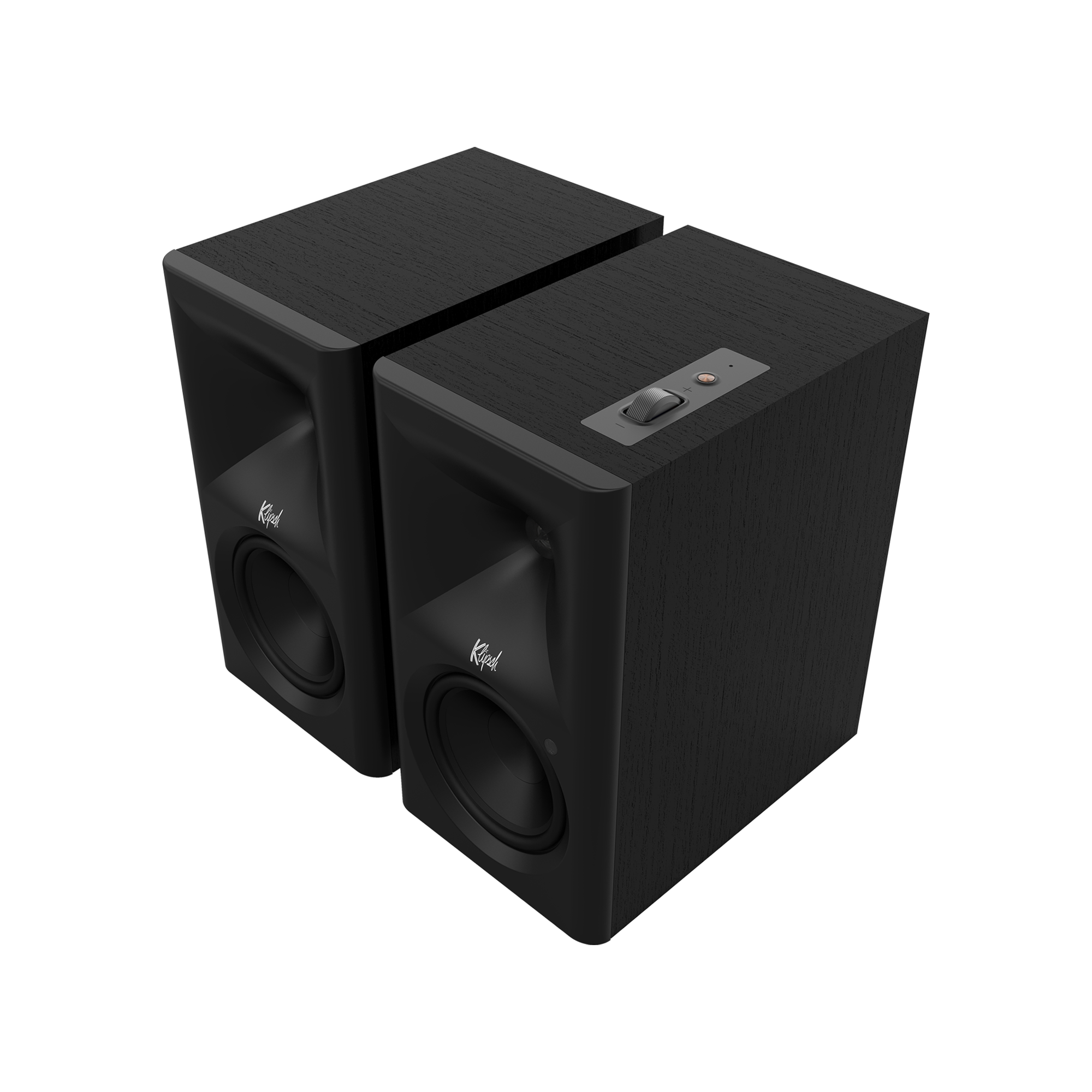
Klipsch The Fives II
Pros
- 50Hz to 25kHz plus or minus 3dB, 103 dB max output
- HDMI 2.1 passthrough with 8K, VRR and ALLM
- Built-in phono stage for a turntable
- Bluetooth 5.4, USB-C, optical and a sub out
Cons
- $1,399.99 is a serious jump over the Edifier
- Still a phantom centre, no centre channel
- 18.2 lb each, these need real furniture
Price as of Sep 20, 2026 — see current price on Amazon.
The Fives II is what you buy when the television is genuinely secondary to the music. A 1 inch titanium LTS tweeter on a Tractrix horn sits above a 5.25 inch Jet Cerametallic woofer, rated 50Hz to 25kHz within 3dB and 103 dB maximum output for the pair at one metre.
Connectivity is the real argument for it over the Edifier. HDMI 2.1 passthrough carries 8K, VRR and ALLM, so unlike the Samsung bar it won't get in a console's way, and the built-in phono stage means a turntable plugs in without a separate box.
A note on measurements, because they're easy to misattribute. Erin's Audio Corner's Klippel data covers the previous generation Fives. It measured on-axis linearity of minus 2.45 to plus 4.86 dB from 80Hz to 16kHz, with a treble rise of roughly 3dB between 2kHz and 12kHz. Output ran out of headroom somewhat above 86 dB at one metre. Derived figures on spinorama.org from that same dataset put the preference score at 5.52, rising to 7.89 once a subwoofer joins in. Treat all of that as background on how the family is voiced, never as a spec for this model. The subwoofer jump is the strongest argument here for using the sub out.
How to Choose Without Regretting It
Measure the console before you fall in love
Stereo needs width. If your TV stand can't give each speaker a spot roughly level with the screen edges, the phantom centre gets narrower, and per Vickers the comb-filter notch climbs higher into the vocal range. Narrow spacing is the worst case for stereo dialogue. A soundbar doesn't care.
Find out what your TV's audio output actually does
Before anything else, check whether your set has eARC, plain ARC, or only optical, and whether the optical output is fixed or variable. That single fact eliminates half the products you were considering. Fixed optical plus no eARC means a stereo pair will need its own remote forever.
Decide about the subwoofer now
Not later. If there's any chance you'll want one, buy something with a sub output on day one. All three of the non-Samsung picks here have one, which is not typical of the category.
Don't buy Atmos you can't place
Virtual height processing needs a reasonably flat, reasonably normal ceiling to bounce off. Vaulted ceiling, beams, or a bar tucked inside a cabinet, and you've paid for a feature the room won't let you hear.
Frequently asked questions
- Will my TV remote control the volume on bookshelf speakers?
- Only through HDMI ARC or eARC with CEC working, or through a variable 3.5mm analogue output. On most televisions the optical output runs at a fixed level and the TV remote does nothing to it, which is the single most common frustration people hit after wiring speakers to a TV. Powered speakers that advertise HDMI eARC with CEC, like the Edifier M90 and Klipsch The Fives II, are the reliable route.
- Can I connect speakers directly to my TV, and will it damage them?
- Powered speakers, yes, that's what they're designed for. Passive bookshelf speakers need an amplifier or receiver between them and the television, because a TV has no speaker-level output to drive them. Connecting powered speakers to a TV's line-level or digital output won't damage anything.
- Do I lose Dolby Atmos if I go with stereo speakers?
- Yes. Height effects need height channels, and a receiver won't even engage Atmos without them connected. A stereo pair will happily play an Atmos soundtrack, but it arrives downmixed. If overhead sound is the point of the exercise, a soundbar with genuine up-firing drivers such as the Samsung HW-Q800F is the shorter path.
- Is a soundbar good enough for music?
- Good ones are fine and bad ones are noticeably worse than a decent stereo pair at the same money. The structural problem is width: drivers a few inches apart can't produce a wide stereo image no matter how clever the processing. If you sit down to listen to albums, two separated speakers will beat a bar at a comparable price.
- What's the difference between ARC and eARC, and do I need it?
- eARC carries far more data, which is what allows uncompressed multichannel and lossless formats over a single HDMI cable. FlatpanelsHD puts standard ARC at roughly 1 Mb/s and eARC at about 37 Mb/s. You need eARC if you want Dolby TrueHD or lossless Atmos from the TV to the audio device. For compressed Dolby Digital, plain ARC is enough.
- Can I add a subwoofer to bookshelf speakers later?
- Only if the speakers have a subwoofer output, and a surprising number of powered bookshelf models don't. Where the TV's own audio output is fixed level, adding a sub afterwards gets awkward fast. Decide before you buy. The Edifier M90 and Klipsch The Fives II both have a sub out, and on the Klipsch family the measured preference score rises sharply once a sub is added.
Bottom Line
Stop thinking about it as a sound quality question, because at these prices both sides are fine. Think about your room.
A wide sofa with people at both ends wants a real centre channel, and that means a soundbar. The Samsung HW-Q800F at $537.99 is the complete version of that answer, sub included and height drivers that actually point up. The Sonos Beam Gen 2 at $499.00 is the one for a small room where 25 inches of width is all you've got.
One chair, or a narrow sofa, plus a record collection, and stereo is clearly better value. The Edifier M90 at $299.99 does it cheaply and keeps the TV remote working. The Klipsch The Fives II at $1,399.99 does it properly, with a phono stage and HDMI 2.1 passthrough that stays out of a console's way.
And if you're still stuck, use the dialogue test. If people in your house already turn on subtitles, buy the soundbar.
Related guides
As an Amazon Associate, we earn from qualifying purchases. This doesn't affect our recommendations or editorial independence.
How We Test
We score products by combining spec-level research, pricing history, trusted third-party benchmarks, and owner sentiment from high-signal sources.
- Performance and real-world value in the category this guide targets
- Price-to-performance and deal consistency over recent pricing windows
- Build quality, reliability patterns, and known long-term issues
- Recommendation refresh cadence to keep these picks current
Author
TheTechSearch Editorial Team
Independent product reviewers & PC builders
We test and compare real-world specs, price trends, and user feedback to recommend gear that actually makes sense to buy.