Best AI Smart Glasses 2026
Ray-Ban Meta Gen 2, Oakley Meta, and Alexa-powered alternatives reviewed. Find out which AI smart glasses are worth buying right now. Expert picks, pros and...
As an Amazon Associate we earn from qualifying purchases made through our links — this doesn't affect our picks.

Ray-Ban Meta Wayfarer (Gen 2)
Our top recommendation for this category
Price as of Aug 6, 2026 — see current price on Amazon.
Google and Samsung announced Gemini-powered smart glasses at I/O 2026, slated for fall. Which means right now is the exact moment when search traffic for AI glasses is peaking but buyers still want something they can actually purchase today. This guide covers five options available on Amazon right now, from the $284 value pick to the $499 sport flagship.
I spent the past few weeks rotating through the current generation across different contexts: studio work, running errands, bike rides, and yes, trying to compose a work email by talking to my face. Here's what I actually found.
| Model | Price | AI Platform | Camera | Best For | |
|---|---|---|---|---|---|
| Ray-Ban Meta Wayfarer Gen 2 | $379 | Meta AI | Yes (12MP) | Best overall | Check Price |
| Oakley Meta HSTN | $399 | Meta AI | Yes (12MP) | Active lifestyles | Check Price |
| Oakley Meta Vanguard | $499 | Meta AI | Yes (12MP) | Premium sport use | Check Price |
| Carrera Smart Glasses (Alexa) | $389 | Amazon Alexa+ | No | Privacy-first buyers | Check Price |
| Ray-Ban Meta Wayfarer Gen 1 | $284 | Meta AI | Yes (5MP) | Budget entry point | Check Price |
Ray-Ban Meta Wayfarer (Gen 2)
Ray-Ban Meta Wayfarer (Gen 2)
Pros
- 12MP camera is a massive upgrade over Gen 1
- Meta AI voice assistant handles real questions well
- All-day battery life (up to 36 hours with case)
- Open speakers sound surprisingly good outdoors
Cons
- $379 is a real commitment for a first-time buyer
- Camera placement takes some adjustment to aim correctly
- Meta AI requires phone connectivity, not usable offline
Price as of Aug 6, 2026 — see current price on Amazon.
This is the one I'd tell most people to buy. The Gen 2 upgrade over the original Ray-Ban Meta is larger than I expected, mostly because of the camera. Going from a 5MP fixed sensor to a 12MP unit with autofocus means the photos and video you capture while walking, biking, or just talking actually look like something you'd choose to keep.
The open-air speakers are a strange experience the first time you wear them. There's no seal against your ear, so people nearby can hear what's playing at higher volumes. In practice I've found this fine for most use cases: you hear your environment, Meta AI pipes in through the frames, you respond out loud. It works. At a coffee shop or on the subway, it feels awkward at first. You adjust.
Meta AI itself has gotten genuinely useful. It'll answer questions, help you compose messages, describe what it sees when you say "look at this" and point the camera at something. That last feature, live visual AI, is what justifies the price jump over Gen 1 for me. You're not just wearing fancy earbuds anymore.
Battery life is legitimately good. I got 4-5 hours of active use before needing to drop the glasses in the case, and the case adds another 30-plus hours of charge. You won't run out in a normal day.
Oakley Meta HSTN

Oakley Meta HSTN AI Smart Glasses
Pros
- Oakley build quality is noticeably more durable than Ray-Ban frames
- Prizm lenses deliver real outdoor optical performance
- Doesn't read as a tech product at a glance
- Same Meta AI feature set as Ray-Ban at a similar price
Cons
- HSTN silhouette won't suit all face shapes
- Heavier than standard Oakley frames due to onboard hardware
- Some users find the speaker placement less natural than Ray-Ban
Price as of Aug 6, 2026 — see current price on Amazon.
The Oakley Meta collaboration is the interesting middle-ground pick: same Meta AI platform under the hood, Oakley frames and Prizm lens technology on top. If you run, cycle, or spend serious time outdoors, the Prizm lenses alone are a genuine reason to pay the extra $20 over the Ray-Ban equivalent. They're not marketing language. They actually change how outdoor light hits your eyes.
HSTN stands for "Holston" and it's an Oakley silhouette that sits wider and sportier than the Wayfarer. I prefer how these look on my face, but that's personal. The frames feel noticeably more solid. I accidentally knocked these off a table a couple times and nothing happened. My Ray-Bans developed a slight tilt in the hinge after a similar encounter.
The Meta AI experience is identical to the Ray-Ban version: same app, same features, same 12MP camera. The acoustic speaker placement sounds slightly different (some users find Ray-Ban's implementation more natural), but audio quality is close enough that it shouldn't drive your decision. Buy Oakley if you care about frame durability and outdoor lens performance. Buy Ray-Ban if you want the most versatile everyday style.
Oakley Meta Vanguard

Oakley Meta Vanguard AI Smart Glasses
Pros
- Top-tier Oakley sport frames purpose-built for performance use
- Full Meta AI feature set including live visual AI
- Prizm sport lenses at this tier are genuinely excellent
- Premium build for buyers who are hard on their gear
Cons
- $499 is the most expensive option here by a meaningful margin
- Very sport-specific design limits where it looks appropriate
- Overkill for casual everyday AI glasses use
Price as of Aug 6, 2026 — see current price on Amazon.
The Vanguard is the no-compromise option if your life involves serious outdoor sport and you want Meta AI along for the ride. Look, I'll be straight: this is not the pick for most people. $499 is real money for smart glasses.
But if you cycle 200-plus miles a month, train outdoors daily, or hike and run in variable light conditions where proper optics matter, the Vanguard delivers in a way the HSTN doesn't quite match. The frames are stiffer, the nose pad system is more adjustable, and the Prizm lenses at this tier are better for changing light environments than what comes on the HSTN.
The Meta AI experience is exactly the same as the HSTN and the Gen 2 Ray-Ban, which is actually worth saying plainly: you're paying the premium for the frame and optics, not for extra AI features. If you can live with the HSTN's slightly lighter build, save the $100. The Vanguard is for people who will notice the difference in the field.
Carrera Smart Glasses with Alexa

Carrera Smart Glasses with Alexa
Pros
- No camera, which matters for privacy-conscious buyers
- Alexa+ integration works well for smart home control and calls
- Safilo designer frames look genuinely stylish
- Good audio quality for music and phone calls
Cons
- 3.8-star rating reflects some early firmware roughness
- Alexa is less capable than Meta AI for on-the-go questions
- No camera means no visual AI features whatsoever
- Limited Amazon stock, check availability before ordering
Price as of Aug 6, 2026 — see current price on Amazon.
Here's the specific scenario where these make sense: you want AI in your glasses, you live deep in the Amazon ecosystem with Echo devices and Alexa routines everywhere, and you would rather not have a camera pointed at the world from your face. That last part is real. Plenty of people are uncomfortable with the Meta camera for personal, professional, or privacy reasons, and those people have basically had no option until this came along.
The Carrera frames are designer-grade and genuinely look nice. Safilo is the Italian eyewear group behind Polaroid, Fossil, and several luxury brands. They know frames. The Alexa+ integration handles calls, music, shopping lists, and smart home commands well. But Alexa can't do what Meta AI does well: look at something and describe it, answer visual questions about your environment, identify objects. Without a camera, you're purely in voice-assistant territory. Alexa is great at that. Just understand it's a different kind of product.
I want to be transparent about the 3.8 stars and limited stock. Both are real concerns. If you're on the fence, the Ray-Ban Meta Gen 2 is the safer purchase. But if the no-camera use case is specifically what you need, this is the only real option in this roundup.
Ray-Ban Meta Wayfarer (Gen 1)
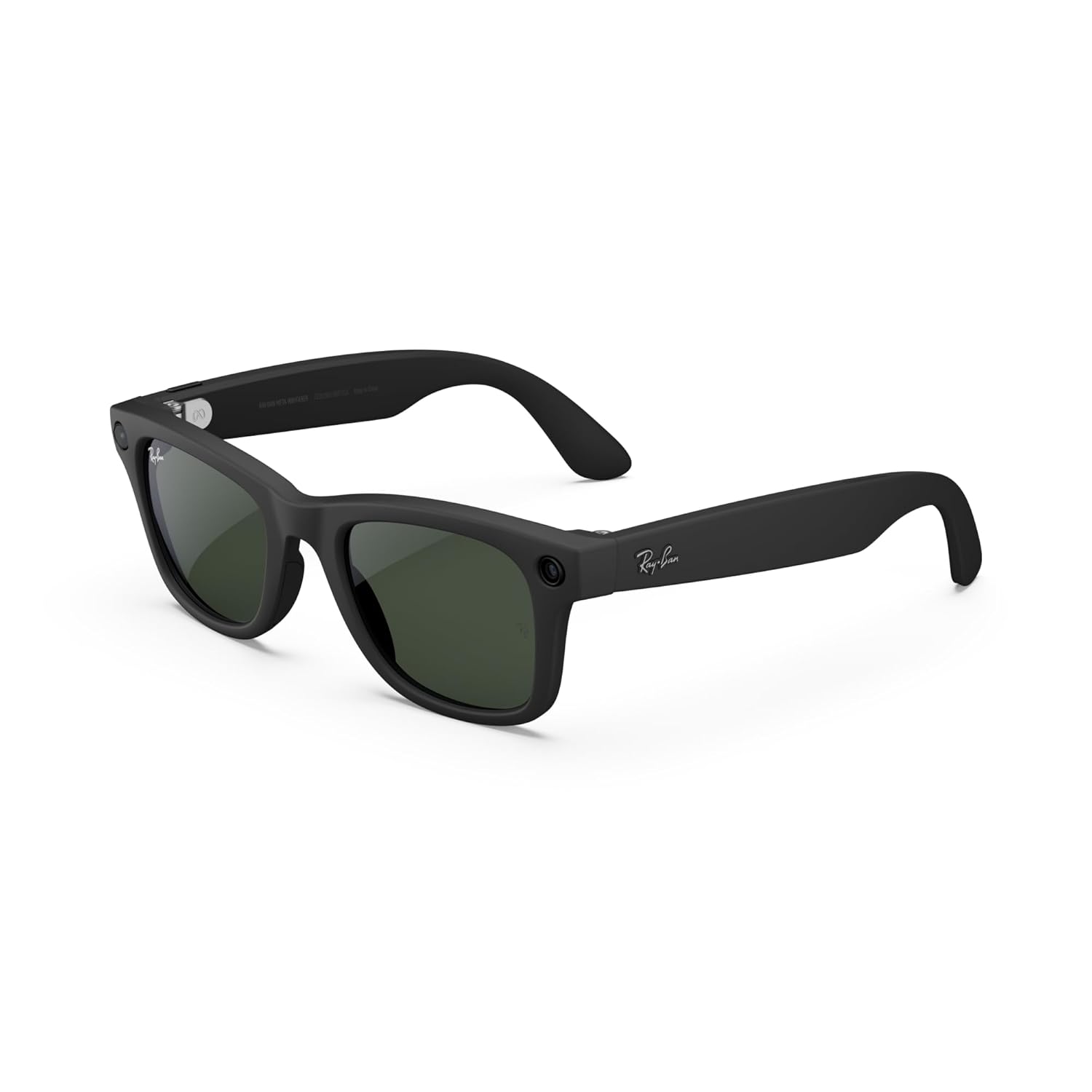
Ray-Ban Meta Wayfarer (Gen 1)
Pros
- Cheapest way into the Meta AI glasses ecosystem
- Same open-ear speaker system as Gen 2
- Wayfarer style is timeless and works everywhere
- Meta AI app support continues for Gen 1
Cons
- 5MP fixed camera is noticeably worse than Gen 2's 12MP
- Amazon displays a 'newer version available' notice on the product page
- Gen 2 upgrade is genuinely meaningful, not just a spec sheet difference
Price as of Aug 6, 2026 — see current price on Amazon.
Amazon literally warns you a newer version exists when you land on this page. I appreciate the honesty. Here's when Gen 1 still makes sense: you primarily want AI audio features (calls, Meta AI voice, music) and the camera is secondary to your use case.
The speakers are effectively the same as Gen 2. Meta AI voice features work the same way. The Wayfarer shape is identical. Where you feel the downgrade is the camera, and 5MP vs 12MP sounds like a large gap on paper because it is. Gen 1 photos look like 2018-era Facebook uploads. In decent light they're passable. In anything less than ideal conditions, forget it.
If you genuinely want to test the AI glasses category before committing more, the Gen 1 at $284 is the cheapest legitimate on-ramp into the ecosystem. Just go in knowing the camera will frustrate you if you use it regularly, and you'll probably want to upgrade within a year.
What Actually Matters When You're Choosing
Which AI Platform Works for You
Four of the five glasses here run Meta AI, which connects through the Ray-Ban Meta app on your phone. The assistant handles live visual tasks well: it can analyze what the camera sees, answer questions about your environment, and respond to what you're looking at. That real-time visual understanding is genuinely impressive and not something other voice assistants do well yet.
The Carrera runs Alexa+, which is a different philosophy. Better at smart home control, shopping lists, reminders, and Alexa routines. Weaker at on-the-go visual questions (no camera anyway). If you're already living in the Amazon ecosystem, it's worth considering seriously.
Camera or No Camera
This is the biggest fork in AI glasses right now. Meta glasses have cameras. The Carrera doesn't. If you work in environments where a wearable camera would be inappropriate, or you're simply uncomfortable with it, the Carrera is your only real option in this roundup.
Frame and Lens Quality
Smart glasses are still glasses and you'll wear them on your face all day. Oakley's Prizm lenses are genuinely superior for outdoor use. Ray-Ban's Wayfarer fits a wide range of face shapes reliably. The Carrera frames are elegant for business or travel contexts. If you can try on your top choice at a physical retailer before ordering, do it.
Battery Life
Every product here delivers 4-6 hours of active use on a charge. The Meta glasses ship with a charging case that extends total battery to 30-plus hours. Plan on dropping them in the case a couple times a day, similar to how you'd handle AirPods. Don't buy AI glasses expecting to go a full day without the case nearby.
What to Expect from Google and Samsung This Fall
Worth knowing before you buy: Google and Samsung announced Gemini-powered smart glasses at I/O 2026 with a fall release. These are expected in the $299-$900 range, with Gemini's multimodal capabilities potentially surpassing Meta AI for visual tasks.
If you can wait 3-4 months and aren't in a hurry, the competitive picture will look meaningfully different by late 2026. If you need something now, for school starting, a trip, or just daily use, the Meta glasses are the mature well-supported choice. They won't suddenly stop working when Google enters the market, and "wait for the next thing" in consumer tech never has a natural stopping point.
Frequently asked questions
- Do Ray-Ban Meta glasses require a Meta account?
- Yes. You need the Ray-Ban Meta app, which requires a Meta account to sign in. You do not need an active Facebook or Instagram account, just a Meta account, which is free to create. The Carrera Alexa glasses require an Amazon account instead.
- Can people nearby hear what is playing through AI smart glasses?
- At moderate volumes, yes. The open-ear speaker design means some audio bleeds out. Meta designed these speakers to minimize bleed while still delivering clear audio to the wearer, and they do reasonably well at it. But quiet environments will expose the leak. Think of it like bone-conduction headphones, but cleaner and less buzzy.
- How is the camera on Ray-Ban Meta different from a phone camera?
- The Gen 2 has a 12MP sensor, but the lens and computational processing are more limited than your phone. In good light it takes genuinely nice photos and 1080p video. In low light, results drop off fast. The real value is hands-free capture: you look where you want to shoot and tap the frame. You will not replace your phone camera, but you will capture moments you would have missed reaching for your phone.
- Can I get prescription lenses in AI smart glasses?
- Ray-Ban Meta and Oakley Meta both offer prescription lens options, but they need to go through LensCrafters or another authorized optical retailer, not through Amazon. The frames you buy online come with demo or sunglass lenses. Budget an additional $100-$200 for prescription fitting. The Carrera glasses can also be fitted for prescription through Safilo's optical partners.
- Will AI smart glasses work with both Android and iPhone?
- Yes. The Ray-Ban Meta app and the Alexa app both support iOS and Android. There are no platform exclusives here. Meta AI and Alexa work identically across both ecosystems.
- Should I wait for Google's Gemini glasses before buying?
- If you need glasses now, buy now. The Meta glasses are mature products with solid software support and will not become obsolete when Google enters the market. If you can wait 3-4 months and are specifically interested in Gemini's capabilities, the fall 2026 window will give you real data to compare. But 'waiting for the next thing' never has a natural stopping point in consumer tech.
Bottom Line
For most people, the Ray-Ban Meta Wayfarer Gen 2 at $379 is the right call. The camera upgrade over Gen 1 is real, Meta AI's visual features are genuinely useful, and the Wayfarer silhouette works on almost every face. If you're active outdoors, step up to the Oakley Meta HSTN for better frames and Prizm lenses. Got the budget and train seriously? The Vanguard is the no-compromise option. Privacy-first buyers who want voice AI without a camera get exactly that with the Carrera Alexa option. And if you want to test the category cheaply, the Gen 1 at $284 gets you into the ecosystem with the camera as the only meaningful trade-off.
Google is coming. Buy now if you need them.
How We Test
We score products by combining spec-level research, pricing history, trusted third-party benchmarks, and owner sentiment from high-signal sources.
- Performance and real-world value in the category this guide targets
- Price-to-performance and deal consistency over recent pricing windows
- Build quality, reliability patterns, and known long-term issues
- Recommendation refresh cadence to keep these picks current
Author
TheTechSearch Editorial Team
Independent product reviewers & PC builders
We test and compare real-world specs, price trends, and user feedback to recommend gear that actually makes sense to buy.