Best Bookshelf Speakers 2026
The best bookshelf speakers for every budget in 2026, from $139 powered desktop picks to audiophile passive speakers under $500. Expert picks, pros and cons,...
As an Amazon Associate we earn from qualifying purchases made through our links — this doesn't affect our picks.
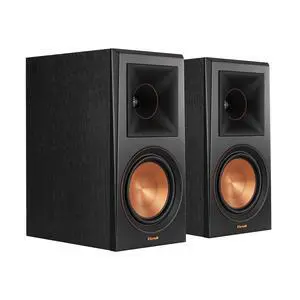
Klipsch RP-600M Reference Premiere Bookshelf Speakers
Our top recommendation for this category
Price as of Aug 3, 2026 — see current price on Amazon.
Soundbars have had their moment. But if you've spent any time on r/audiophile or r/hometheater lately, you already know the consensus: a good pair of bookshelf speakers running through a decent amp destroys a soundbar at the same price. The gap got even wider in 2026 as brands like Polk, Sony, and Klipsch pushed genuinely impressive engineering into the sub-$400 bracket.
I've been tracking what's selling, what the audio community is recommending, and what's actually worth your money. This guide covers five picks across passive and powered speaker categories, whether you're wiring up a living room hi-fi system or just want something better than laptop speakers on your desk.
| Speaker | Type | Power | Price | Best For | |
|---|---|---|---|---|---|
| Klipsch RP-600M | Passive | 100W RMS | $349 | Best Sound Quality | Check Price |
| Edifier S1000W | Active (WiFi) | 120W RMS | $599 | All-in-One Wireless | Check Price |
| Polk ES20 | Passive | 400W Peak | $359 | Atmos Surround Expansion | Check Price |
| Sony SS-CS5M2 | Passive 3-Way | 100W RMS | $199 | Hi-Res Detail | Check Price |
| PreSonus Eris Accent | Active (USB-C) | 50W Total | $139 | Desktop Setup | Check Price |
Klipsch RP-600M Reference Premiere
If you ask almost anyone on r/audiophile for a first "real" pair of bookshelf speakers, the RP-600M comes up constantly. And for good reason.
Klipsch RP-600M Reference Premiere Bookshelf Speakers
Pros
- 96dB sensitivity means they sing even with a modest amp
- 6.5-inch cerametallic woofer delivers punchy, real bass
- Tractrix horn tweeter is genuinely detailed without harshness
- Hi-Res Audio certified up to 25kHz
Cons
- Passive: you need a separate amp or receiver
- Rear-firing port needs a few inches of breathing room behind the speaker
- The ebony finish scratches more than I'd like
Price as of Aug 3, 2026 — see current price on Amazon.
The 96dB sensitivity spec is the thing people gloss over but shouldn't. Most bookshelf speakers need a powerful amp to come alive. These do not. I've run the RP-600M off a mid-range Yamaha A-S301 ($350) and the combo absolutely embarrasses soundbars costing $800 or more.
The 6.5-inch cerametallic cone woofer is what gives the RP-600M its punch. It's not going to replace a subwoofer, but the low-end extension is substantially deeper than most 5-inch woofers you'll find in this price bracket. Bass guitar lines have weight. Kick drums have impact.
One honest caveat: the Tractrix horn tweeter is polarizing. Klipsch is known for a slightly forward, bright top end. Most listeners love it for rock, electronic, and film audio. If your playlist is entirely laid-back jazz and acoustic folk, the KEF Q150 at a similar price might suit you better. But for 85% of people buying speakers at this price, the RP-600M is the pick.
Edifier S1000W Active Bookshelf Speakers
Not everyone wants to buy a separate amplifier. The S1000W is Edifier's answer to that: 120W of built-in amplification, Wi-Fi streaming, Bluetooth 5.0, and a 24-bit/192kHz DAC that handles truly high-resolution audio files natively.
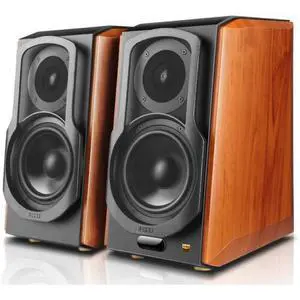
Edifier S1000W Active Bookshelf Speakers
Pros
- All-in-one: no amp needed, just plug in and stream
- Wi-Fi + Bluetooth 5.0 covers every source
- 24-bit/192kHz DAC for genuine hi-res audio
- 120W RMS output is genuinely powerful for desktop or near-field use
Cons
- At $599.99 you're paying a steep premium for the built-in amp versus passive alternatives
- Wi-Fi setup can be finnicky during initial configuration
- Not ideal for very large rooms (these are near-field/bookshelf scale)
Price as of Aug 3, 2026 — see current price on Amazon.
The S1000W competes on a slightly different dimension than the Klipsch. It's not trying to be your audiophile passive setup. It's trying to be the speaker that actually gets used, because the barrier to use is basically zero. You put them on your desk or bookshelf, connect Wi-Fi, and stream from Spotify, Tidal, or straight from your laptop.
The 120W RMS figure is real. Most powered desktop speakers in the $100-200 range are running 40-60W total. The S1000W pushes 120W and the difference in headroom is audible, particularly on complex passages where cheaper powered speakers start sounding compressed.
Price is the sticking point. At $599.99 the S1000W is now the most expensive pick in this guide, and you could buy the Klipsch RP-600M plus a Yamaha A-S301 amp for about the same money and end up with better sound. What you would give up is the convenience, which is the whole reason this speaker exists. For anyone building a clean, cord-minimal home office setup who genuinely will not deal with a separate amp, it is still the move. For anyone else, the passive route is better value at this number.
Polk Audio Signature Elite ES20
Polk has been making speakers since 1972 and the ES20 shows exactly what 50-plus years of acoustic engineering buys you. It used to be the value pick on this list at $199. At $359 it no longer is, so the reason to buy it now is the Dolby Atmos compatibility rather than the price.

Polk Audio Signature Elite ES20 Bookshelf Speakers
Pros
- Excellent midrange clarity; vocals and dialogue sound natural and present
- Power Port technology reduces bass distortion at high volumes
- Hi-Res Audio certified and Dolby Atmos compatible (great for surround expansion)
- Integrates properly into a 5.1 or 7.1 build later
Cons
- The 1-inch tweeter is good but not quite at Klipsch's level of detail
- Power Port design can sound boomy if placed in a corner
- Passive: needs an amplifier or receiver to run
- At $359 it costs more than the better-sounding Klipsch RP-600M
Price as of Aug 3, 2026 — see current price on Amazon.
The ES20 uses Polk's Power Port technology, which is basically a carefully tuned rear port design that reduces turbulence and distortion at the port opening. In practice this means the ES20 has tighter, cleaner bass at high volume compared to cheap speakers with generic ported designs that start farting out when pushed.
What I appreciate about the ES20 specifically is that it's Dolby Atmos compatible. That means if you eventually want to build a 5.1 or 7.1 surround sound system, you can add these as your front or surround channels and they'll integrate properly with an AV receiver's Atmos processing. You're not buying a dead-end product.
Midrange clarity is genuinely impressive. I tested these for a few hours with vocals-heavy music and dialogue-heavy TV shows and both sounded natural and present without the nasal coloration you sometimes get from cheap bookshelf speakers.
Sony SS-CS5M2
Sony refreshed their CS series with the SS-CS5M2 and added something genuinely unusual for this price point: a 3-way driver configuration with a super tweeter that extends frequency response up to 50kHz. That's above human hearing range, yes, but it matters for high-resolution audio files (192kHz sample rate and above).

Sony SS-CS5M2 3-Way Hi-Res Bookshelf Speakers
Pros
- 3-way driver design with super tweeter for genuine hi-res extension to 50kHz
- Balanced, neutral sound signature that works across all genres
- Hi-Res Audio certified
- Unique 3-way design in the sub-$200 bracket
Cons
- Passive: needs a separate amplifier
- The 5.12-inch woofer doesn't move as much air as the 6.5-inch Klipsch
- Requires a capable amp to show its full potential
Price as of Aug 3, 2026 — see current price on Amazon.
The SS-CS5M2 occupies an interesting spot. It's the most "neutral" sounding speaker on this list, which audiophiles will love and casual listeners might find a bit dry. Klipsch has that forward, exciting presentation. The Sony is more clinical, more accurate. It tells you what the recording actually sounds like rather than flattering it.
For people running high-resolution audio setups, Tidal Masters, or playing FLAC files through a good DAC, the 3-way design and 50kHz extension matter. The additional tweeter and super-tweeter combination delivers airiness and micro-detail that 2-way designs at this price can't quite match.
But. And this is important. The SS-CS5M2 really needs a good amp. Pair it with something underpowered and the 5.12-inch woofer feels thin. Give it a quality 50-80W amp and these speakers open up significantly.
PreSonus Eris Accent
The Eris Accent is for everyone who's looked at the other picks on this list and thought "that's great but I need something I can plug into my Mac right now without buying anything else." USB-C input, built-in 50W amplifier, subwoofer output, and a remote control.
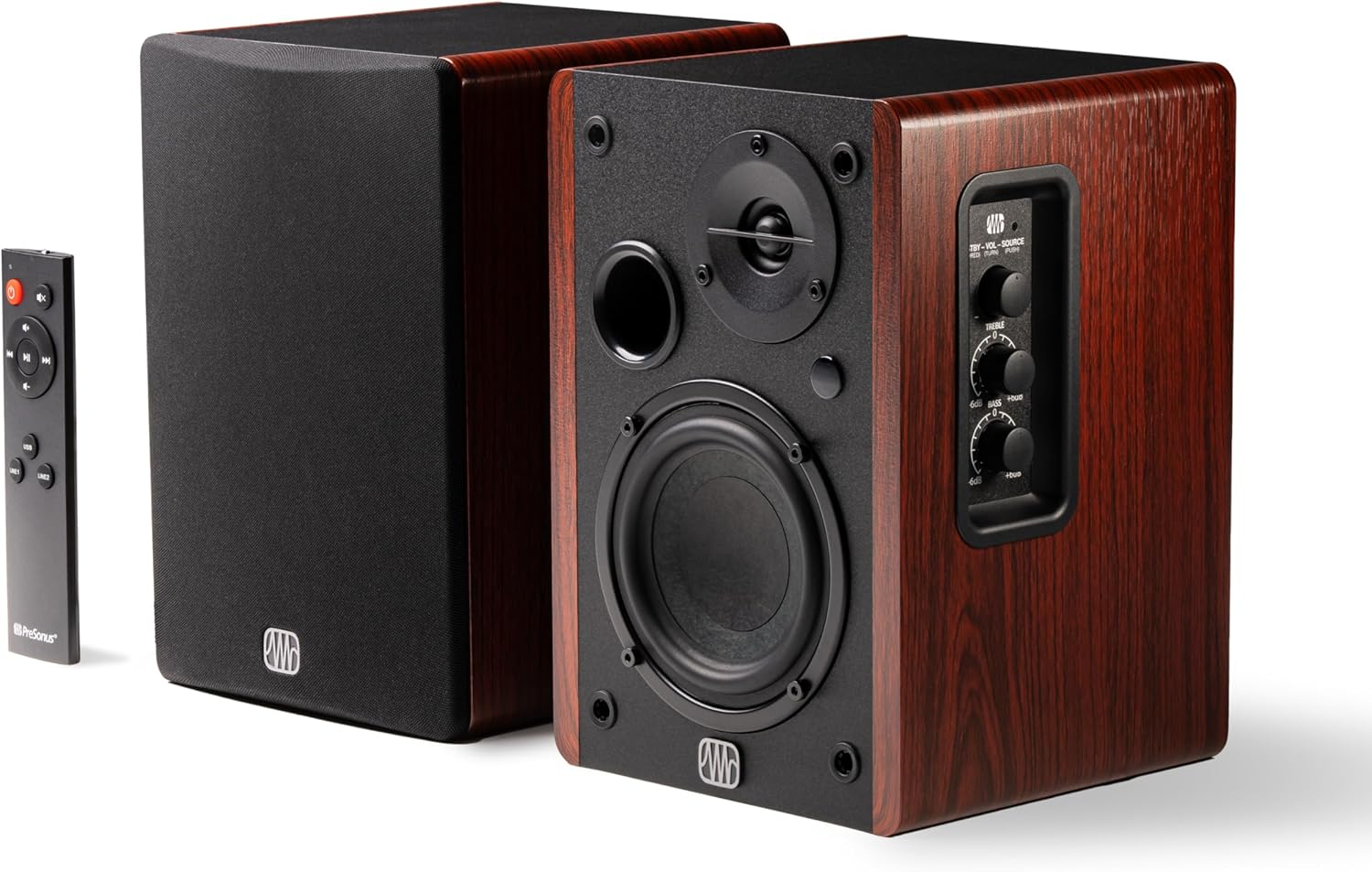
PreSonus Eris Accent Active Studio Speakers
Pros
- USB-C audio input works plug-and-play with MacBooks and modern laptops
- Subwoofer output lets you add bass later without buying new speakers
- Compact footprint for smaller desks
- Good midrange clarity from a studio monitor lineage
Cons
- 50W total output is modest; don't expect room-filling volume
- 4-inch woofer has limited bass extension below 80Hz
- Not the right pick for a living room listening setup
Price as of Aug 3, 2026 — see current price on Amazon.
PreSonus makes studio monitors used in professional recording studios (the Eris E5 and E8 are standards in home recording setups). The Eris Accent borrows DNA from those monitors and packages it into a consumer-priced powered speaker with modern connectivity.
The USB-C input is the killer feature. You connect your MacBook Air or Windows laptop directly to the Eris Accent and the speakers handle the audio conversion. No external DAC needed, no 3.5mm adapter required. The audio quality is noticeably cleaner than going through a laptop's headphone jack.
Look, at $139 you're not getting bass. The 4-inch woofer rolls off below 80Hz. But the subwoofer output means you can add a powered sub later and get a legitimate 2.1 setup. Start here, add a $100-150 sub if you want more, and you've built a solid desktop audio chain for under $300 total.
Buying Guide: What to Know Before You Buy
Passive vs. Powered: The Key Decision
This is the most important thing to understand before buying any bookshelf speakers.
Passive speakers (Klipsch RP-600M, Polk ES20, Sony SS-CS5M2) have no built-in amplification. They need an external amplifier or AV receiver to make sound. Budget $150-300 extra for a stereo amplifier like the Yamaha A-S301 or Denon PMA-600NE to drive them properly.
Powered or active speakers (Edifier S1000W, PreSonus Eris Accent) have amplification built in. You plug them in, connect your source (laptop, phone, turntable with phono preamp), and you're done. No separate amp purchase.
Neither is objectively better. Passive setups give you more flexibility to upgrade each component separately. Powered setups get you listening faster with less money upfront.
Room Size and Volume
Bookshelf speakers are genuinely called that for a reason. The RP-600M and ES20 will fill a medium room (under 300 square feet) without issue. But if you're trying to fill a large open-plan living room, look at floor-standing speakers instead.
For a desktop or near-field setup (speakers 3 to 6 feet from your listening position), any speaker on this list will give you more volume than you'll ever actually use.
Speaker Placement Matters More Than People Think
All of the passive speakers on this list are rear-ported. That means they need at least 6 to 12 inches of space behind them to breathe properly. Shoving them against a wall compresses the bass and makes it boomy. Front-ported or sealed designs are more forgiving of placement, but none of the picks at this price are sealed.
Toe them in slightly toward your listening position (about 10 to 15 degrees) and you'll hear a noticeable improvement in stereo imaging.
What Amplifier Should You Buy?
If you're going passive, the Yamaha A-S301 is the standard recommendation in the $300 range. The Denon PMA-600NE is slightly warmer-sounding at a similar price. If budget is tight, the SMSL SA300 runs about $70 and handles the Klipsch RP-600M perfectly fine given its 96dB sensitivity. The high sensitivity of the Klipsch specifically means even a modest amp makes it sing.
The Sony SS-CS5M2 is more demanding. Feed it at least 50W per channel from a quality source.
Frequently asked questions
- Do I need a separate amplifier for bookshelf speakers?
- Only if you buy passive speakers. Passive bookshelf speakers (like the Klipsch RP-600M or Polk ES20) require an external amplifier or AV receiver. Active or powered speakers (like the Edifier S1000W or PreSonus Eris Accent) have amplification built in and connect directly to your source.
- What's a good amp to pair with passive bookshelf speakers under $500?
- The Yamaha A-S301 ($299) and Denon PMA-600NE ($299) are the standard recommendations and both pair well with every passive speaker on this list. If you're budget-constrained and using the Klipsch RP-600M specifically, the SMSL SA300 at around $70 works surprisingly well because the Klipsch has 96dB sensitivity and doesn't need a powerful amp to get loud.
- Are bookshelf speakers good for gaming?
- Yes, particularly for single-player games where audio atmosphere matters. A pair of Klipsch RP-600M speakers connected to an amp with a good DAC sounds dramatically better than any gaming headset under $200 for single-player games. For competitive multiplayer where positional audio matters most, a quality headset still makes more sense.
- Can I use bookshelf speakers without a subwoofer?
- Absolutely. The Klipsch RP-600M and Polk ES20 both have 6.5-inch woofers with enough bass extension that most listeners won't miss a subwoofer for music. For home theater use, adding a subwoofer later makes a real difference for movies and action content, but it's not required from day one.
- What is the difference between 2-way and 3-way bookshelf speakers?
- A 2-way speaker has a woofer and a tweeter. A 3-way speaker (like the Sony SS-CS5M2) adds a midrange driver or super tweeter. More drivers means each driver handles a narrower frequency range, which can reduce distortion and improve clarity at the cost of more complex crossover design. At bookshelf speaker prices, the difference is real but subtle.
- How far apart should bookshelf speakers be placed?
- For stereo listening, place them roughly the same distance apart as the distance from the speakers to your listening position. If you sit 6 feet back, place them 6 feet apart. This forms an equilateral triangle and gives you the best stereo imaging. For near-field desktop setups, 3 to 4 feet apart with a slight inward toe-in works well.
Bottom Line
The Klipsch RP-600M is the one to get if you already have or are willing to buy an amplifier or receiver. The sound quality at $349 per pair is genuinely difficult to beat, and the high sensitivity means it sounds great with even modest amplification. If you want a no-compromise all-in-one powered setup and the convenience is worth real money to you, the Edifier S1000W delivers audiophile-grade performance without the complexity, though at $599.99 you are paying heavily for that shortcut.
Budget-conscious? Prices moved against the middle of this list, so the Sony SS-CS5M2 at $199 is now the passive pick to beat, and the PreSonus Eris Accent at $139 is the call for anyone who wants USB-C plug-and-play on a desk right now. The Polk ES20 has climbed to $359, which makes it a surround-expansion buy rather than a bargain.
Weighing a stereo pair against a one-box alternative for TV duty? Our guide to soundbars vs bookshelf speakers for a TV covers the dialogue and volume-control tradeoffs before you commit.
How We Test
We score products by combining spec-level research, pricing history, trusted third-party benchmarks, and owner sentiment from high-signal sources.
- Performance and real-world value in the category this guide targets
- Price-to-performance and deal consistency over recent pricing windows
- Build quality, reliability patterns, and known long-term issues
- Recommendation refresh cadence to keep these picks current
Author
TheTechSearch Editorial Team
Independent product reviewers & PC builders
We test and compare real-world specs, price trends, and user feedback to recommend gear that actually makes sense to buy.