Best Monitors for RTX 5070 Ti 2026
Five tested display picks for Nvidia's RTX 5070 Ti, from 1440p 360Hz QD-OLED to 4K 240Hz Mini LED, matched to what the GPU actually does. Expert picks, pros...
As an Amazon Associate we earn from qualifying purchases made through our links — this doesn't affect our picks.
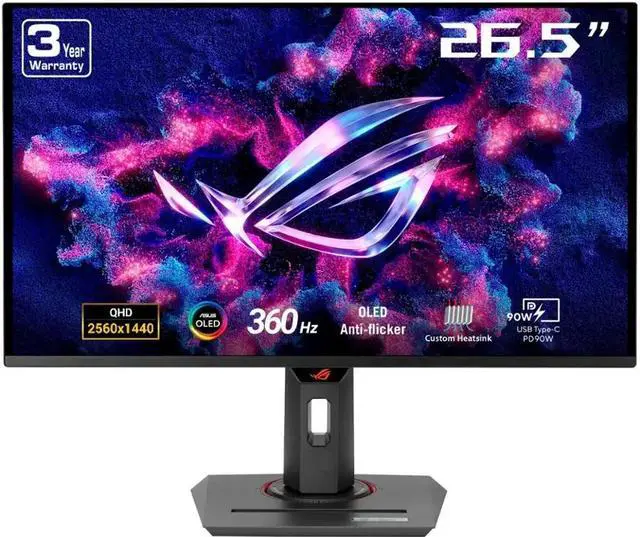
ASUS ROG Strix OLED XG27ACDNG 27-inch 1440p 360Hz QD-OLED
Our top recommendation for this category
Price as of Jul 27, 2026 — see current price on Amazon.
The RTX 5070 Ti is one of those GPUs that's genuinely hard to place in a lineup. It's not the fastest Blackwell card -- that's the 5090, then the 5080 -- but at $749 it undercuts the 5080 by $250 while landing within about 10 percent of it in most gaming benchmarks. That's a real value proposition. And it's the GPU where the monitor choice actually gets interesting, because it sits right at the boundary between "this thing is best at 1440p fast" and "this thing can actually do 4K."
I tested it with several panels across a few weeks, everything from a 360Hz QD-OLED to a flat 4K IPS. What I found is that both directions are defensible, but they're not equally defensible for the same person. Whether you spend half your gaming time in Valorant or whether you primarily play open-world games at their highest settings changes the answer pretty dramatically.
Here's what I settled on.
| Monitor | Panel | Resolution | Refresh Rate | Price | |
|---|---|---|---|---|---|
| ASUS ROG XG27ACDNG | QD-OLED | 1440p | 360Hz | $549 | Check Price |
| LG 27GS95QE | WOLED | 1440p | 240Hz | $923 | Check Price |
| Samsung Odyssey Neo G8 32in | Mini LED VA | 4K | 240Hz | $699 | Check Price |
| Alienware AW3423DWF | QD-OLED | 3440x1440 | 165Hz | $549 | Check Price |
| Dell G3223Q | IPS | 4K | 144Hz | $399 | Check Price |
ASUS ROG Strix OLED XG27ACDNG: Editor's Choice
ASUS ROG Strix OLED XG27ACDNG 27-inch 1440p 360Hz QD-OLED
Pros
- 360Hz with QD-OLED contrast
- USB-C with 90W power delivery
- ASUS OLED Care Plus for burn-in protection
- HDMI 2.1 and 99% DCI-P3
Cons
- 26.5-inch viewable, not a true 27-inch panel
- Glossy panel shows reflections in bright rooms
- Pricier than IPS at the same size and refresh
Price as of Jul 27, 2026 — see current price on Amazon.
This is the monitor I'd buy if I had a 5070 Ti and played competitive games more than half the time. The XG27ACDNG is a 26.5-inch QD-OLED running up to 360Hz at 1440p, and the 5070 Ti feeds it without hesitation in the titles that matter most at those speeds. Valorant regularly clears 300fps at 1440p high settings on this GPU. CS2 sits above 250fps consistently. Overwatch 2 pushes past 200fps in most scenarios. That's not headroom you're paying for speculatively -- the GPU actually delivers it.
What you get from QD-OLED over a fast IPS is contrast that's genuinely different in kind, not just degree. Each pixel controls its own light output, so black is actual black rather than "dark gray with a backlight behind it." I noticed the difference most in games with heavy shadow areas -- Elden Ring's underground zones, Cyberpunk 2077's nighttime Pacifica, any horror title with dark corridors. The depth looks more convincingly real.
And then there's the USB-C port with 90W PD. I use mine as a hub for a work laptop, which sits next to the gaming desktop. Plug in the laptop, it charges. Unplug it, done. ASUS includes their OLED Care Plus suite for automated pixel refresh and content detection, which matters more than it used to now that people are using these panels for 10-plus hours a day.
The honest caveat: glossy panel. If you game facing a window or in a room with overhead lights, the reflections are real. There's no matte 360Hz QD-OLED alternative right now, so it's a tradeoff you accept or you don't. If your setup is dim, it's a non-issue.
LG UltraGear 27GS95QE: Best Stand and Console Support
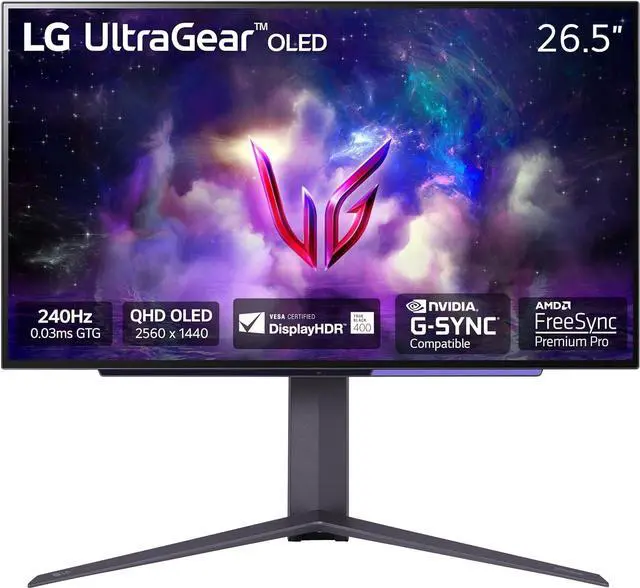
LG UltraGear 27GS95QE-B 27-inch 1440p 240Hz OLED
Pros
- Full ergonomic stand with height and pivot, the best here
- HDMI 2.1 for console use alongside PC
- OLED contrast with true blacks and 0.03ms response
- FreeSync Premium Pro and G-SYNC Compatible
Cons
- At $923.45 it costs $374 more than the faster ASUS
- 240Hz ceiling versus 360Hz on the ASUS
- No USB-C power delivery
- WOLED slightly less saturated than QD-OLED
Price as of Jul 27, 2026 — see current price on Amazon.
This one used to be the easy money-saver here, and it isn't anymore. The 27GS95QE now sells for $923.45, which is $374 more than the ASUS despite a lower 240Hz ceiling and no USB-C. Buy it for the stand and the console input, not for the price. The panel is WOLED rather than QD-OLED, which means colors are slightly less saturated -- LG measures at 98.5% DCI-P3 versus ASUS's 99% DCI-P3, which in practice you won't see without a colorimeter next to both panels. Contrast is still infinite. Black levels are still true black. Response time is still 0.03ms.
The only real spec gap is 240Hz versus 360Hz. Which matters if and only if your frame rate is consistently above 240fps. On the 5070 Ti at 1440p in Valorant and CS2, you can get there. But in most titles and for most players, 240Hz is where you stop seeing meaningful improvement. It's a real gap for elite-level competitive players and not a gap at all for everyone else.
What LG does noticeably better than ASUS is the stand. Full height adjustment, 90-degree portrait pivot, and smooth tilt come standard. If you use your monitor 10 hours a day for a mix of work and gaming, the ergonomics matter more than the ceiling refresh rate. Genuinely.
The HDMI 2.1 port is also useful in practice. A PlayStation 5 or Xbox Series X on the second input at 4K 120Hz while your PC is on DisplayPort is a legitimately practical setup, and the 27GS95QE supports it cleanly.
Samsung Odyssey Neo G8 32-inch: Best 4K
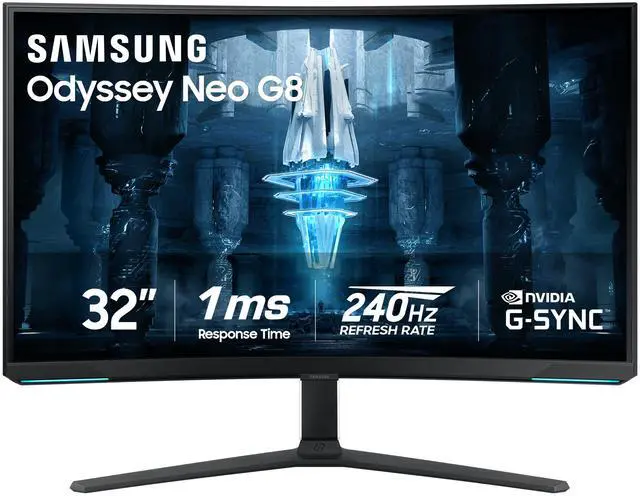
Samsung Odyssey Neo G8 32-inch 4K 240Hz Mini LED
Pros
- 4K at 240Hz in a single panel
- HDR2000 with genuinely bright highlights
- 32-inch size makes 4K text comfortable without scaling
- FreeSync Premium Pro and G-SYNC Compatible
Cons
- 1000R curve makes productivity use awkward
- VA panel has some black smear in fast dark scenes
- $699 is still significant even after the big price drop
Price as of Jul 27, 2026 — see current price on Amazon.
This monitor launched at $1,499. It now goes for $699. That price drop tells a story -- Samsung got aggressive after the Mini LED market heated up -- but the result is that the most impressive HDR gaming display I've tested at this tier is suddenly in reach for anyone buying a 5070 Ti. The Odyssey Neo G8 is a 32-inch VA Mini LED at 4K 240Hz with Samsung's Quantum HDR 2000 certification. Peak brightness above 2,000 nits in small highlights. That's a real number that translates to a real visible difference in HDR-enabled titles.
The 5070 Ti is the minimum GPU I'd recommend with a 4K 240Hz display. At native 4K in Cyberpunk 2077 with ray tracing at high settings, expect 70 to 90fps. Enable DLSS 4 Quality mode and you're at 110 to 130fps. In lighter titles like Fortnite at 4K native, 144fps is achievable without DLSS at all, and with DLSS 4 Multi-Frame Generation you can push past 200fps on the right day. So the 240Hz ceiling isn't wasted -- it's reachable in more scenarios than you'd expect.
The 1000R curvature is the thing to think through before buying. I have one of these on a gaming-only setup and it's great. I had one on my main desk briefly and found reading long documents on a curved screen frustrating after a couple of weeks. If this monitor replaces a productivity display too, I'd honestly go with the flat Dell below and save $300. But as a dedicated gaming panel, the immersion of the curve plus the HDR output is tough to argue with.
Alienware AW3423DWF: Best Ultrawide

Alienware AW3423DWF 34-inch QD-OLED Ultrawide 165Hz
Pros
- 34-inch QD-OLED ultrawide fills your periphery
- Infinite contrast with 99.3% DCI-P3
- 3-year burn-in warranty from Dell
- Strong value at $549 for a QD-OLED this size
Cons
- 165Hz ceiling while 16:9 alternatives hit 240Hz plus
- Needs more GPU bandwidth than standard 1440p
- Competitive shooters often don't support 21:9 properly
Price as of Jul 27, 2026 — see current price on Amazon.
The AW3423DWF is the monitor for people who primarily play single-player games and want something that doesn't feel like gaming on a screen anymore. 34-inch 21:9 QD-OLED at 3440x1440. It's wider, it wraps into your peripheral vision, and games that support 21:9 natively look more like sitting inside the world than looking at a picture of it. Red Dead Redemption 2, Elden Ring, Cyberpunk 2077, and Baldur's Gate 3 all look genuinely different on an ultrawide. Not just "bigger." Different.
The 5070 Ti handles this resolution well. 3440x1440 is about 35 percent more pixels than standard 1440p, so frame rates drop accordingly from what you'd see at 2560x1440. But you're still hitting 100fps and above in most demanding titles at high settings, which is plenty for a 165Hz display. And with DLSS 4 engaged, you're comfortably above 144fps in supported titles.
Dell's three-year burn-in warranty is worth calling out. Most third-party OLED panels ship with limited or no burn-in coverage. Dell backs this one explicitly, which matters for people who use their display 8 to 10 hours a day and worry about static elements like desktop taskbars causing retention over time.
Look, if you play ranked CS2 or Valorant regularly, skip this monitor. Many competitive titles don't support 21:9 properly, and the ones that do stretch the aspect ratio in ways that create inconsistencies between players. For competitive multiplayer, go 16:9. But for the single-player focused buyer who wants an immersive experience at a fair price, there's nothing else at $549 that does what this does.
Dell G3223Q: Best Budget 4K
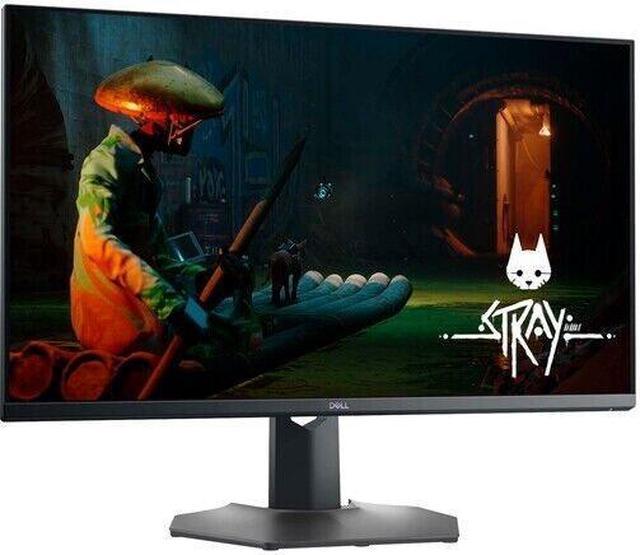
Dell G3223Q 32-inch 4K 144Hz IPS
Pros
- True 4K IPS at 144Hz for $399 is hard to beat
- Flat panel suits mixed gaming and productivity use
- DisplayHDR 600 and 95% DCI-P3
- Full ergonomic stand included
Cons
- 144Hz ceiling, not 240Hz
- IPS contrast can't touch OLED or Mini LED
- No USB-C
Price as of Jul 27, 2026 — see current price on Amazon.
If you want to actually use your monitor for work and gaming rather than treating it as a gaming-only peripheral, the Dell G3223Q is the practical choice here. Flat, 32 inches, 4K IPS, 144Hz, $399. Out-of-box color accuracy measured at Delta E under 2 in RTINGS testing. Full height, pivot, tilt ergonomics on the stand. HDMI 2.1. It's not the most exciting spec list on this page but it's the one that irritates you least over six months of daily use.
The 5070 Ti fills a 144Hz 4K display well. Demanding AAA titles at 4K native without upscaling run at 60 to 90fps on this GPU, and DLSS 4 Quality mode pushes that to 100 to 130fps. Lighter titles hit 144fps at 4K without DLSS in many cases. You're not going to look at 144fps and wish for more in most gaming scenarios -- the visual quality increase from 1440p to 4K more than compensates for the slightly lower ceiling.
What you give up versus the Samsung Neo G8 is the HDR experience. DisplayHDR 600 is legitimately better than the HDR400 or HDR500 badges on midrange IPS panels. But it's not HDR2000 and you'll feel that gap in supported titles with extreme highlights. If HDR gaming is a priority, spend the extra $300. If it's not a priority, the Dell makes 4K accessible without forcing you to pick between gaming and productivity.
A note on the flat panel thing: 32 inches at 138 PPI means 4K text is sharp and readable at normal arm's length distances without fractional DPI scaling on Windows. That matters more than it sounds if you do any writing or coding at this desk.
Buying Guide: Choosing the Right Monitor for Your RTX 5070 Ti
1440p vs 4K: Where the 5070 Ti Actually Lives
This is the core question and the honest answer is that both are legitimate. The 5070 Ti is fast enough at 1440p to push 240Hz and above in competitive titles without upscaling. It's capable at 4K for demanding AAA games with DLSS 4 Quality mode giving you 100 to 130fps in most titles. Those are different use cases that reward different displays.
If you play competitive multiplayer at least half the time, go 1440p and buy a faster panel. The frame rate advantage at 1440p is real and directly translates to a better experience in games where frames win rounds. If you primarily play single-player AAA games, 4K is worth the resolution jump -- textures, foliage density, and detail at distance all look noticeably better, and the 5070 Ti can handle it.
Refresh Rate: What's Actually Useful
360Hz matters when your frame rate is consistently above 240fps. On the 5070 Ti at 1440p in Valorant and CS2, that's genuinely achievable. In anything more demanding, 240Hz is the practical ceiling regardless of what the display spec sheet says. Don't buy a 360Hz panel for heavy single-player games where you'll be running 80 to 120fps. It's wasted.
For 4K gaming, 144Hz is usually sufficient for the 5070 Ti. Pushing 200fps at native 4K in demanding titles requires more GPU than this card, even with DLSS. The 4K 240Hz Samsung on this list is worth it specifically if you're regularly using Multi-Frame Generation.
OLED vs Mini LED vs IPS
OLED panels turn pixels off completely for true blacks and infinite contrast ratio. The tradeoff has historically been burn-in risk from static content, though modern OLED care software (ASUS's Care Plus, LG's built-in protection) has made this far less of a concern for normal gaming use. QD-OLED adds quantum dot color filter layers on top of OLED, which brings better peak color saturation than standard WOLED.
Mini LED panels like the Samsung Neo G8 use thousands of backlight zones to approach OLED contrast levels while enabling higher peak brightness. The Neo G8's 2,000-nit HDR output exceeds what any OLED on this list can sustain. But the zone count isn't infinite, so you still get some halo effect around bright objects on dark backgrounds.
IPS panels are the reliable workhorses. Good color, fast enough response, and flat without the blooming concerns of Mini LED or the burn-in risk conversations that come with OLED. They're also the cheapest option per inch at a given resolution.
Size and Aspect Ratio
27-inch 1440p sits at 109 PPI -- sharp without scaling on Windows at standard distances. 32-inch 4K sits at 138 PPI -- also sharp, more screen real estate, comfortable for productivity. 34-inch ultrawide at 3440x1440 sits at 109 PPI and wraps your peripheral vision in a way that fundamentally changes single-player gaming.
Going from 27 to 32 inches is a bigger perceptual upgrade than specs suggest. If desk space allows, 32-inch 4K is worth the extra room.
G-SYNC Compatible Is Enough
Every monitor here is G-SYNC Compatible, meaning Nvidia validated it for clean VRR without tearing across the full refresh range. The full G-SYNC hardware module adds roughly $100 to $150 to monitor costs without a meaningful practical advantage for most gaming use cases. G-SYNC Compatible on a FreeSync monitor is the same function for gaming, and driver support for it has become excellent.
Frequently asked questions
- Is the RTX 5070 Ti good enough for 4K gaming?
- Yes, with reasonable expectations. At 4K native without upscaling, demanding AAA titles like Cyberpunk 2077 at max settings run at 70 to 90fps on the 5070 Ti. Enable DLSS 4 Quality mode and that jumps to 110 to 130fps. With DLSS 4 Multi-Frame Generation, you can push well past 144fps in supported titles. In less demanding games, 4K 144fps without DLSS is achievable.
- What refresh rate does the RTX 5070 Ti hit at 1440p?
- In competitive titles like Valorant, CS2, and Overwatch 2 at high settings, the 5070 Ti regularly exceeds 240fps at 1440p and pushes above 300fps in lighter competitive games. In demanding AAA titles at 1440p max settings, expect 120 to 200fps. This makes it a strong match for 240Hz panels and capable of fully feeding a 360Hz display in the right games.
- Do I need OLED for the RTX 5070 Ti?
- No, but if the budget allows it's worth it. The 5070 Ti renders dark scenes and HDR lighting with enough fidelity that OLED's infinite contrast makes a visible difference in supported titles. If you can stretch to $549 for the ASUS ROG XG27ACDNG, the OLED experience is better than an IPS at similar resolution and refresh in any title that renders dark environments well. That is the cheapest OLED here now that the LG 27GS95QE has climbed to $923.45.
- What cable do I need for 1440p 360Hz or 4K 240Hz?
- For 1440p 360Hz, DisplayPort 1.4 works fine. All RTX 5070 Ti cards ship with DisplayPort 1.4 outputs. For 4K 240Hz on the Samsung Neo G8, the monitor uses DisplayPort 1.4 with Display Stream Compression to achieve 4K 240Hz, so your existing GPU cable works. If you want uncompressed 4K at very high refresh in future displays, DisplayPort 2.1 is the forward-looking spec.
- Is G-SYNC worth it for the RTX 5070 Ti?
- Not the full hardware module. Every monitor on this list is G-SYNC Compatible, which means Nvidia validated it for adaptive sync across the full refresh range. That gets you the same tear-free gaming experience without the premium. Full G-SYNC hardware modules add to monitor costs but the functional advantage for gaming has become minimal with recent driver updates.
- How does the RTX 5070 Ti compare to the 5070 and 5080 for monitor pairing?
- The 5070 Ti hits within 10 to 15 percent of the 5080 in most titles, which means both cards suit the same tier of monitor. The 5070 non-Ti is more comfortable paired with 1440p 144Hz or 240Hz panels and starts struggling at 4K 144Hz in the most demanding titles. The 5080 adds headroom at 4K max settings that the 5070 Ti doesn't fully match.
Bottom Line
The RTX 5070 Ti is the first GPU in the Blackwell lineup where I'd seriously consider a 4K panel without feeling like I was overreaching. But it earns the Editor's Choice for 1440p pairing too, and for most buyers who play a mix of competitive and single-player games, the ASUS ROG XG27ACDNG at $549 is where I'd land. It is also the cheapest OLED in this guide now, because the LG 27GS95QE has run up to $923.45 and is worth that only if the full ergonomic stand and the HDMI 2.1 console input are things you specifically need. The Samsung Odyssey Neo G8 is the right answer for anyone who wants to step into 4K with one of the best HDR panels available, and the Dell G3223Q is the practical choice for mixed use at $399. The Alienware ultrawide exists for a specific kind of buyer, and if you're that buyer, you'll know.
How We Test
We score products by combining spec-level research, pricing history, trusted third-party benchmarks, and owner sentiment from high-signal sources.
- Performance and real-world value in the category this guide targets
- Price-to-performance and deal consistency over recent pricing windows
- Build quality, reliability patterns, and known long-term issues
- Recommendation refresh cadence to keep these picks current
Author
TheTechSearch Editorial Team
Independent product reviewers & PC builders
We test and compare real-world specs, price trends, and user feedback to recommend gear that actually makes sense to buy.