Best Travel Routers in 2026
Hotel Wi-Fi caps you at one or two devices and shows everyone your traffic. These six pocket routers fix both, from $39.99 to $159.99. Expert picks, pros and...
As an Amazon Associate we earn from qualifying purchases made through our links — this doesn't affect our picks.

GL.iNet GL-MT3600BE Beryl 7 Dual-Band Wi-Fi 7 Travel Router
Our top recommendation for this category
Price as of Sep 27, 2026 — see current price on Amazon.
A travel router is a small box that logs into the hotel, cruise or Airbnb Wi-Fi once and then rebroadcasts it as your own private network. Every laptop, phone, Fire TV stick and Switch you packed connects to it automatically, and the captive portal that limits you to two devices only ever sees one.
The category moved a lot in the past twelve months. Wi-Fi 7 models from GL.iNet, ASUS and TP-Link all landed, and prices dropped fast: a Wi-Fi 7 travel router now costs what a Wi-Fi 6 one did last year. So the question isn't whether to buy one anymore. It's which one, and whether you need Wi-Fi 7 at all when the hotel feeding it is running 50 Mbps.
Quick Picks
| Router | Price | Wi-Fi | Ethernet | Weight | |
|---|---|---|---|---|---|
| GL.iNet GL-MT3600BE Beryl 7 | $129.99 | Wi-Fi 7 BE3600 | 2x 2.5 GbE | 205 g | Check Price |
| ASUS RT-BE58 Go | $99.99 | Wi-Fi 7 BE3600 | 1x 2.5 GbE + 1x 1 GbE | About 230 g | Check Price |
| GL.iNet GL-BE3600 Slate 7 | $159.99 | Wi-Fi 7 BE3600 | 2x 2.5 GbE | 295 g | Check Price |
| TP-Link Roam 7 (TL-WR3602BE) | $119.99 | Wi-Fi 7 BE3600 | 1x 2.5 GbE + 1x 1 GbE | 170 g | Check Price |
| GL.iNet GL-MT3000 Beryl AX | $98.99 | Wi-Fi 6 AX3000 | 1x 2.5 GbE + 1x 1 GbE | 196 g | Check Price |
| GL.iNet GL-SFT1200 Opal | $39.99 | Wi-Fi 5 AC1200 | 3x 1 GbE | 145 g | Check Price |
GL.iNet GL-MT3600BE Beryl 7
GL.iNet GL-MT3600BE Beryl 7 Dual-Band Wi-Fi 7 Travel Router
Pros
- WireGuard rated up to 1,100 Mbps, fast enough that the VPN stops being the bottleneck
- Two 2.5 GbE ports in a 205 g body
- $129.99 against GL.iNet's $139.99 list
- Fanless, and NAS Compares measured just 3.7 to 6.7 W under typical loads
Cons
- No 6 GHz band, same as every travel router here
- Single USB 3.0 port has to choose between a phone tether and a storage drive
Price as of Sep 27, 2026 — see current price on Amazon.
The Beryl 7 is the one to buy if you only read one section of this page. It takes the Beryl AX body (120 x 83 x 34 mm, basically the same footprint) and swaps in a MediaTek quad-core at 2.0 GHz, 512 MB of DDR4, dual-band Wi-Fi 7 and a second 2.5 GbE port.
That quad-core is the real story. GL.iNet rates WireGuard at up to 1,100 Mbps and OpenVPN with DCO at up to 1,000 Mbps. For comparison, the Beryl AX tops out at 300 Mbps on WireGuard and 150 Mbps on OpenVPN. If you run a VPN on the router so every device behind it is covered, this is the difference between a VPN you notice and one you don't.
NAS Compares gave it 8.2 out of 10 in February, with external temperatures of 41 to 42°C while streaming and 51 to 54°C under heavy mixed load. Warm, not worrying. Its main gripe was USB storage topping out around 50 to 70 MB/s, which only matters if you plan to use it as a pocket file server.
It runs GL.iNet's OpenWrt-based firmware, so AdGuard Home, Tailscale and multi-WAN failover (hotel Wi-Fi plus a phone tether, say) are all there on day one.
Best for: almost everyone, and especially anyone who wants a router-level VPN at real speed.
ASUS RT-BE58 Go

ASUS RT-BE58 Go Wi-Fi 7 Dual-Band Travel Router
Pros
- $99.99 against a $159.99 MSRP, the biggest discount in this guide
- Full ASUSWRT firmware, including AiMesh and VPN Fusion
- Can join your home ASUS mesh as a node, then leave with you
- Quad-core 2.0 GHz with 1 GB of RAM
Cons
- Only one of its two Ethernet ports is 2.5 GbE
- Dong Knows Tech found USB storage speeds weak, a few tens of MB/s
Price as of Sep 27, 2026 — see current price on Amazon.
At $99.99 this is a Wi-Fi 7 travel router for the price of GL.iNet's Wi-Fi 6 Beryl AX, and that makes it the value pick by a wide margin. ASUS launched it at $159.99.
What you're really buying is the firmware. ASUSWRT on the RT-BE58 Go is the same interface as on ASUS's home routers, with the same VPN client and server options (WireGuard and OpenVPN), VPN Fusion for sending only some devices through the tunnel, and AiMesh. That last one is the neat trick: at home it can sit in your existing ASUS mesh as a node, and on the road it becomes a standalone router again.
Dong Knows Tech scored it 8.5 out of 10 and saw wired throughput close to 2 Gbps on a 10 Gbps fiber line, with Wi-Fi generally between 300 Mbps and Gig+ depending on distance. Modes cover router, access point, repeater, WISP, USB tethering and a cellular-dongle mode, so it handles the hotel-Wi-Fi case and the "hotel Wi-Fi is broken, use my phone" case.
It runs off 18 W USB-C Power Delivery, so a decent phone charger or a laptop's USB-C port can power it.
Best for: people who already run ASUS at home, and anyone who wants Wi-Fi 7 at the lowest price.
GL.iNet GL-BE3600 Slate 7
GL.iNet GL-BE3600 Slate 7 Wi-Fi 7 Travel Router with Touchscreen
Pros
- Front touchscreen toggles the VPN, scans a Wi-Fi QR code and shows live speed
- Two 2.5 GbE ports plus USB 3.0
- 1 GB of RAM, twice the Beryl 7
- Under the $169.99 US launch price
Cons
- 295 g, the heaviest router in this guide
- Dong Knows Tech saw long-range Wi-Fi fall off quickly and occasional WISP connection failures
Price as of Sep 27, 2026 — see current price on Amazon.
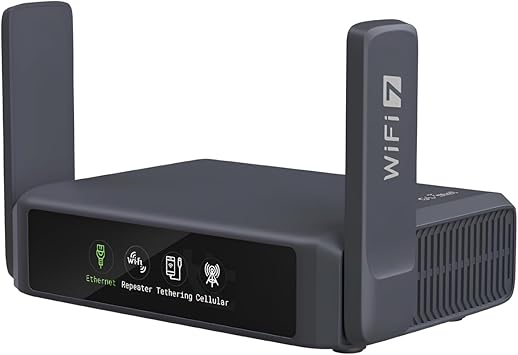
The Slate 7 is GL.iNet's flagship dual-band travel router, and the thing that sets it apart is the small touchscreen on the front. From it you can flip the VPN on or off, switch providers, scan a QR code to join a network, and watch throughput in real time without opening an app or a laptop.
That sounds like a gimmick until you're in a hotel room at 11 p.m. and the VPN is blocking the captive portal. One tap off, log in, one tap back on.
The hardware is solid: dual-band Wi-Fi 7 at 688 Mbps on 2.4 GHz and 2,882 Mbps on 5 GHz, two 2.5 GbE ports, USB 3.0 and 1 GB of RAM. Dong Knows Tech rated it 8 out of 10 and found its NAS write speeds more than doubled the ASUS RT-BE58 Go's.
Here's the honest catch. Since the Beryl 7 arrived, the Slate 7's specs are no longer unique. Both have two 2.5 GbE ports and the same Wi-Fi class, and the Beryl 7 is $30 cheaper and 90 g lighter. You're paying for the screen, and for the extra RAM.
Best for: travelers who flip their VPN on and off daily and want a physical control for it.
TP-Link Roam 7 (TL-WR3602BE)

TP-Link Roam 7 BE3600 Wi-Fi 7 Portable Travel Router (TL-WR3602BE)
Pros
- 170 g, the lightest Wi-Fi 7 router here
- VPN Merge runs more than one VPN connection at once
- Setup through the familiar TP-Link Tether app
- $119.99 against a $139.99 MSRP
Cons
- Dong Knows Tech measured 5 GHz throughput only slightly above 1 Gbps
- No 6 GHz, as the listing itself spells out
Price as of Sep 27, 2026 — see current price on Amazon.
TP-Link's Roam 7 is the least nerdy router in this guide, and that's the point. You set it up in the Tether app, the same one millions of people already use for their home TP-Link router, and there's no OpenWrt menu to wander into.
It's small too: 4.96 x 3.68 x 1.5 inches and 170 g, with two antennas that fold flat against the body. Ports are one 2.5 GbE WAN, one gigabit LAN, USB 3.0 for tethering or storage, and USB-C for power.
VPN support covers WireGuard, OpenVPN, L2TP/IPSec and PPTP, and VPN Merge lets you run more than one VPN connection at once. Dong Knows Tech called its performance "reliable but modest" at 8 out of 10. In plain terms: it's a clear step up from the older Roam 6, but it won't match the GL.iNet or ASUS boxes on raw speed.
Honestly, at hotel-Wi-Fi speeds that difference rarely shows up.
Best for: people who want the lightest Wi-Fi 7 box and an app-based setup.
GL.iNet GL-MT3000 Beryl AX

GL.iNet GL-MT3000 Beryl AX Wi-Fi 6 Travel Router
Pros
- Same $98.99 as GL.iNet's own store
- Years of community guides for Tailscale, AdGuard Home and OpenWrt packages
- 2.5 GbE WAN, gigabit LAN, USB 3.0
- Under 8 W power draw from 5V/3A USB-C
Cons
- WireGuard tops out at 300 Mbps, OpenVPN at 150 Mbps
- Wi-Fi 6 at the same price as the Wi-Fi 7 ASUS RT-BE58 Go
Price as of Sep 27, 2026 — see current price on Amazon.
The Beryl AX was the default travel router recommendation for about two years, and it's still a very good one. Wi-Fi 6 at 574 Mbps on 2.4 GHz and 2,402 Mbps on 5 GHz, a dual-core MT7981B at 1.3 GHz, 512 MB of RAM, a 2.5 GbE WAN port and a gigabit LAN port, all at 196 g.
Why is it this low on the list, then? Because the price didn't fall with everything else. At $98.99 it now costs the same as the ASUS RT-BE58 Go, which has Wi-Fi 7, a faster CPU and twice the RAM. Its 300 Mbps WireGuard ceiling is also a third of the Beryl 7's.
The reason to still buy one is the ecosystem. If you've read a guide on putting Tailscale, a Pi-hole-style blocker or some odd OpenWrt package on a travel router, there's a good chance it was written for this model. That track record counts.
Best for: tinkerers who want the most documented travel router rather than the fastest.
GL.iNet GL-SFT1200 Opal

GL.iNet GL-SFT1200 Opal AC1200 Dual-Band Travel Router
Pros
- $39.99, a quarter of the price of the Slate 7
- Three gigabit Ethernet ports (1 WAN, 2 LAN)
- 145 g with retractable antennas
- Same GL.iNet firmware and admin panel as the pricier models
Cons
- WireGuard rated at 65 Mbps and OpenVPN at just 12 Mbps
- Wi-Fi 5 and USB 2.0
Price as of Sep 27, 2026 — see current price on Amazon.
The Opal does the core job, which is turning one hotel login into a private network for all your devices, for $39.99. That's also the price on GL.iNet's own site, so this isn't a clearance deal on old stock.
Specs are modest: AC1200 Wi-Fi 5 (300 Mbps on 2.4 GHz, 867 Mbps on 5 GHz), a dual-core 1 GHz chip and 128 MB of RAM. The three gigabit Ethernet ports are more than any other router here has, which is handy in a room that still has a wall jack.
Just be clear about the VPN numbers before you buy. GL.iNet rates it at 65 Mbps for WireGuard and 12 Mbps for OpenVPN. WireGuard at 65 Mbps is fine for most hotel connections. OpenVPN at 12 Mbps is not enough for a 4K stream.
Best for: occasional travelers who want the device-limit fix and a basic WireGuard tunnel for the price of a nice lunch.
What We Left Out, and Why
Cellular routers like the NETGEAR Nighthawk M7 are a different product. They carry their own SIM and battery and replace hotel Wi-Fi instead of cleaning it up. They also cost several times more. If you need internet where there's no Wi-Fi at all, that's the category to look at, not this one.
The Slate AX (GL-AXT1800) was a strong pick in 2024. With the Beryl 7 at $129.99, there's no longer a reason to buy Wi-Fi 6 at a similar price.
Tri-band travel routers with 6 GHz are starting to appear, but none of the six above supports 6 GHz, and at hotel speeds you won't miss it.
How to Choose a Travel Router
Start with how you'll use the VPN
This is the spec that separates these routers most. If you run a VPN on the router, every device behind it is protected, including the smart TV and the game console that can't run a VPN app at all.
The ceiling varies tenfold. The Opal is rated at 65 Mbps on WireGuard, the Beryl AX at 300 Mbps, the Beryl 7 at 1,100 Mbps. If the hotel gives you 40 Mbps, any of them is fine. If you're in an apartment rental with 500 Mbps fiber, only the quad-core Wi-Fi 7 models keep up. For choosing the VPN service itself, our VPN guide covers what matters. Whichever service you pick, including NordVPN, confirm it supports manual router setup before you rely on it.
Don't pay for Wi-Fi 7 speed you can't feed
Wi-Fi 7 in a travel router mostly buys you a faster CPU and better range, not faster hotel internet. The upstream connection is almost always the bottleneck. That's why the ASUS RT-BE58 Go at $99.99 is such an easy call: it's Wi-Fi 7 without a Wi-Fi 7 premium.
Check the Ethernet ports
A 2.5 GbE WAN port matters in rental apartments and some newer hotels with a wired jack. Two 2.5 GbE ports (Beryl 7, Slate 7) also let you use the router as a fast wired bridge for a laptop. The Opal's three gigabit ports are the most flexible for older rooms.
Plan for power
Every router here powers over USB-C. The ASUS asks for 18 W Power Delivery. GL.iNet's Wi-Fi 7 models accept 5V/3A, 9V/3A or 12V/2.5A PD. The Beryl AX and Opal want 5V/3A. In practice, a 20 W or larger USB-C phone charger covers all six, which means one less brick in the bag.
Captive portals and cruise ships
All six can join a hotel network in repeater (WISP) mode and pass the login page through to the device you're holding. If a portal misbehaves, the usual fixes are cloning your laptop's MAC address or reconnecting from a phone. The one rule: turn the VPN off until you've logged in, then turn it back on. That's where the Slate 7's touchscreen earns its keep.
Frequently asked questions
- Do I actually need a travel router?
- If you travel with more than two devices, stay in hotels with per-device limits, or want every device behind a VPN, yes. A travel router logs into the hotel Wi-Fi once and every laptop, phone and streaming stick connects to your own network. If you travel with one laptop and use a VPN app on it, you can skip it.
- Is Wi-Fi 7 worth it in a travel router?
- Mostly for the hardware that comes with it. The Wi-Fi 7 models here have quad-core chips that run WireGuard up to 1,100 Mbps on the Beryl 7, against 300 Mbps on the Wi-Fi 6 Beryl AX. With the ASUS RT-BE58 Go at $99.99, Wi-Fi 7 costs no more than Wi-Fi 6 did.
- Can a travel router run a VPN for every device?
- Yes. All six support WireGuard and OpenVPN clients, and every device connected to the router goes through the tunnel, including smart TVs and consoles that can't install VPN apps. The ASUS adds VPN Fusion to route only chosen devices through the VPN.
- Will a travel router work on a cruise ship or plane?
- It will rebroadcast ship or in-flight Wi-Fi like any hotel network, and the captive portal login works the same way. Whether the ship or airline allows it, and whether its bandwidth makes it worthwhile, varies by operator, so check the policy before you go.
- GL.iNet or ASUS or TP-Link?
- GL.iNet if you want OpenWrt, AdGuard Home and Tailscale out of the box. ASUS if you already run an ASUS router at home and want AiMesh and the familiar ASUSWRT menus. TP-Link if you want the simplest app-based setup and the lightest Wi-Fi 7 body at 170 g.
- What power supply do travel routers need?
- All six run from USB-C. A 20 W or higher USB-C PD phone charger covers every model here; the ASUS RT-BE58 Go calls for 18 W PD and the Beryl AX and Opal need 5V/3A.
Bottom Line
Buy the GL.iNet Beryl 7 at $129.99. It has two 2.5 GbE ports, a quad-core chip that runs WireGuard up to 1,100 Mbps, and a 205 g body that disappears in a bag. If you want Wi-Fi 7 for less, the ASUS RT-BE58 Go at $99.99 is the value pick, and it's the obvious choice for anyone already on ASUS at home. Pick the Slate 7 for its touchscreen, the Roam 7 for the lightest Wi-Fi 7 build and simplest setup, the Beryl AX for its huge library of community guides, and the $39.99 Opal if all you want is to stop hitting the hotel's two-device limit.
How We Test
We score products by combining spec-level research, pricing history, trusted third-party benchmarks, and owner sentiment from high-signal sources.
- Performance and real-world value in the category this guide targets
- Price-to-performance and deal consistency over recent pricing windows
- Build quality, reliability patterns, and known long-term issues
- Recommendation refresh cadence to keep these picks current
Author
TheTechSearch Editorial Team
Independent product reviewers & PC builders
We test and compare real-world specs, price trends, and user feedback to recommend gear that actually makes sense to buy.